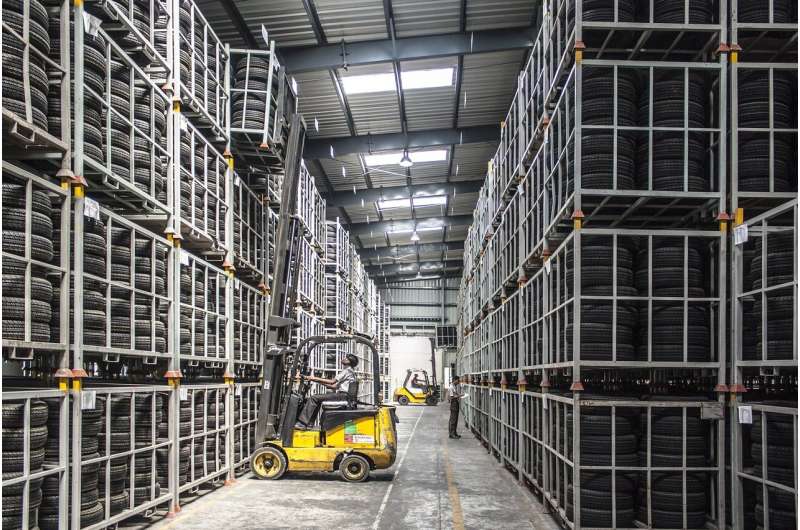
In an e-commerce warehouse where workers are expected to complete tasks in as little as 20 seconds, you might assume the human element has been engineered out entirely. But new research from Cornell suggests something more hopeful: even in environments designed to eliminate interaction, workers are profoundly shaped by the people around them.
Caitlin Ray, an assistant professor in the ILR School's Human Resource Studies Department, spent months analyzing data from a real warehouse operation—one that processed approximately 8,000 orders per day and employed over 1,000 people. The dataset covered 31 months from 2015 to 2017, capturing, as Ray put it, "every single second of performance data." That's unusually rich territory for researchers.
What Ray found upended assumptions about warehouse work. "If you're placed in a group of people who perform higher on average, your performance is going to be higher," she explained. "If it's a lower-performing group, then your performance tends to be lower." This peer effect persisted even though the warehouse system explicitly discouraged interaction—short task windows of 20 seconds to three minutes meant that stopping to chat was treated as waste.
The implications are significant. Warehouse operations are often designed around the idea that workers are interchangeable cogs: optimize the layout, set the timers, swap in a replacement. Ray's research suggests that logic misses something fundamental about human beings. "There's so much literature on the emergence of workplace culture and climate and the power of identifying and fostering the things that make us want to go to work," she said.
Ray's recommendation is straightforward but potentially transformative: when possible, pair newcomers with high-performing incumbents. In these settings, surrounding new workers with consistent top performers could accelerate their development and raise overall productivity—not through stricter monitoring, but through the simple, irreducible power of working alongside someone who's good at what they do.
Ray hopes to expand this line of inquiry into turnover rates. Many companies in the industry, she noted, remain "hyper focused on individual outputs instead of what could be done collectively." But the data makes a quiet case for something different: that workplaces are still, at their core, human places—shaped by who stands next to whom.