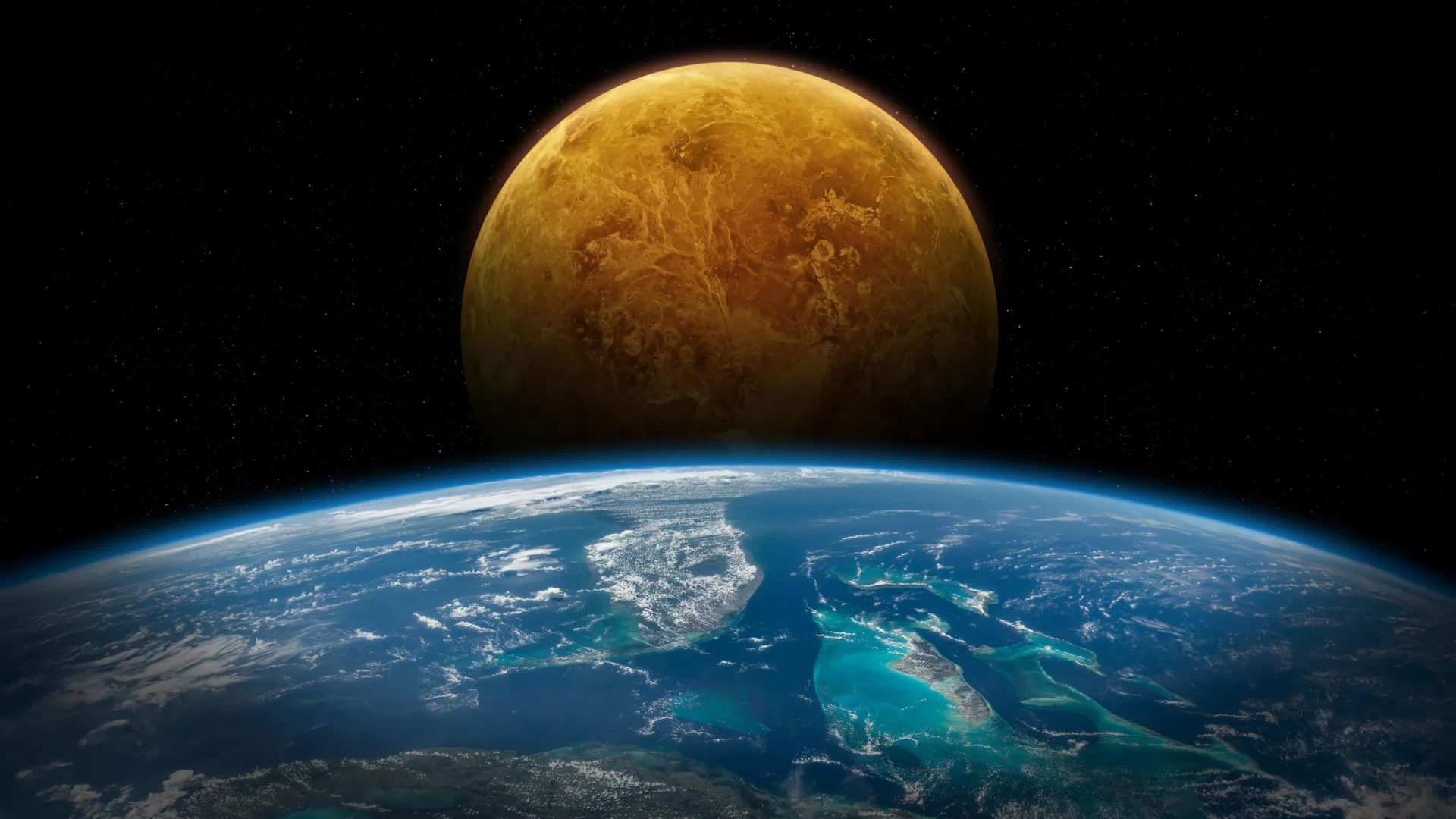
In the dance of planets, Earth may have been quietly sharing the seeds of life with its neighbor Venus for billions of years.
New research from The Johns Hopkins University Applied Physics Laboratory and Sandia National Laboratories suggests that material blasted off Earth's surface by asteroid impacts could have carried microbial life across the 25 million-mile void between the worlds. The study, presented at the 2026 Lunar and Planetary Science Conference, uses a framework called the Venus Life Equation to estimate how often this cosmic handoff might occur.
The Venus Life Equation, developed by Noam Izenberg and colleagues in 2021, works similarly to the famous Drake Equation used in the search for extraterrestrial intelligence. It multiplies several factors—origination, robustness, and continuity—to estimate the probability that life exists somewhere. But before applying that framework, the researchers first asked a more basic question: could anything actually survive the journey?
The answer, according to their modeling, is yes. Material ejected from Earth during powerful impacts would face intense heat, the vacuum of space, and radiation exposure. Yet previous studies of meteorites found on Earth show that organic material can endure both the violent shock of ejection and passage through interplanetary space. The team modeled how fireball meteorites behave entering Venus' thick atmosphere—how they fragment, explode into airbursts, and spread into flattened "pancake" layers of material suspended in the clouds.
The numbers are striking. Their calculations suggest that approximately 100 cells of potential biological material become dispersed throughout Venus' clouds each Earth year. Over the past billion years, that adds up to roughly 20 billion cells that may have made the trip. Hundreds of billions of cells could have arrived, with hundreds of billions potentially remaining viable.
Life delivered from Earth could survive in Venus' clouds for at least a few days per century—not long, perhaps, but perhaps long enough.
The researchers are careful to note that their model doesn't capture every detail of atmospheric interactions, and each parameter carries significant uncertainty. Still, their findings add scientific grounding to a tantalizing possibility: if future astrobiology missions discover life in Venus' clouds, one explanation is that it originally came from home.