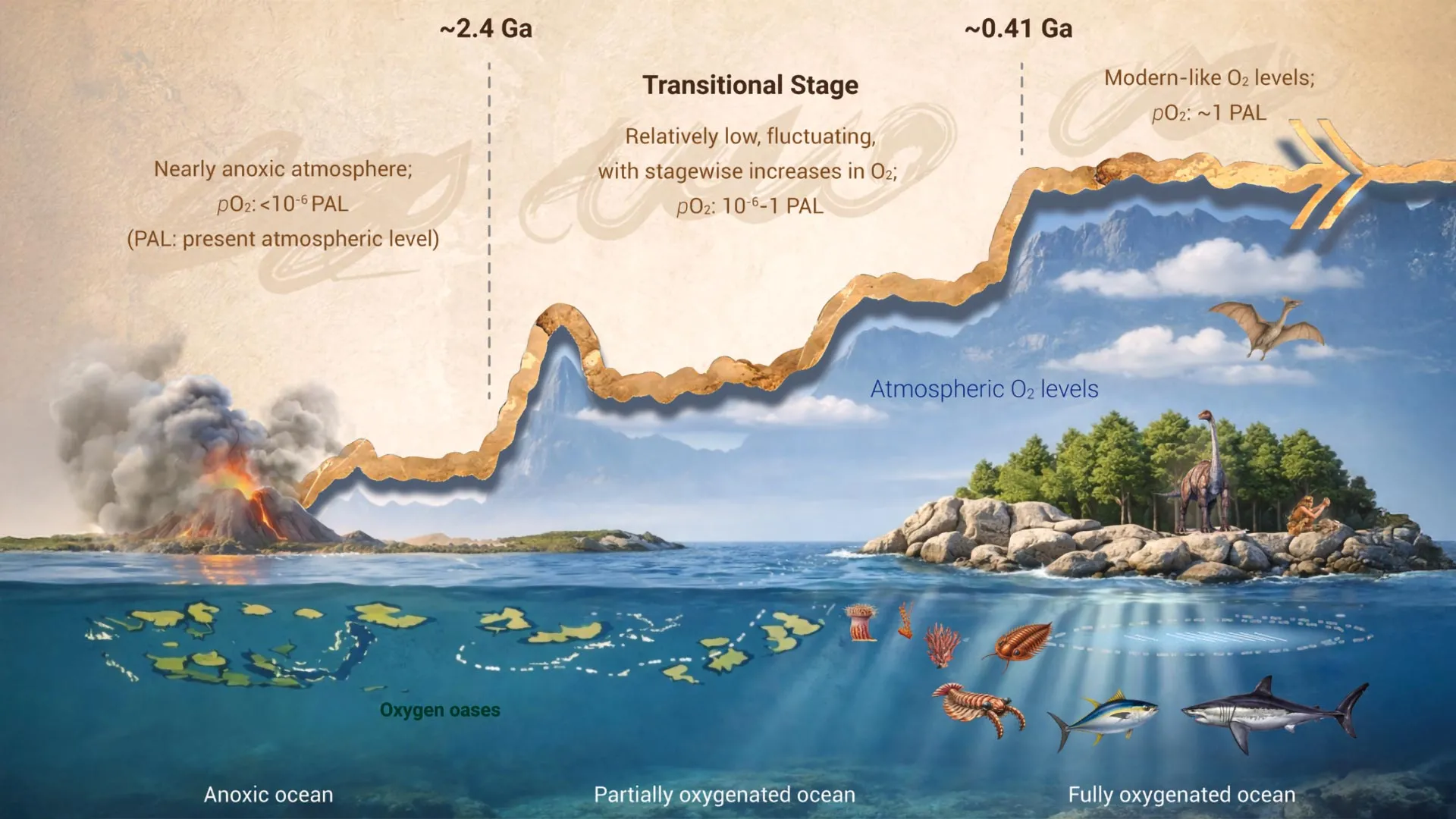
For much of Earth’s early history, the air held almost no oxygen, even as tiny pockets of oxygen-rich water appeared in ancient seas. A new analysis suggests that the atmosphere and deep oceans followed different schedules, with the final major gap between them lasting about 600 million years.
Two geochemists from Chengdu University of Technology set out a revised oxygen timeline in The Innovation. Their work matters because scientists have often used chemical traces in ancient ocean sediments to estimate how much oxygen was in the air. But seawater chemistry also depends on nutrients, life, ocean currents and the shape of ocean basins. It can be a misleading record of the atmosphere above it.
The researchers instead examined sulfate preserved in old rocks. Sulfate can carry a chemical fingerprint created by reactions involving oxygen, ozone and carbon dioxide in the atmosphere. These reactions leave an unusual shortage of oxygen-17, a form of oxygen. As sulfide minerals weather, that signal can pass into sulfate and then into sedimentary rock. The clue offers scientists a more direct way to track changes in the air.
The evidence points to three major rises in atmospheric oxygen. The first was the Great Oxidation Event, between 2.4 billion and 2.1 billion years ago. Oxygen climbed from less than one-millionth of today’s level to between 0.1% and 10% of the modern concentration. A second rise came around 1.3 billion to 1.0 billion years ago. A third followed between 440 million and 410 million years ago. The latter two rises came earlier than many traditional timelines indicate.
In this reading, familiar ocean oxygenation events happened after the atmosphere had already changed. The Neoproterozoic event, usually dated to 800 million to 500 million years ago, mainly reflects ocean changes that lagged the air by about 200 million years. The Paleozoic event, dated to 420 million to 360 million years ago, reflects a roughly 30-million-year delay. Across the full history, the final transition to a fully oxygenated deep ocean came about 600 million years after the related atmospheric increase.
Oxygen was still scarce for long stretches. During the middle Proterozoic, the researchers’ models put atmospheric oxygen at just 0.1% to 1% of today’s level. Charcoal provides another check: widespread burning needs oxygen at about three-quarters of the modern concentration, and charcoal first appears in the rock record around 420 million years ago.
The history was not a smooth climb. Over very long periods, oxygen in the air and sea generally rose together, but over timescales of about a million years, they could move in opposite directions. Oxygen entering seawater could react with stored organic carbon and sulfide, using up oxygen and potentially lowering levels in the atmosphere. That means some chemical clues once read as evidence of rising oxygen may instead mark a decline.
There were also early exceptions to the generally oxygen-poor world. Photosynthetic microbes may have created small oxygenated patches in seawater as early as 3 billion years ago, or earlier, even while most of the ocean and atmosphere lacked free oxygen. Later, oxygen absorbed from the air became more important than these local sources in driving broader ocean change. The revised timeline offers a reminder that Earth’s atmosphere and oceans did not transform in lockstep—and that ancient rocks may still hold clues to how they changed.