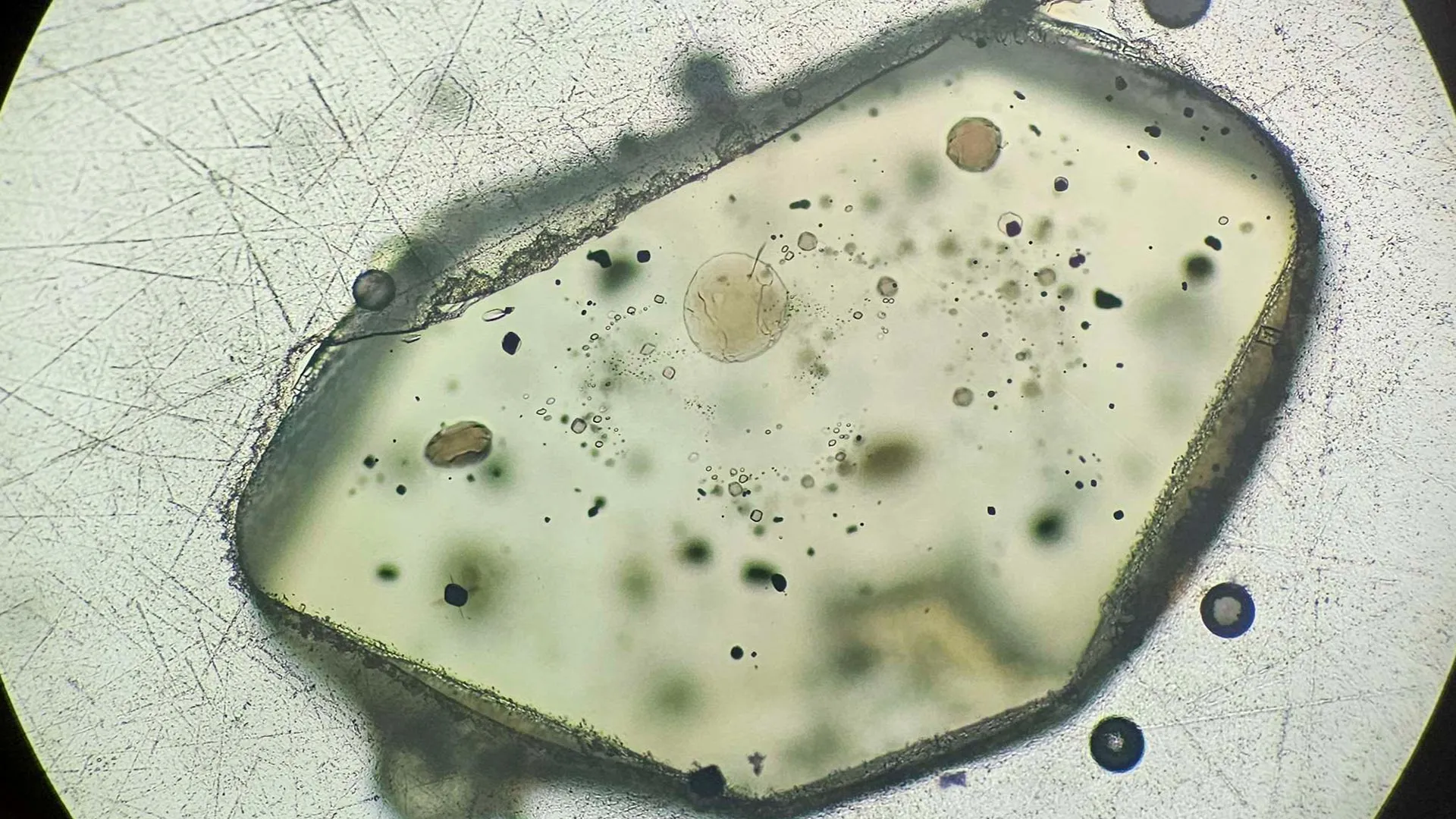
A tiny pocket of ancient magma inside a Hawaiian volcanic rock may hold a clue to where Earth's carbon began—and whether some of it has escaped from the planet's core.
Carbon is part of every living thing, but its early journey to Earth remains a major question. A study of volcanic rocks from Kīlauea and the Tantalus Rift in Hawaii points to one possible answer: some of Earth's carbon may have arrived in meteorites during the planet's formation, then become trapped deep inside Earth. The findings, published in the Proceedings of the National Academy of Sciences, also suggest that some carbon could have traveled back toward the surface.
The researchers looked at tiny pockets of once-molten rock, called undegassed melt inclusions, sealed inside crystals. These pockets can preserve gases, including carbon dioxide, that might otherwise escape from magma. Lead author Yves Moussallam, an associate professor at Columbia University's Department of Earth and Environmental Sciences and Lamont-Doherty Earth Observatory, described the inclusions as “fossils of the magma.”
Hawaii offers a useful place to search for deep-Earth material because its volcanoes are fed by a mantle plume: a rising column of hot rock that may begin near the boundary between the mantle and the core. The mantle extends about 1,800 miles below Earth's crust. Beneath it, the outer core is a roughly 1,400-mile-thick layer of molten metal, surrounding a solid inner core.
Using a recently developed technique, the team measured carbon isotopes in inclusions from the two locations. Isotopes are forms of the same element with slightly different masses; their proportions can help identify a carbon source. The Tantalus Rift samples, thought to come from the outer parts of the plume, showed a familiar mantle signature of about -5 to -7 per mil. Kīlauea's samples, believed to come from closer to the plume's center, showed a much heavier signature: about -1 per mil.
That value is unusual and differs from the typical mantle range. Moussallam said the difference suggests the Kīlauea carbon was mixed with another source, which the team thinks may be Earth's core. The researchers propose that carbon could move from the core-mantle boundary upward in the plume, enter magma, and reach the surface in volcanic eruptions.
The result offers a rare way to investigate a part of Earth that scientists cannot directly sample. But it is not proof that the carbon came from the core. Moussallam said the evidence is not definitive, and the reported isotope pattern points to a likely explanation rather than a settled answer. The study's broader idea—that ancient carbon may have been delivered by meteorites and some later stored in the core—also remains a proposal.
For now, the Hawaiian rocks provide a new chemical clue in a question that reaches back to Earth's beginnings. Further work will be needed to test whether the core is truly the source, but volcanic crystals may help researchers trace a hidden journey from the planet's deepest layers to its surface.