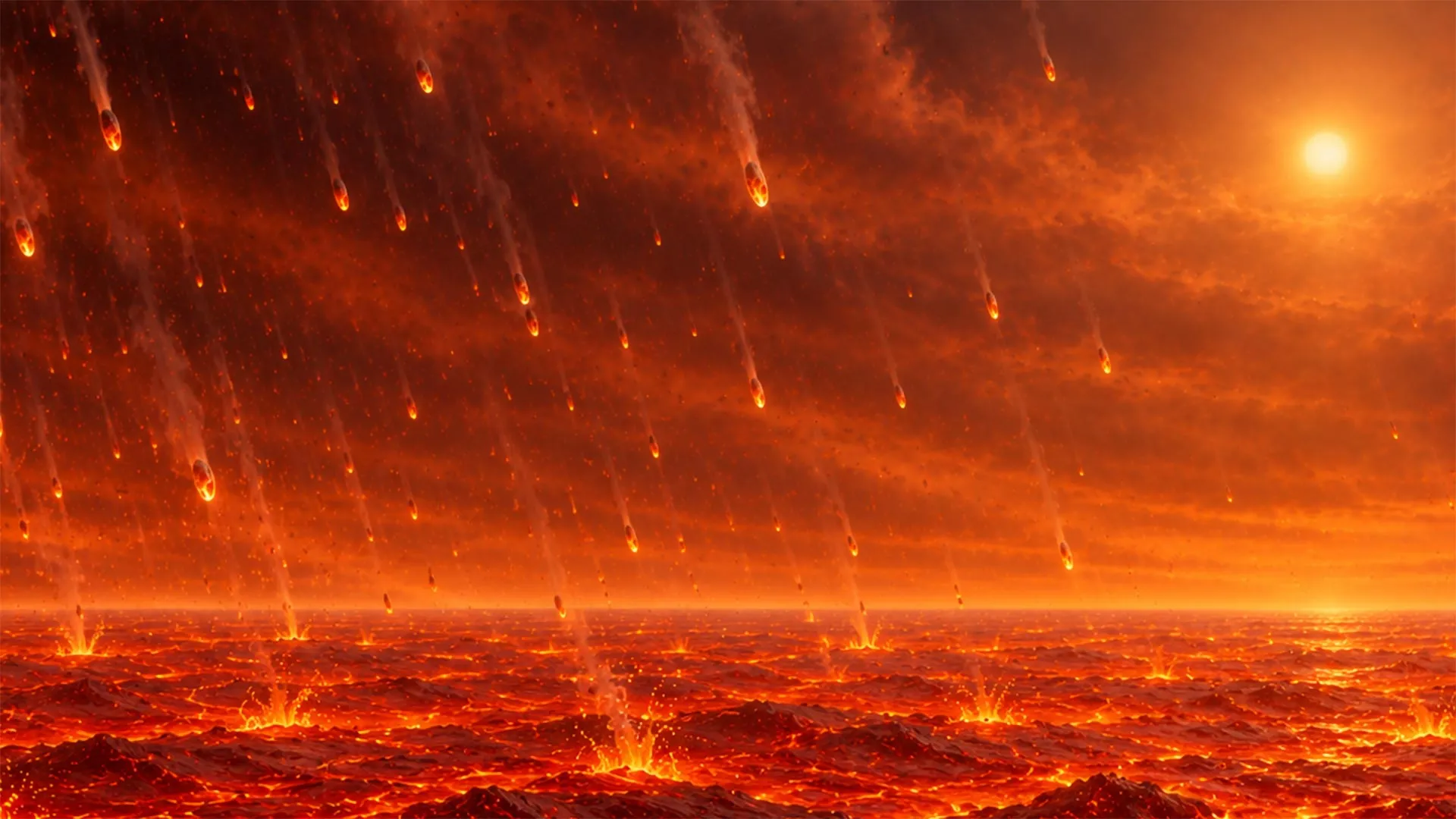
A pebble falling through Earth’s early atmosphere may have helped make water in minutes, in a world hot enough to transform rock. New experiments suggest that this process could have supplied the young planet with hundreds of oceans’ worth of water.
Scientists have long debated how Earth got its water. One leading idea is that icy objects from the colder, outer parts of the early solar system carried water here. But researchers have questions about whether enough of those objects could have reached Earth, and whether delivery from space explains the planet’s chemical makeup. A study published in Nature Geoscience points to another possibility: some water may have formed on Earth itself.
The team from the University of New Mexico studied conditions during Earth’s formation, when small rocky pieces gathered into a growing planet. This process, called pebble accretion, may have taken place beneath a dense atmosphere rich in hydrogen. As rocky pebbles fell through that hot atmosphere, hydrogen could react with iron oxide in the rocks. The reaction would turn the iron oxide into metallic iron and release water vapor.
Graduate student Susmita Garai led the study with Zachary Sharp, a professor and director of Earth and Planetary Sciences, and Peter Olson. In the lab, they heated silicate rock samples to between 1,200 and 1,400 degrees Celsius. The samples were exposed to flowing hydrogen gas in experiments lasting 15 minutes to three hours. The team also repeated the tests using helium as a comparison.
The contrast was clear. In hydrogen, almost 80% of the iron oxide in the rocks became metallic iron, and water vapor formed. The same reaction did not appear with helium, showing that hydrogen was key. The team found that water could be produced in just minutes under the high-temperature conditions.
The researchers then used their experimental results to estimate what might have happened on early Earth. Their calculations suggest the process may have generated hundreds of oceans’ worth of water. That is an estimate based on extending lab results to the conditions of a forming planet, rather than a direct measurement of ancient water. Still, it offers a striking new way to explain how Earth gained a vital ingredient for life alongside, or instead of, water delivered by icy bodies.
The idea could matter beyond Earth, too. Sharp said the mechanism should apply to virtually any Earth-sized planet, raising the possibility that water may be less unusual on rocky worlds than once thought. The experiments do not show that every such planet will become habitable, but they offer a testable route for water to form during planetary growth.
Earth’s oceans may have begun not only as cargo from space, but also as the product of its own fiery beginnings. If similar reactions took place on other rocky planets, the ingredients for water could be built into the process of making a world.