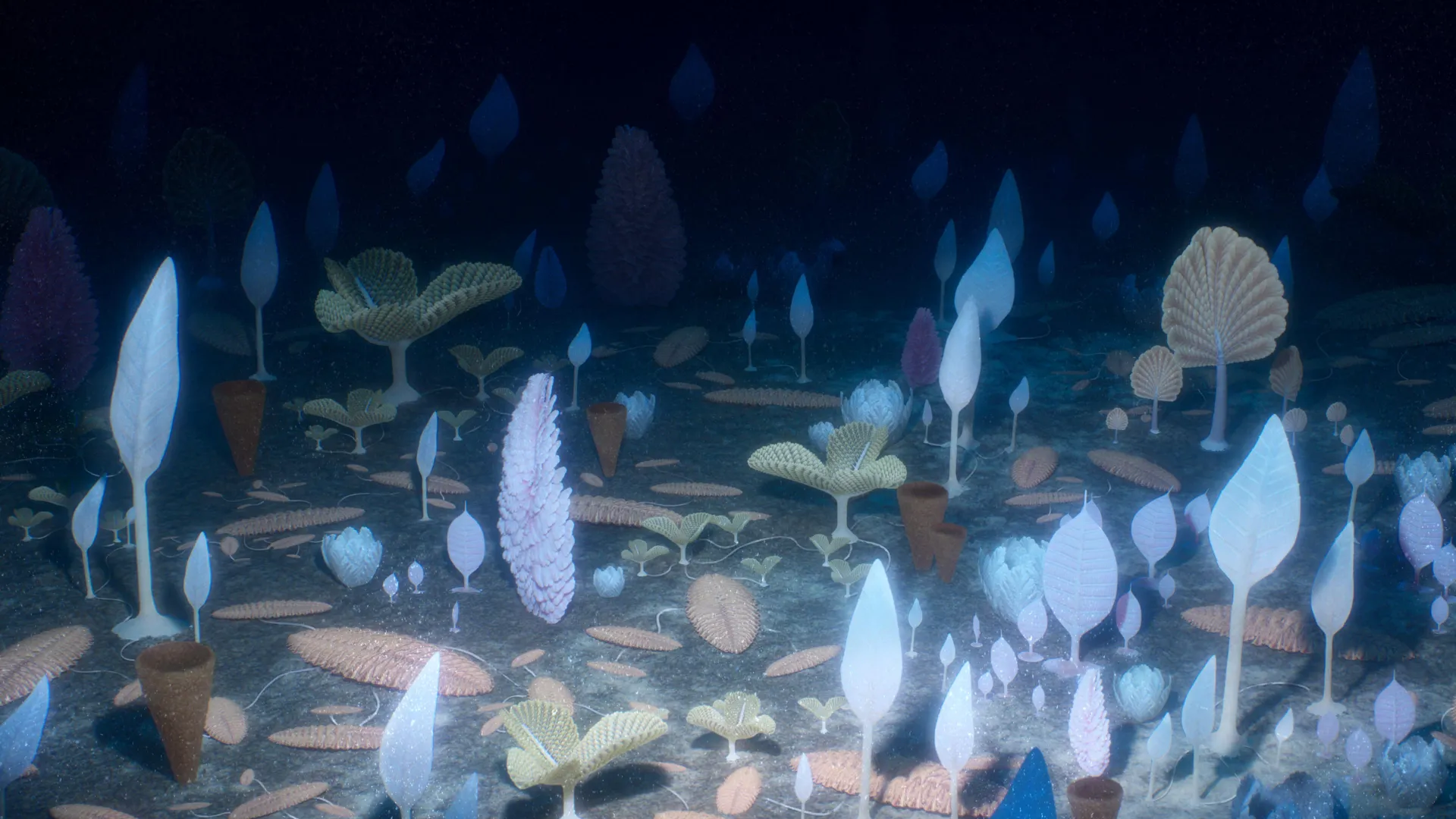
At Mistaken Point in Newfoundland, one of Earth's most remarkable fossil sites, researchers discovered why the earliest animals barely bothered to evolve for millions of years: life was simply too easy. Using laser scanning, artificial intelligence, and computer simulations, scientists from the University of Cambridge have solved a paleontological puzzle that has long mystified the field—why animal diversity remained surprisingly limited throughout most of the Ediacaran period, from about 635 million to 539 million years ago, before exploding into abundance.
The Ediacaran was life's first great experiment with complex organisms. After billions of years dominated by microscopic life, creatures unlike anything alive today emerged in ancient oceans. Some, like Fractofusus, stretched up to two meters tall, though most were far smaller. Many resembled ferns rather than animals, lacking mouths, organs, and the ability to move. They survived by absorbing nutrients directly from the nutrient-rich seawater surrounding them. Yet for the vast majority of this 96-million-year period, these organisms remained limited in diversity—a mystery that had puzzled researchers for decades.
The answer, according to a study published in Nature Ecology and Evolution, lies in how they reproduced. Most Ediacaran animals spread through asexual reproduction, cloning themselves through runners called stolons—much like modern strawberry plants producing genetically identical offspring connected by a shared network. In oceans abundant with food and few competitors, this strategy was devastatingly effective. As Dr. Emily Mitchell from Cambridge's Department of Zoology explained, "Life was pretty nice during the Ediacaran, so the need for sex was rather limited."
But mild conditions bred evolutionary stagnation. When organisms reproduce asexually through runners, they remain tethered to their neighbors in a nutrient-sharing network, eliminating the pressure to compete or adapt. Mitchell and her colleague Professor Andrea Manica tested this theory by analyzing fossils from Mistaken Point and running thousands of computer simulations guided by artificial intelligence. Using a technique called Approximate Bayesian Computation, they worked backward from the fossil record to model how competition and dispersal patterns shaped early animal communities. The simulations revealed a striking conclusion: limited dispersal caused by asexual reproduction could fully explain why Ediacaran ecosystems contained so few species.
The real change came when the world grew hostile. As early animals gradually expanded from deeper waters into shallower marine environments, conditions transformed dramatically. Tides churned, storms raged, temperatures fluctuated, and nutrient availability became unpredictable. Survival was no longer guaranteed. "If you're suddenly in an environment where you're essentially getting killed a couple of times per year, then that changes everything," Mitchell said. Stress drove the evolution of sexual reproduction, which allowed organisms to disperse across far greater distances and colonize new areas as competition intensified.
This transition marked a pivotal moment in Earth's history. As early animals adapted to harsher conditions and new reproductive strategies, species diversification accelerated dramatically. This second wave of Ediacaran evolution laid the groundwork for the even more explosive expansion of the Cambrian period, when animals became mobile, developed complex body plans, and transformed Earth's ecosystems beyond recognition. The study, supported by the UK's Natural Environment Research Council, reveals how stress and competition—not abundance—are evolution's true engines.