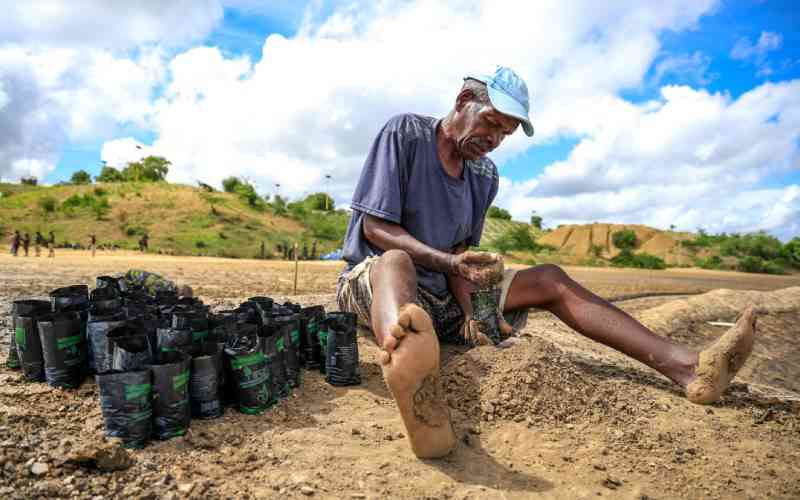
Knee-deep in Tsunza's muddy wetlands, hundreds of volunteers pressed 10,000 mangrove seedlings into the ground in a single day, their small act carrying the weight of a much larger fight against climate change. The planting campaign, led by the Kenya Navy in Kwale County, marks an escalating commitment to restore the fragile coastal ecosystems that line Kenya's shores—ecosystems that are quietly among the world's most effective natural carbon sinks.
The significance of this work cannot be overstated. Mangrove forests absorb and store vast amounts of atmospheric carbon dioxide, protect shorelines from erosion, and provide critical breeding grounds for fish and marine life. Yet across the coast, logging and development have devastated these forests, leaving communities increasingly vulnerable to flooding and declining fish stocks. The Tsunza initiative brings together the Kenya Defence Forces, conservation groups, insurers, and local residents under a coordinated vision of restoration that extends far beyond a single day's labor.
Lieutenant Colonel Boniface Amimo of the Kenya Navy explained the scope of the military's involvement. After President William Ruto directed the Kenya Defence Forces to spearhead the national tree-planting initiative, the Kenya Navy alone set an ambitious target: to plant eight million seedlings during the 2025/2026 financial year. As of now, they have reached approximately 3.2 million seedlings across the Coast region, including mangroves, fruit trees, and indigenous species. These numbers feed into Kenya's larger goal of planting 15 billion trees by 2032—a commitment that positions environmental restoration as a central national priority.
Sakwa James of Furaha Baraka Farms, a conservation organization involved in the project, emphasizes what mangroves mean to the communities that depend on them. "For us, mangroves are not just trees. They protect the environment, absorb huge amounts of carbon and also help communities survive," he said. Over the past two years, nearly three million mangroves have already been planted in the area, with plans to expand further.
What makes this initiative particularly compelling is its recognition that environmental restoration and economic opportunity are not opposing forces. Khadija Ali Kodi, a member of the Tsunza community, speaks to this directly: mangrove conservation has become a source of income for many families. "We plant mangroves and also sell the seedlings and get school fees for our children," she said. This livelihood dimension transforms the project from a top-down conservation mandate into something rooted in community agency and tangible benefit.
Private companies, too, are recognizing both the urgency and the investment potential. Samuel Muthomi of First Assurance and Brian Hamadi of Absa Life Assurance Kenya both framed their involvement in terms of necessity and opportunity. "We need to do this as frequently as possible because we are one with nature," Muthomi said. Hamadi went further, describing mangrove restoration as both environmental protection and economic investment. "Trees are money. By planting mangroves, we are trying to capture as much carbon as possible while also helping communities create livelihoods," he stated.
The Tsunza planting day represents something larger than its numbers alone suggest: a convergence of military capacity, corporate commitment, scientific understanding, and community participation around a single ecological imperative. As Khadija Ali Kodi reminded her neighbors, environmental destruction affects everyone. The work of restoration, too, belongs to everyone.