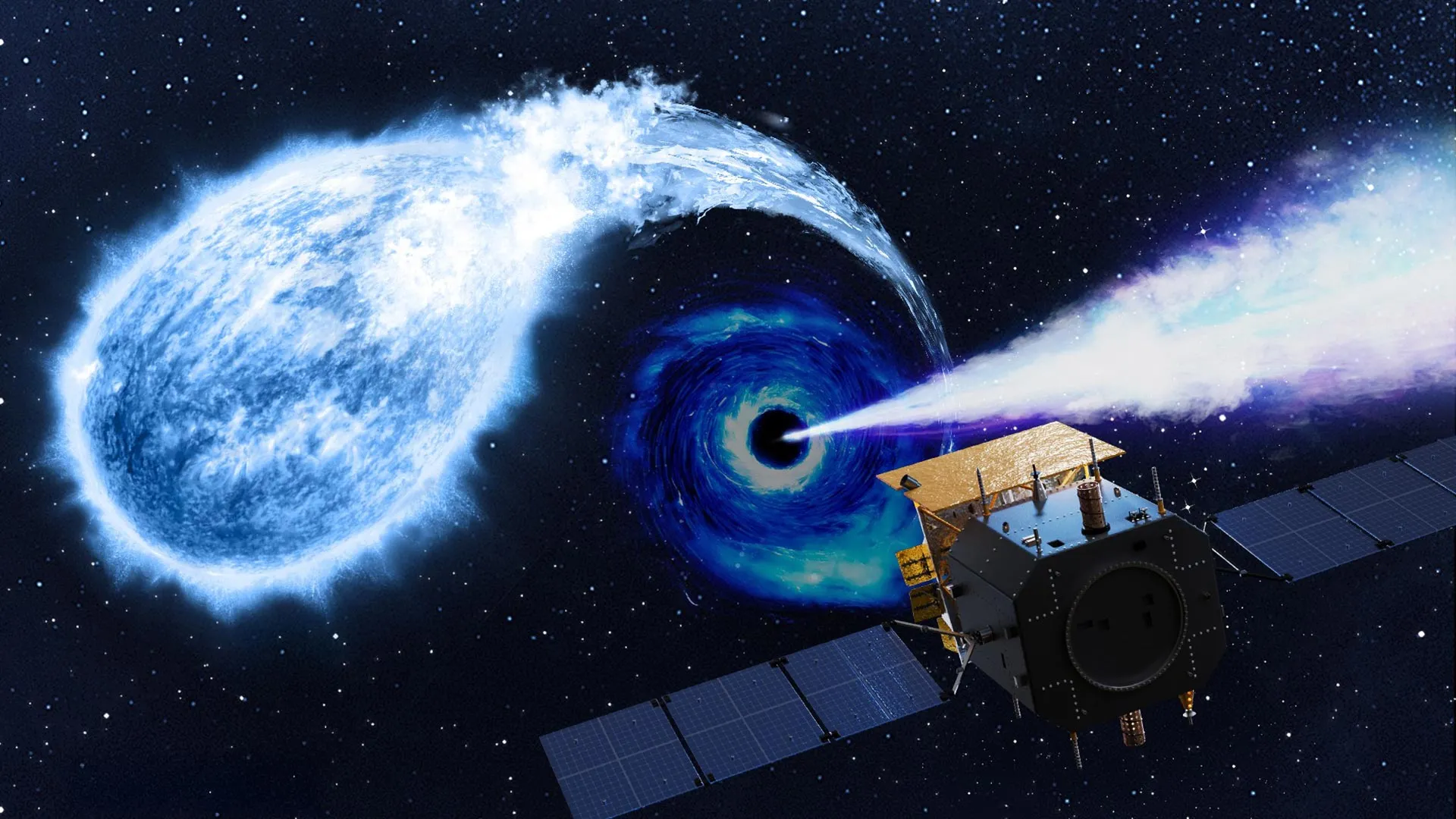
Somewhere in the distant cosmos, a black hole may have been caught in the act of shredding a star — and humanity had a front-row seat. On July 2, 2025, China's Einstein Probe space telescope detected an extraordinarily bright and rapidly changing X-ray source that has scientists around the world buzzing with possibility. The event, designated EP250702a, displayed characteristics so unusual that researchers believe they may have witnessed something never before directly observed: an intermediate-mass black hole tearing apart and consuming a white dwarf star.
The discovery was made possible by the Einstein Probe's Wide-field X-ray Telescope, which uses advanced lobster-eye micro-pore optics to survey the sky with both a very wide field of view and high sensitivity. Within hours of the detection, observatories across the globe turned their instruments toward the same patch of sky. NASA’s Fermi Gamma-ray Space Telescope also picked up several gamma-ray bursts from the region — though the real surprise came from what came next.
"This early X-ray signal is crucial," said Dr. Dongyue Li, first author of the research from the National Astronomical Observatories of China. "It tells us this was not an ordinary gamma-ray burst." The team soon realized the event was far more peculiar than it first appeared. Roughly a day before the gamma-ray bursts arrived, the Wide-field X-ray Telescope had already detected steady X-ray emission from the same location — a sequence rarely associated with such powerful cosmic explosions. Then, around 15 hours after the initial detection, the source erupted into a series of intense flares. At its peak, it reached a luminosity of approximately 3 × 10^49 erg s^-1, making it one of the brightest instantaneous outbursts ever recorded in the Universe.
Over roughly 20 days of follow-up observations using the Einstein Probe's Follow-up X-ray Telescope, the object's brightness faded by more than a factor of 100,000. Its X-ray emission also shifted from higher-energy "hard" X-rays to lower-energy "soft" X-rays — a pattern that offered crucial clues. Researchers from The University of Hong Kong's Department of Physics, key members of the Einstein Probe collaboration, helped interpret these observations alongside colleagues from institutions across China and beyond. After evaluating multiple possible explanations, the intermediate-mass black hole and white dwarf scenario emerged as the strongest fit. If confirmed, it would represent the first direct observational evidence of this type of feeding event — a milestone in our understanding of these elusive cosmic objects.
The results, published as a cover article in Science Bulletin, point to an event occurring not at the center of its host galaxy, as many high-energy phenomena do, but in its outer region — another rarity that adds to the discovery's significance. Intermediate-mass black holes, which occupy the gap between stellar-mass and supermassive black holes, remain among the least understood objects in the cosmos. This detection offers astronomers a rare, real-time glimpse into their behavior — and a reminder that the Universe still has plenty of surprises to share.