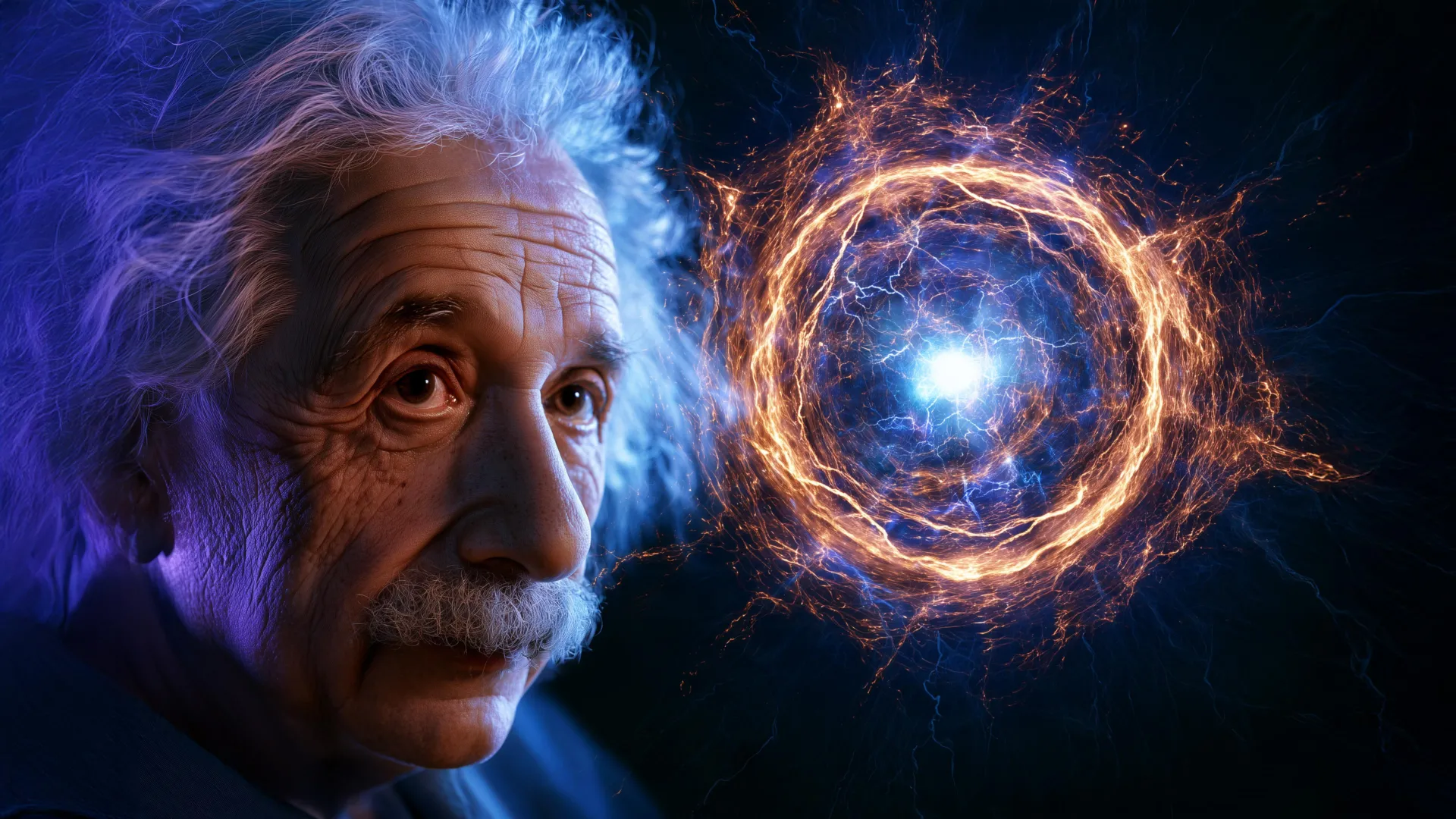
A droplet of quark-gluon plasma can last for only tens of septillionths of a second, yet it may carry clues to the universe’s first moments. MIT physicists and a collaborator at the University of California at Santa Barbara have developed new mathematics to help explain how particles move through this short-lived, ultra-hot material.
Soon after the Big Bang, the universe was filled with quark-gluon plasma: a mixture of quarks and gluons at temperatures reaching trillions of degrees. After a few microseconds, quarks began joining into protons and neutrons, building blocks of the matter around us. Researchers cannot watch that ancient plasma directly, but powerful particle accelerators can recreate tiny droplets of it by smashing ions together at nearly the speed of light.
To study the plasma, scientists can track heavy quarks passing through it. Their motion can reveal how the plasma behaves on a microscopic scale. The approach echoes an idea Albert Einstein set out in 1905, after explaining the jittery movement of pollen grains in water. He showed that a particle’s motion reflects both drag from the fluid and random pushes from its surrounding atoms and molecules.
That familiar picture may not be enough for particles moving close to light speed. Under those extreme conditions, the balance of forces can differ from the one described by Einstein’s original framework. Jean Du Plessis, a graduate student in MIT’s Center for Theoretical Physics, and Bruno Scheihing-Hitschfeld of UCSB developed a framework that predicts how a fluid can accelerate, slow, and redirect particles traveling at relativistic speeds—the speeds at which effects from relativity matter.
The researchers say their calculations point to a particularly useful signal: rare, unusually large changes in a heavy quark’s motion. How often those jolts happen depends on the plasma’s microscopic nature, Du Plessis said. If accelerator measurements match the team’s predictions, those events could offer a new way to investigate what the early-universe material is like inside.
The work, published in Physical Review Letters, does not claim that Einstein’s theory was wrong. Instead, it extends a framework built for a different setting to account for particles moving through an extreme fluid at near-light speeds. The distinction matters because the plasma droplets made in experiments vanish almost as soon as they form, leaving scientists to piece together their properties from the particles that emerge.
The next step is to compare the new predictions with accelerator results. Those comparisons could help physicists tell whether the rare, large changes in motion reveal details that more ordinary particle movements miss. A theory first inspired by pollen drifting in water may thus help researchers read traces of a universe that existed for only a few microseconds.