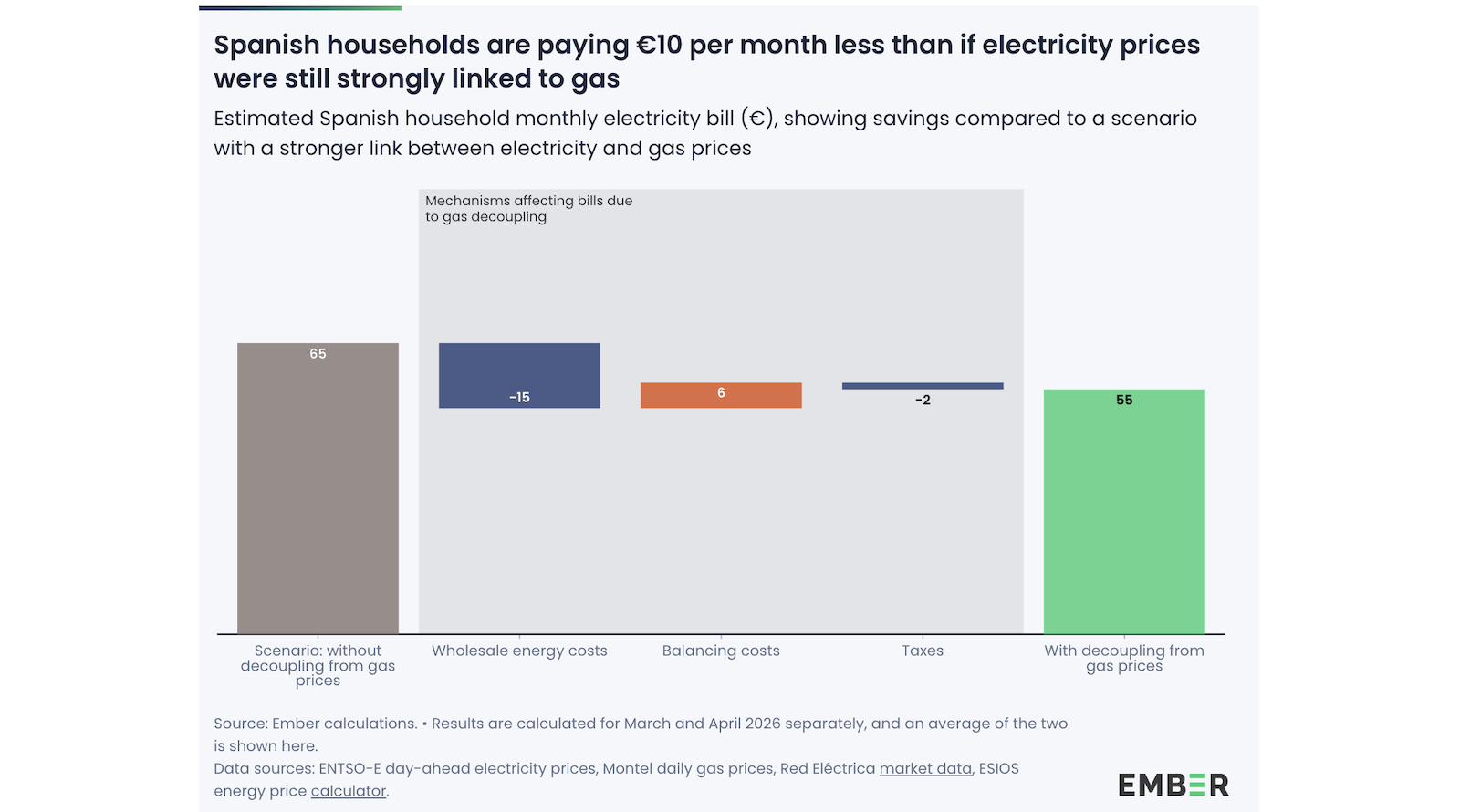
María López, a schoolteacher in Seville, noticed something unusual on her March electricity bill: €84, down from the usual €94. She wasn’t alone. Across Spain, 19.7 million households have been saving exactly €10 per month on their power bills—thanks to the country’s swift pivot to wind and solar energy. At a time when global fossil fuel prices have surged due to conflict in the Middle East and disrupted oil shipments through the Strait of Hormuz, Spain stands out as a beacon of energy resilience. While other European nations reel from skyrocketing costs, a recent analysis by climate think tank Ember reveals that Spain’s renewable energy expansion has insulated its citizens from the worst of the crisis.
Gas-fired power, typically the most expensive source on the grid, now influences electricity prices in Spain during just 9% of hours in 2026—down from 52% in 2021. This dramatic shift is the result of a focused national push: between May 2025 and February 2026, Spain added an average of 1.3 gigawatts of wind and solar capacity every month, outpacing the previous 12-month average of 1.2 GW. Over the four-year span from 2021 to 2025, wind and solar generation grew by 37%, fundamentally reshaping the country’s energy mix. The impact is stark: while Italy, still heavily reliant on gas, saw wholesale electricity prices average €143 per megawatt-hour in March, Spain’s prices hovered at just €42/MWh—one-third as much.
The savings add up fast. At €10 per household per month, Spanish families are collectively saving €197 million monthly—money that can now flow into local economies, support small businesses, or ease the burden of inflation. Chris Rosslowe, author of the Ember report, puts it simply: “Wind and solar growth are acting as a shield against the price impacts of global instability.” That shield is already strong, but experts say it could be even stronger. Ismael Morales of Fundación Renovables points to Spain’s ‘reinforced mode’—a grid management protocol introduced after the 2025 Iberian blackout—which currently limits how much of the renewable gains translate into consumer savings. Removing it, he argues, could unlock even deeper reductions.
Spain’s transformation didn’t happen by accident. It was propelled by crisis, political will, and public demand for cleaner, more stable energy. As global instability continues to roil fossil fuel markets, Spain’s experience offers a powerful lesson: investing in renewables isn’t just about cutting emissions—it’s about building economic resilience. The country’s journey shows that a future powered by wind and sun isn’t just possible—it’s already saving people money, today.