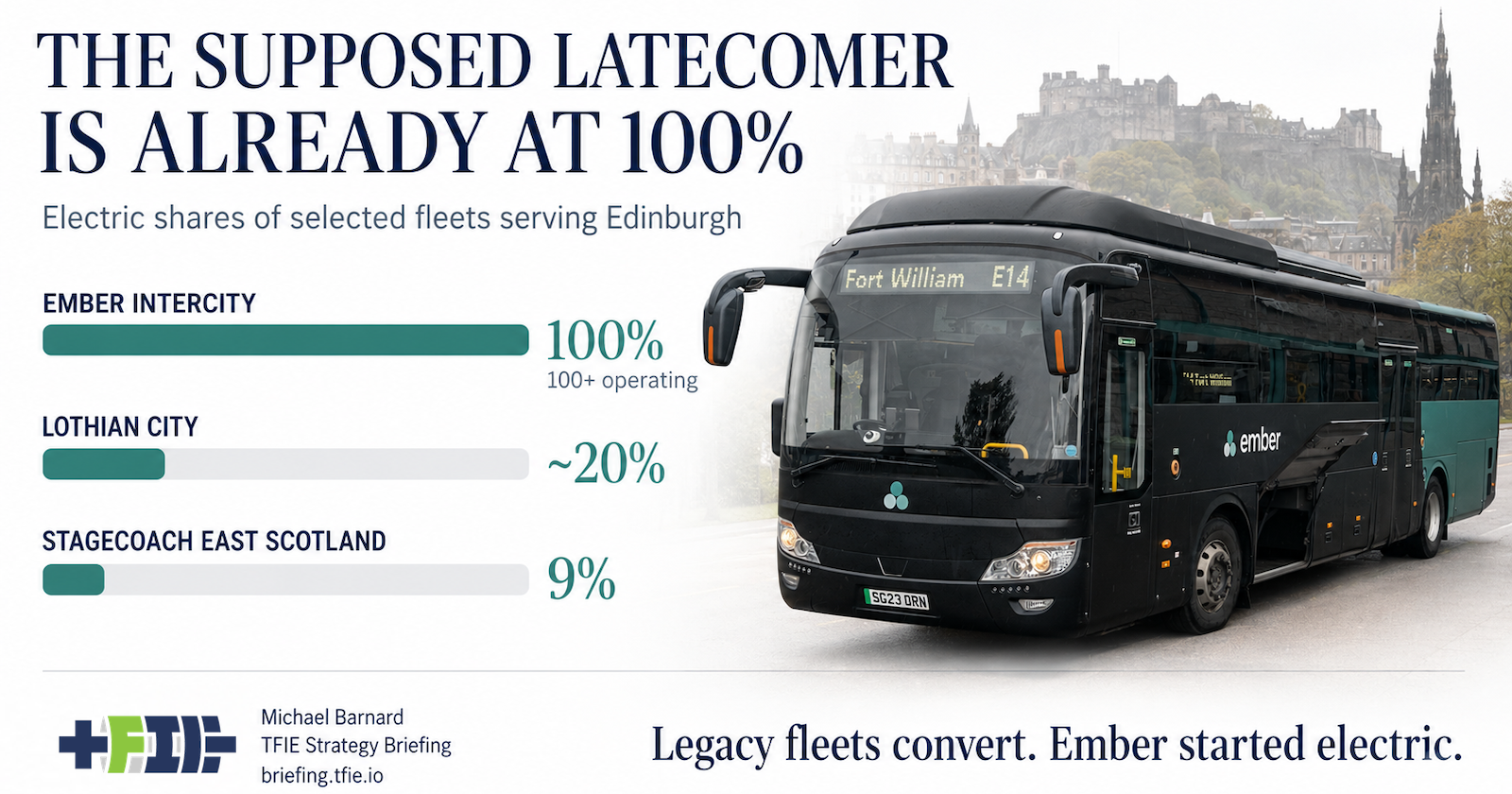
On a typical morning in Edinburgh, passengers boarding a bright yellow Yutong coach might not realize they're stepping onto a piece of history. That coach belongs to Ember, a company that launched the United Kingdom's first all-electric intercity coach service in October 2020 — just two vehicles running between Dundee and Edinburgh. Less than six years later, Ember's fleet has grown to more than 100 electric coaches crisscrossing Scotland.
The routes now reach from Edinburgh to Glasgow, Dundee, Aberdeen, Inverness, Fort William, Oban, and Thurso. Some corridors run so frequently they look more like train timetables than traditional bus schedules, including overnight and round-the-clock services. Over the year ending January 2026, Ember reported carrying more than 1.5 million passengers and delivering over 120 million zero-emission passenger-kilometers.
That number matters because these aren't easy miles. The Edinburgh-to-Fort-William route climbs through Lochearnhead, Tyndrum, and Glencoe — steep hills that demand far more battery power than flat roads would. Scotland's icy winters add another challenge: keeping the cabin warm drains energy that could otherwise power the motor. The coaches manage partly through regenerative braking on descents, which recovers some energy, but the mountains don't become any smaller.
Ember's coaches can travel roughly 350 miles on a single charge, but the real trick isn't extracting one heroic trip from each battery. The coaches charge several times throughout the day and can cover nearly 200,000 miles annually. The company has built charging facilities in Dundee, Aberdeen, Inverness, Oban, Thurso, Fort William, and Perth, with chargers rated at up to 300 kilowatts — powerful enough to add significant range during a short stop.
The business model revolves around knowing exactly where each coach should be. Most intermediate stops require advance booking, often just ten minutes ahead. When nobody has reserved a seat at a particular stop, the coach bypasses it — saving time and battery life. This tight coordination lets Ember plan charging breaks as naturally as any other part of the schedule.
Scotland's larger city operators are electrifying too. Lothian, which runs most of Edinburgh's city buses, has roughly one in five of its buses running on batteries, including large double-deckers and nine single-deckers that entered service in June. But intercity coaches were expected to lag behind city buses for years, held back by the challenge of covering long distances without frequent depot access.
Ember's success suggests that assumption was wrong. Scheduled coach routes can electrify successfully — and already have — by treating charging as part of the timetable rather than an afterthought.