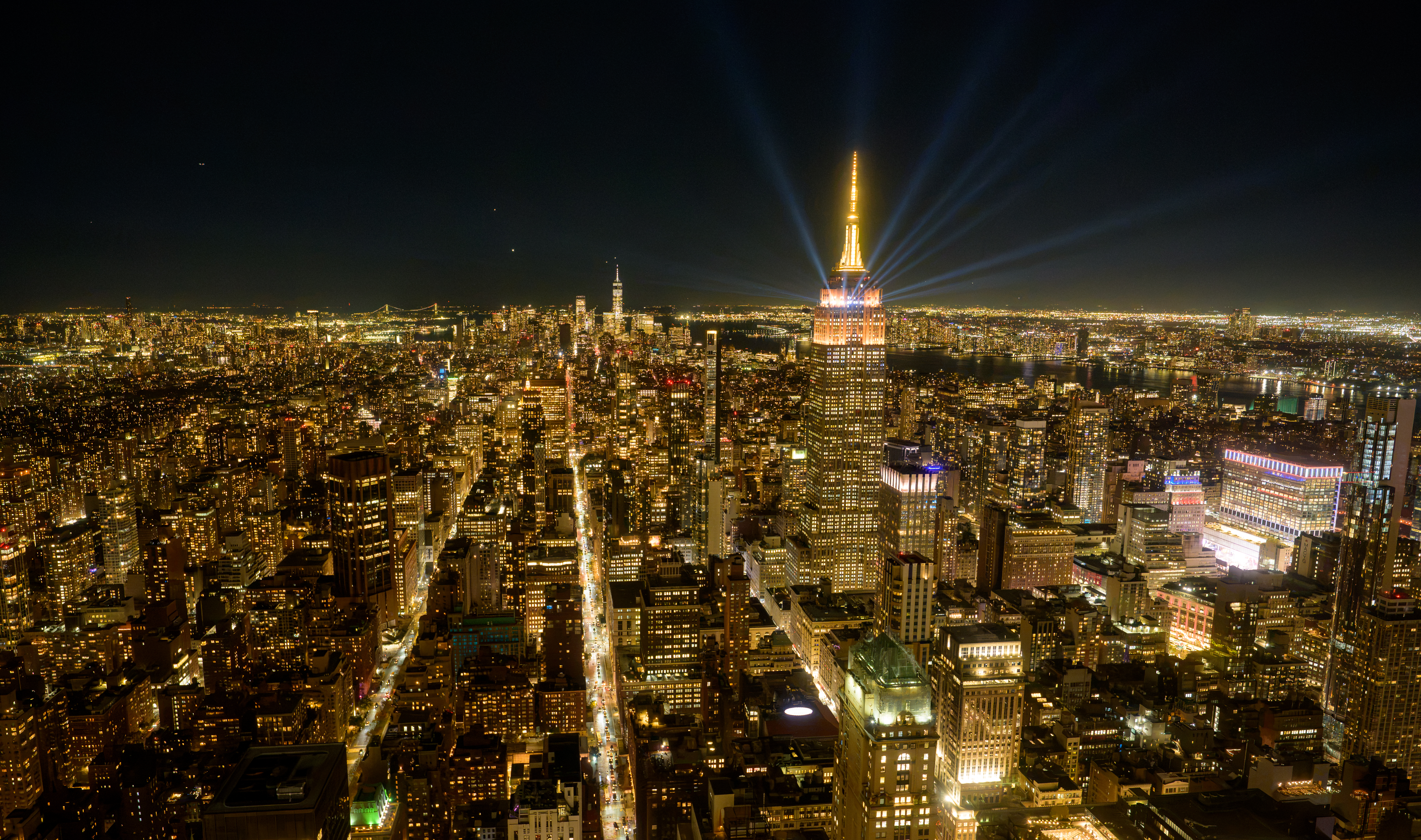
On the evening of Nov. 17, 2026, the Empire State Building shone gold above New York City for a spacecraft far beyond the skyline: NASA’s Voyager 1. The building’s lights marked a striking milestone as the probe was about to pass one light-day from Earth, a distance no other human-made object has reached.
A light-day is the distance light travels in a day. Voyager 1’s journey puts the spacecraft so far away that a message traveling at light speed would take a full day to cover that distance. The milestone offers a way to grasp the scale of a mission that has carried a small piece of Earth into deep space.
Gold was chosen for a reason. Voyager carries a phonograph record made of gold-plated copper. Known as the Golden Record, it holds sounds and images selected to portray the diversity of life and culture on Earth. The glowing building echoed the record’s color, linking a familiar New York landmark with the spacecraft’s unusual cargo.
The record was designed as a representation of Earth, not simply as a collection of scientific measurements. Its sounds and images offer a portrait of life and culture on the planet. As Voyager 1 travels farther from Earth, the record travels with it, carrying that human-made message into space.
The Nov. 17 illumination turned Voyager’s distance into a public moment. Rather than marking the achievement only with a number, the display connected the probe to a visible symbol: gold light across one of the world’s best-known buildings. The celebration also highlighted how far a human-made object can travel, while reminding viewers that the mission carries an account of Earth along with it.
The report described Voyager 1 as about to pass the one-light-day mark that night. It did not give a precise crossing time or additional mission measurements, but the achievement was clear: no other human-made object had reached that distance from Earth. The building’s golden glow offered a simple way to mark the occasion and to draw attention to the Golden Record’s purpose.
Voyager 1’s progress makes the gap between Earth and the spacecraft easier to imagine, even as it grows beyond everyday experience. And with the Golden Record still aboard, the probe carries more than the story of how far people can send a machine: it carries selected sounds and images meant to show something of the world it left behind.