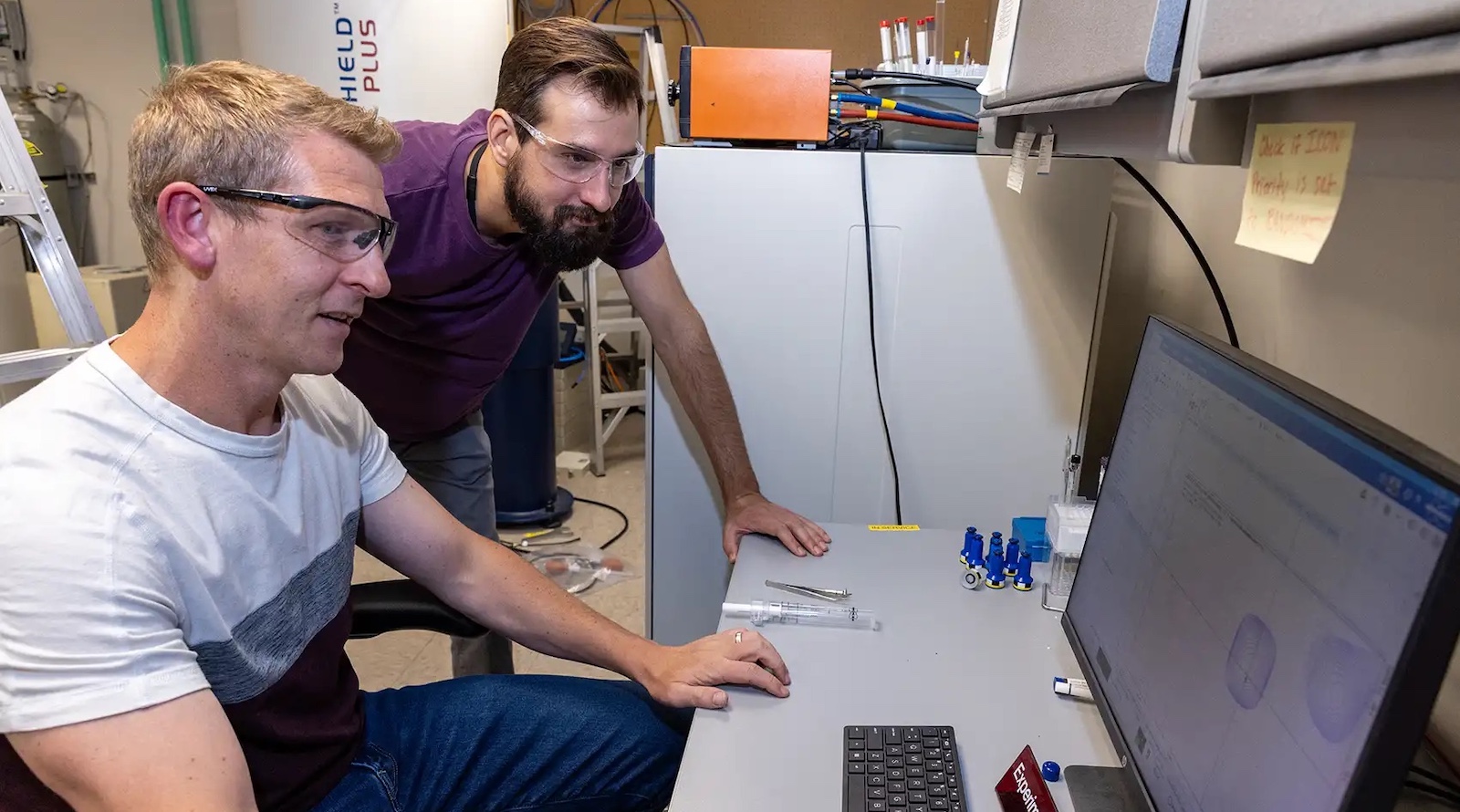
When inventors bring their creations to Bennett Addison, he often asks them a simple question: "Did you really make what you think you made?"
At the atomic level, the answer is often no. A company might believe they built a perfect semiconductor, but it falls short. A scientist might think they created a strong synthetic fiber, only to watch it break apart without explanation.
The problem, Addison says, is that they are missing an 80-year-old technique that can see inside materials at the atomic level. It is called nuclear magnetic resonance, or NMR for short. Instead of cutting something open, scientists place a material in a powerful magnet. The magnet makes the atoms inside spin in a special way, sending back signals that reveal exactly what is happening inside the material.
"There's almost definitely a way that NMR is useful in your field," said Addison, who directs the NMR facility at the U.S. Department of Energy's National Laboratory of the Rockies in Boulder, Colorado. "You just have to go and do it."
Most laboratories only use NMR for simple checks, like confirming that a chemical reaction worked. But Addison and his colleague Ross Kerner have been pushing the technique much further, applying it to batteries, semiconductors, and even bioplastics.
Kerner first learned NMR in graduate school, where many students skim the surface. Going deeper requires learning more chemistry, but for those who stick with it, the method opens doors to studying nearly any material imaginable.
"I was doing really routine stuff," Kerner said. "Then I started talking to Bennett more."
Their conversations led to a breakthrough. The pair began using a 600-megahertz magnet with a cryoprobe, which is more sensitive than the standard equipment found in most labs. With this setup, they discovered flaws in semiconductor crystals that manufacturers had never detected before.
NMR works by reading the spin of atomic nuclei. Common elements like hydrogen, carbon, phosphorus, and fluorine send particularly clear signals. Scientists can analyze liquids, gels, and even solid materials by adjusting how they spin the samples. This flexibility means NMR can study everything from biochemical feedstocks to new battery materials.
Addison and Kerner believe this approach could give American industries a real advantage. If more researchers tried the less common NMR methods, they could design better batteries, stronger semiconductors, and smarter materials. The technology exists. The magnets are already spinning. Scientists just need to ask what they are really making.