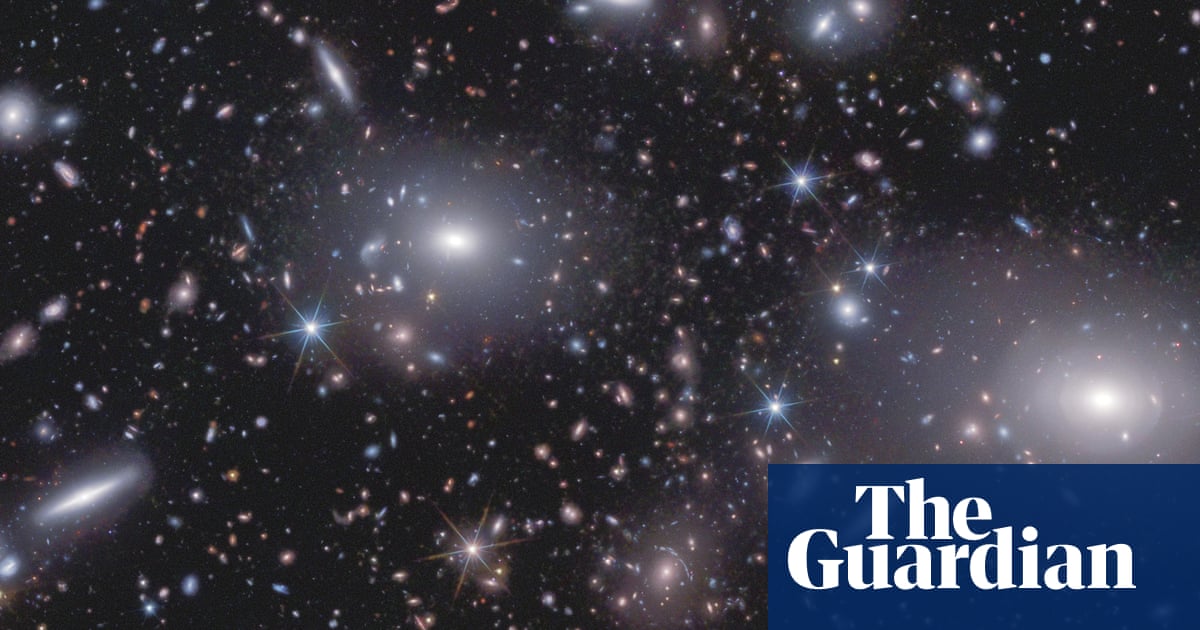
More than 900 million galaxies now fill the first major sky survey from Europe’s Euclid space mission, including about 15,000 possible examples of a cosmic lens that could help scientists investigate dark matter.
Launched in July 2023 by the European Space Agency, Euclid is building what is intended to become the largest three-dimensional map of the universe. Its planned survey will cover a third of the sky and more than 10 billion years of cosmic history. The mission aims to explore dark matter and dark energy, two poorly understood parts of the universe thought to account for about 25% and 70% of it, respectively.
The new release covers about 14% of the sky area Euclid will eventually map. Alongside more than 900 million galaxies, it contains over 60 million possible quasars: bright objects at the centres of distant galaxies, powered by supermassive black holes.
The data also turns up thousands of likely cases of strong gravitational lensing. This happens when a galaxy in the foreground bends and magnifies light from a more distant galaxy behind it. The effect can make the background object appear as bright arcs or rings. Albert Einstein predicted that gravity could bend light in this way, and dark matter adds to the foreground galaxy’s mass and gravitational pull.
That makes these lenses valuable clues. By examining how dark matter gathers within galaxies, researchers can test ideas about what it is made of. “With strong gravitational lensing, you find out how the dark matter is clumping,” said Stephen Serjeant, a professor of astronomy at the Open University. Different kinds of matter may gather in different patterns, he explained, so the observations could help distinguish between theories.
The scale of the new haul is striking: before Euclid, scientists knew of about 1,000 strong gravitational lenses. Researchers have now identified roughly 15,000 probable cases in the released data, and the mission is expected to find about 170,000 by the time it ends.
Euclid’s contribution is not just its number of targets, but its ability to capture a wide area in fine detail. Prof Andy Taylor of the University of Edinburgh, who leads the mission’s UK science ground segment, said earlier surveys either covered less sky at high resolution or offered less detail across broad areas. He called the release the biggest high-resolution image of the universe yet.
A further data release is expected next summer, with findings on how galaxies are spread across space and on weak gravitational lensing. That subtler effect is caused by small distortions in distant objects, and researchers can use its pattern to map dark matter across the universe. As Euclid gathers more observations, the project will add to a sky survey so large that, Taylor said, no person can inspect all of its data by eye. The map is still growing, and each new pattern may offer another way to test what the universe is made of.