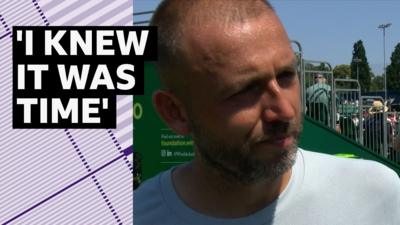
Dan Evans walked off the grass of Roehampton with a quiet smile, the weight of a 14-year professional journey settling not as regret, but as peace. The 34-year-old British tennis stalwart bowed out of singles competition at Wimbledon qualifying, losing 6-4, 6-4 to Australia’s Tristan Schoolkate in the second round—a match that marked the symbolic end of his solo career on the ATP tour. Yet, for Evans, this wasn’t a farewell, but a transition. He remains very much in the spotlight, granted a wildcard into the men’s doubles at Wimbledon alongside rising star Henry Searle, a 22-year-old who won last year’s boys’ singles title at the All England Club.
Evans’ departure from singles play closes a chapter defined by perseverance and late-blooming excellence. Once ranked outside the top 1,000, he climbed to a career-high No. 21 in 2023, becoming a mainstay in Grand Slam draws and a trusted figure in Great Britain’s Davis Cup campaigns. His gritty, counterpunching style earned him wins over top-10 players including Matteo Berrettini and Hubert Hurkacz. But beyond the stats—240 ATP tour-level match wins, 18 finals across singles and doubles—Evans leaves behind a legacy of resilience. He once dropped to 750th in the world after a 2017 doping suspension, only to claw his way back through the lower tiers with sheer determination.
Now, he shifts focus to one final fortnight on the sport’s most iconic lawns. Partnering with Searle, a player less than half his age and a product of the same British tennis pipeline Evans once navigated, feels symbolic. “It’s nice to be able to finish at Wimbledon,” Evans said. “It’s where I’ve had some of my best moments.” His presence in the doubles draw offers both continuity and mentorship—a bridge between generations at a tournament where tradition and evolution walk hand in hand.
The decision to retire wasn’t made in haste. Evans had long indicated that Wimbledon would be his likely endpoint, a full-circle moment at the tournament where he first captured the public’s attention with a run to the third round in 2013. His final singles match in Roehampton wasn’t a triumph, but it was dignified—a fitting end for a player who never relied on flash, but on consistency, craft, and quiet belief.
As Centre Court buzzes with the season’s biggest names, Evans’ final walk into the doubles draw will carry its own significance. It’s not just an exit, but a celebration—a veteran savoring the grass, the crowd, and one last chance to compete where dreams are both made and gently laid to rest.