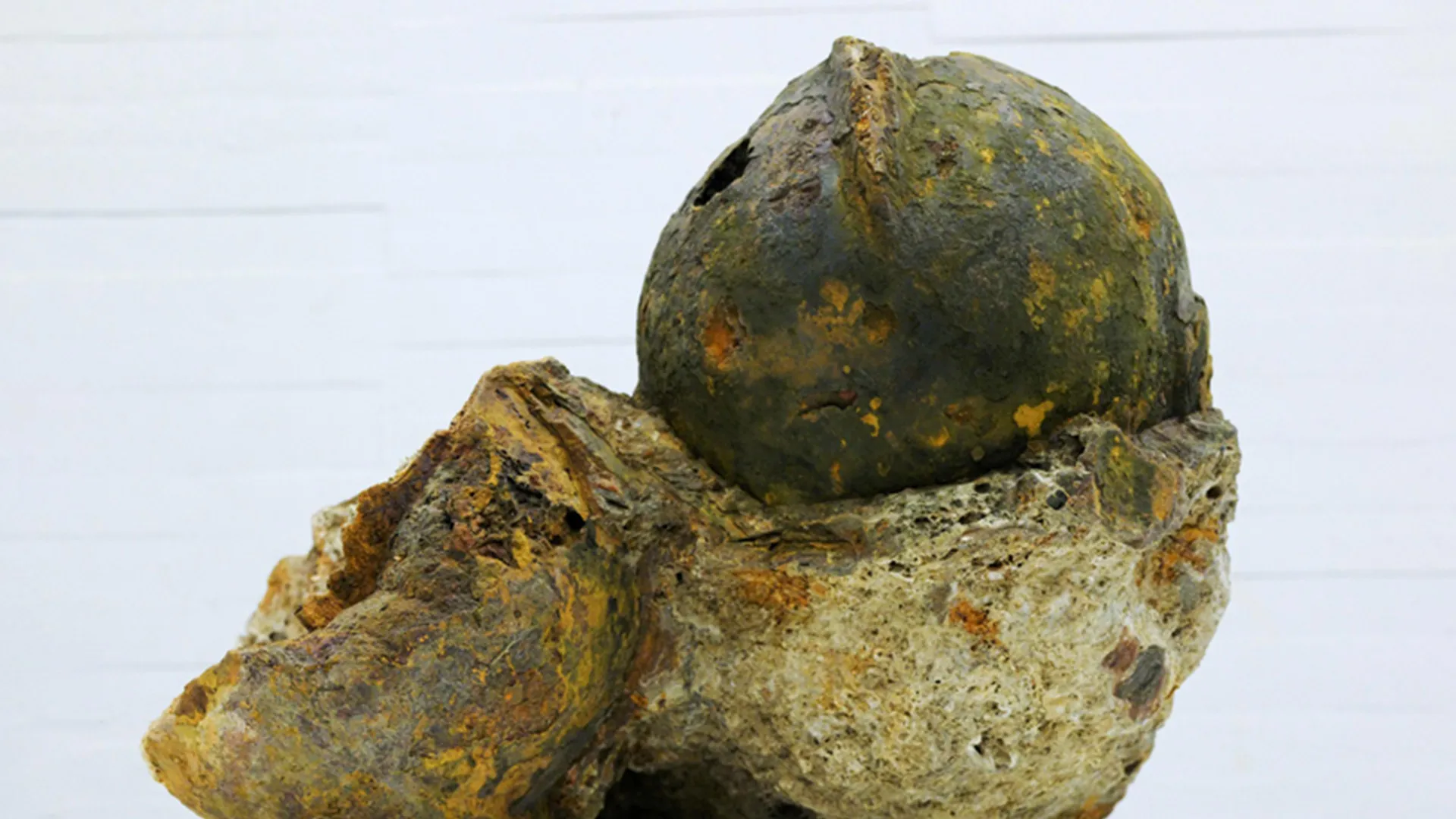
Manuel Frallicciardi pulled open a metal file and found something that would rewrite three decades of Mediterranean history: 43 iron helmets, perfectly preserved beneath centuries of rust and sediment, waiting to tell a story no one had thought to ask them.
For more than 30 years, these helmets sat in archives catalogued as Roman relics, a misidentification so entrenched that no one thought to question it. But when the doctoral student at the University of Alicante began his research, he discovered something extraordinary—the helmets weren't ancient at all. Using advanced analytical methods developed at his institution alongside radiocarbon dating of fabric fragments sealed inside the metal, Frallicciardi and his team determined that these artifacts were actually medieval, forged between the late 14th and early 15th centuries. The findings, published in Cambridge University Press's journal Antiquity, completely overturn the long-standing classification that had gone unchallenged since the helmets' discovery in 1990.
The 43 pieces were recovered from Piedras de la Barbada, an underwater archaeological site near Benicarló on Spain's eastern coast, after local fishermen accidentally snagged two massive, corroded metal blocks in their nets. Inside those concreted lumps lay the largest known hoard of medieval helmets ever found in the western Mediterranean—a cache so rare that when Frallicciardi began searching for parallels, he found almost none. "When I started the research, it was incredible to see that practically no known parallels existed," he explained. A few similar designs appeared in 14th-century English artwork, but nothing exact. These helmets represented a transitional design from military history that left no direct descendants, making them uniquely valuable windows into a poorly documented period of weapons technology.
The significance of the find extends far beyond the metal itself. According to Raimon Graells, a lecturer at the University of Alicante and co-author of the study, these helmets offer direct evidence of something historians had only theorized: large-scale arms trading across the medieval Mediterranean. "We are looking at direct evidence of large-scale arms trading. This discovery reveals a network of exchange and communication that was far more complex than previously thought," Graells said. The size of the shipment—and researchers suspect even more pieces may have been lost to the seafloor—indicates that weapons were moving through well-established commercial systems linking coastal Valencia with major trading hubs like Genoa, one of the era's most powerful cities.
The helmets likely sank as a single cargo, researchers believe, probably during loading or unloading at a jetty located just six meters beneath the surface. A combination of sediment and mineral deposits that accumulated around the metal over centuries created an accidental preservation chamber. In several cases, these concretions sealed the interior so completely that fabric linings—fragments that should have decayed centuries ago—survived intact, ultimately becoming crucial evidence for dating and understanding the collection.
The discovery arrives as a reminder that history rarely stays still. What seemed settled fact for three decades proved to be a case of mistaken identity, overturned not by accident but by one researcher's willingness to ask whether the old assumptions were right. Those 43 helmets, pulled from the Mediterranean's depths, now tell a far richer story about medieval commerce, military technology, and the complex networks that connected Europe's maritime world.