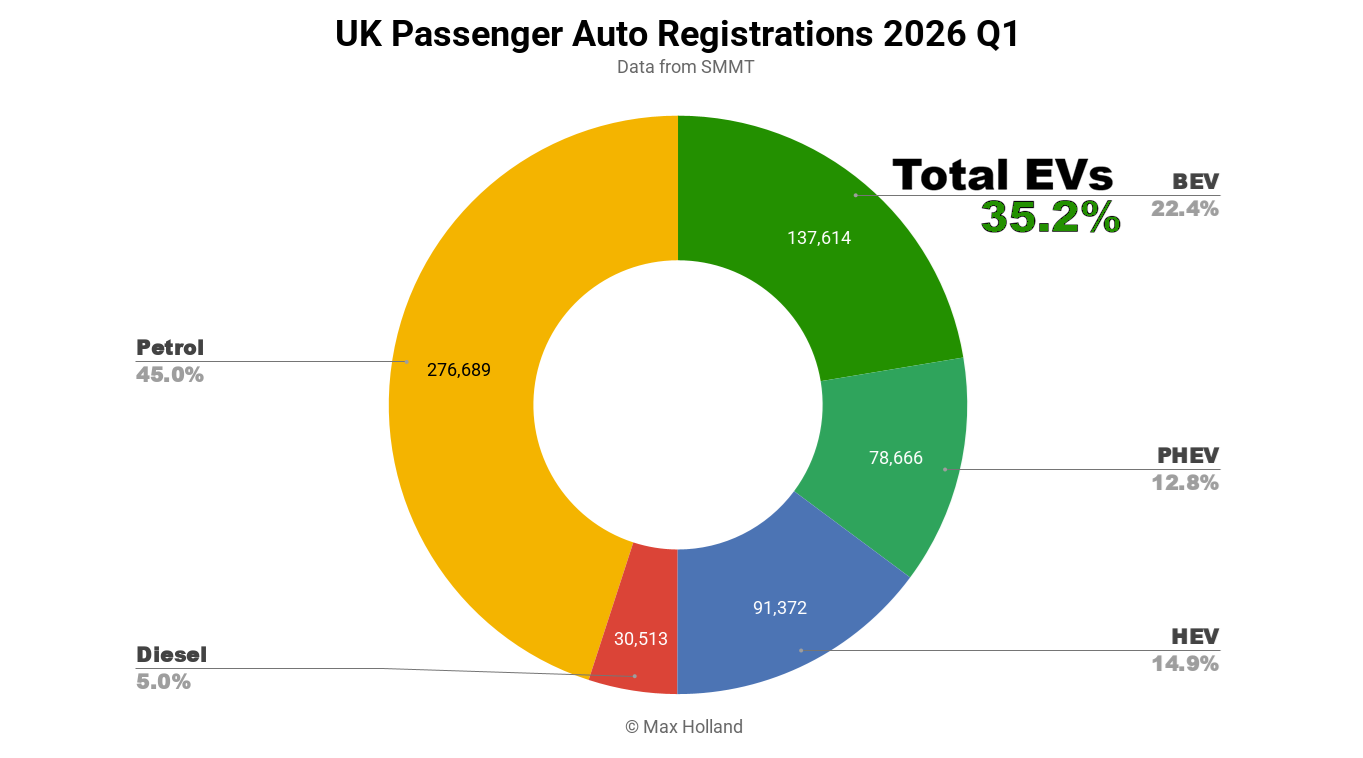
The United Kingdom just crossed a milestone that would have seemed improbable just five years ago: in the first quarter of 2026, electric vehicles claimed more than one in three cars sold. The precise figure is 35.2% market share for plugin EVs—a leap from 30% in the same quarter a year earlier—with battery-electric vehicles (BEVs) accounting for 22.4% and plug-in hybrids (PHEVs) making up 12.8%.
This shift matters because it marks a genuine tipping point in how Britain buys cars. For decades, petrol and diesel dominated the roads so thoroughly that a realistic transition seemed generations away. Yet combustion engines now account for exactly half the market, down from their once-unshakeable dominance. That decline is accelerating: diesel sales fell 10% year-on-year, and petrol slipped 3.5%. The direction of travel is unmistakable.
The numbers reveal a market in rapid motion. In real terms, BEV sales climbed to 137,614 units in Q1 2026, up 14.5% from a year prior. PHEVs surged even faster, jumping 46.5% to 78,666 units. The overall UK auto market expanded by 6%, to 614,854 units, meaning EV growth is outpacing the sector as a whole. The UK's Zero Emission Vehicle (ZEV) mandate—which requires manufacturers to hit escalating EV sales targets—has created a tailwind. After successfully meeting a 28% headline target in 2025 (once flexibilities were factored in), the mandate now requires 33% in 2026, rising to 38% in 2027 and 52% in 2028.
Tesla dominated the BEV rankings but not without surprises. The automaker held the top spot with 8.7% market share, though that slipped from 10.2% a year earlier. The decline wasn't because Tesla sales tanked—they fell just 3.7%—but because rivals grew much faster. Ford leapt from ninth place to second, claiming 7.7% share, powered by the new Puma model that launched in Q2 2025 and achieved the fourth-best-selling BEV model status by Q1 2026. Ford's volume roughly doubled year-on-year. BYD, the Chinese manufacturer, climbed from tenth to third place with 7% share, a remarkable achievement built on seven different BEV models, each selling at least 500 units quarterly. Skoda, Renault, and Kia also expanded robustly, each roughly doubling or coming close to it.
Smaller players are making noise too. Leapmotor entered the top 20 rankings in nineteenth place, growing from a few hundred units to around 3,000 in Q1 2026. Omoda and Jaecoo brands are just outside the top 20, poised for potential breakthroughs.
The UK economy remains muted—GDP grew just 1.1% year-on-year in Q1—yet EV momentum appears insulated from broader headwinds. The government's reintroduction of modest purchase incentives for BEVs in 2025, combined with the ZEV mandate's iron logic, should keep electric vehicles on a growth trajectory throughout 2026. Tesla's grip on the market is loosening, but not because it's failing; it's because the entire sector is finally accelerating.