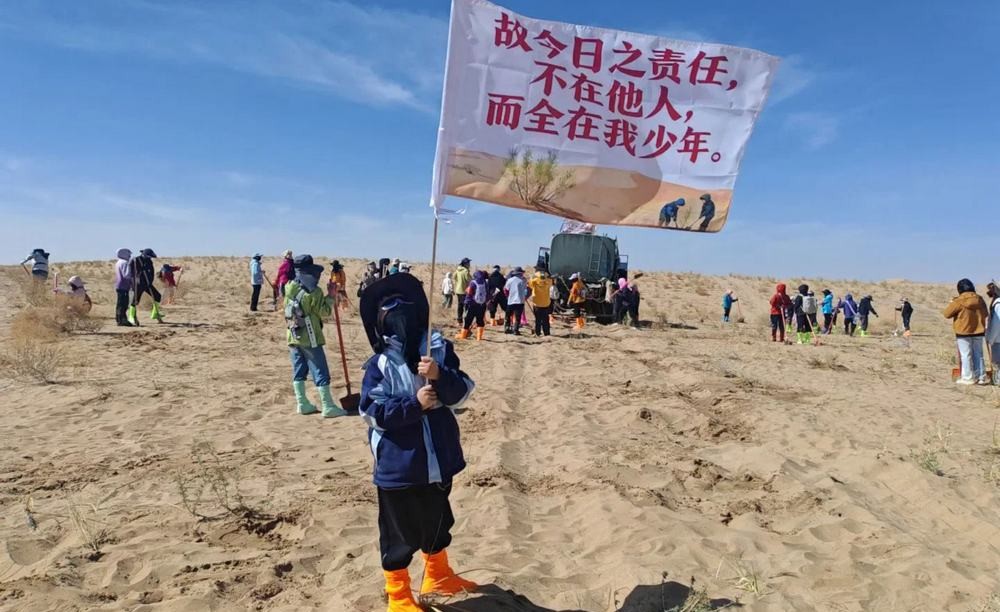
When Zhong Jin returned to Minqin County in Gansu Province after university, he carried expertise in desert control but found his arid, struggling hometown desperately short on resources. So in 2024, he did something that would transform the county's fight against desertification: he posted a call for help on short video platforms, asking volunteers to plant trees in one of China's most vulnerable regions. What happened next was extraordinary—30,000 people, many from distant cities, traveled to the remote area on their own dime to answer.
Minqin County sits on the front line of China's decades-long war against desertification, a battle that began in 1950 with mass planting campaigns. The county relies on hardy crops like corn, onions, and melons to survive, while using desert plants such as saxaul and white thorn to stabilize soil and protect precious water sources. But the work has always outpaced local capacity. When a Chinese reality TV program called "Become a Farmer" filmed in Minqin with ten urban youth cultivating 450 acres over 190 days, it sparked something unexpected: national interest. The show became a hit, and suddenly the county's struggles felt real to audiences across China.
Capitalizing on that momentum, Minqin's public welfare center launched a volunteer registration portal on its website, inviting people to experience what the TV show had dramatized. Between February and May, the response was staggering. College students came, drawn by the show or by genuine concern for the environment. Parents brought children to teach them about farming's real challenges. Fans of "Become a Farmer" made the journey. Together, they planted 1 million trees, their labor aimed at protecting critical irrigation areas and agricultural land from further encroachment by the desert.
The reality of the work proved harsh. Volunteers faced sandstorms, unforgiving terrain, relentless sun, and cramped dormitories—conditions that separated genuine commitment from casual interest. Yet the difficulty forged something unexpected: a spirit of frontier camaraderie. Pit-digging and tree-planting wore everyone down equally, leveling the differences between city dwellers and locals, professionals and students. In their shared exhaustion, volunteers discovered connection.
Local entrepreneurs seized the moment to deepen the experience. Curated travel routes now guide visitors through tree-planting sites and scenic areas, where cultural performances and live-action exhibitions showcase Minqin's landscapes and heritage. What began as an environmental emergency became, briefly, a place where urban and rural China met—where people from Shanghai and Beijing and Chengdu came to understand, viscerally, what it means to green a desert.
The campaign's success is both environmental and social: 1 million trees now stand as a living buffer against desertification, while 30,000 volunteers carry home a transformed understanding of their country's edges. In a region fighting for survival against sand and drought since 1950, Zhong Jin's viral call proved that help, when asked for clearly, can arrive from anywhere.