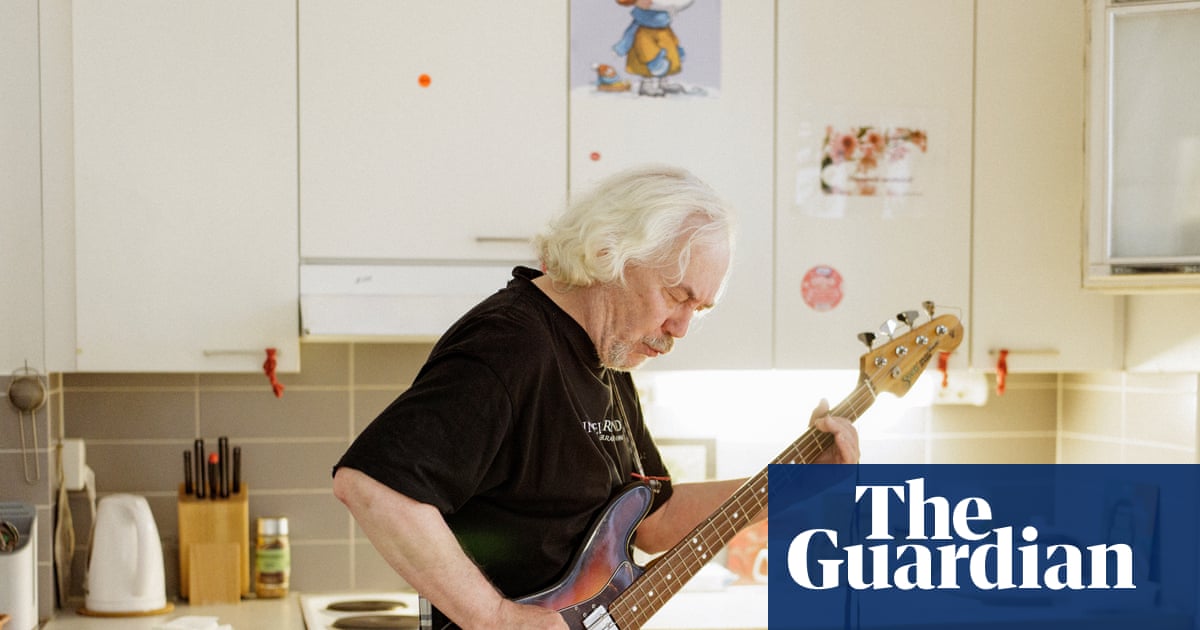
At 3.30am, someone knocked on Vello Senkel's door. His neighbours needed salt to boil macaroni — and then admitted they needed the macaroni, too. It is the kind of friendly, ordinary chaos that fills the Helsinki apartment building where Senkel, 67, lives with 77 other formerly homeless people. He calls the building home, and he has good reasons to.
Senkel, whose nickname Velho means "wizard" in Finnish, spent ten days on the streets of the Finnish capital after being evicted. Before that came a diagnosis of borderline personality disorder and a devastating loss: his partner died after two years in a coma. When he moved into this converted student accommodation three and a half years ago, he had almost nothing. Today he shows off a fully stocked freezer, jars of pickled cabbage and shrimp salad he made for a friend's lunch, and a bass guitar he plays every day. "Having this apartment has changed everything," he says.
This building runs on a principle called Housing First, and it is the reason Finland is famous worldwide for tackling homelessness. The idea is simple and radical: housing is a basic human right, not a reward for good behaviour. Instead of making people prove they are "ready" for a home, the system gives them a permanent place first. Treatment, healthcare and jobs all come after — built around the stability of having a roof. Marko Lahtela, who manages the unit for the care provider Rinnekodit, says it is "more of a marathon than a sprint." There is no time limit on staying. Some residents have lived here since it opened in 2022; others move on to more independent housing after just six months.
A big part of the magic is 24-hour staff support. Without it, Senkel says, his home would have been a "black hole" of loneliness. He has an agreement with management: if they do not see him for 72 hours, they get in touch. Every morning there is porridge and coffee in the shared living room, and once a week residents meet to talk things through. A notice on the pinboard reads: "You are precious. We listen and support and together with you we build the life that is true to you."
Housing First is not a perfect fix. Lahtela admits the system does not do enough to stop people falling into rental debt, which after two months can lead to eviction — and for some, a return to the streets. Still, the results are striking. Between 2012 and 2023, homelessness rose across Europe even as Finland cut its numbers by more than half, from about 8,000 homeless people to about 3,400. In Spain, by contrast, homelessness rose by about a quarter over a similar period. Finland's experiment shows what can happen when a country decides that a home is not a privilege but a right — one neighbourly knock on the door at a time.