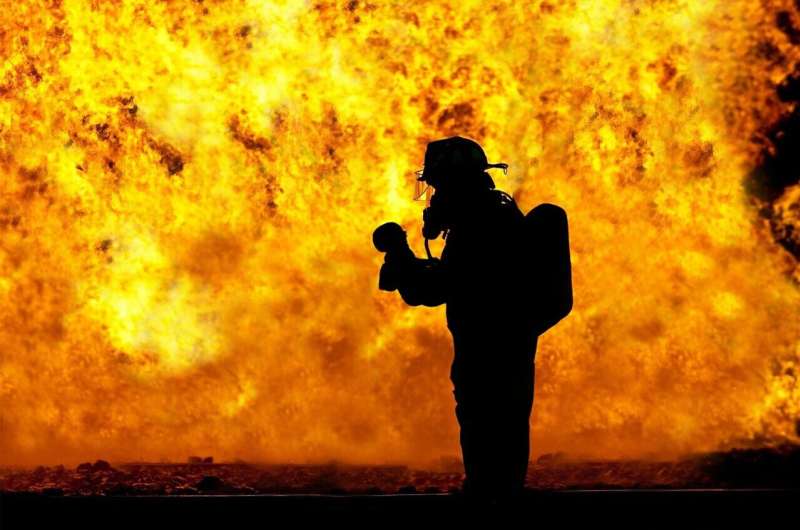
On a scorched hillside in Oklahoma, researchers are weaving hope into the threads of wildland firefighters' protective gear. Scientists at Oklahoma State University's Textile and Apparel Science Laboratory are developing nano-fiber fabrics designed to shield firefighters from the carcinogenic smoke and ash that seeps through conventional clothing during multiday fire assignments.
The stakes are urgent. A 2025 study revealed that firefighters face a 58% higher risk of dying from skin cancer than non-firefighters, and a 40% higher risk of kidney cancer mortality. Wildland firefighters face particular peril: they work in smoke-laden environments where carcinogenic compounds mix with sweat and skin oils, penetrating deep into the body's layers and accumulating over years of exposure. The longer assignments stretch—sometimes lasting weeks—the greater the chemical load absorbed by their skin.
The problem is deceptively simple. Ultrafine particles of soot and ash can travel through most protective fabrics, reaching the skin and eventually the bloodstream. When researchers visited controlled-burn sites and examined firefighters' soiled protective clothing, they found that carcinogenic smoke particles could pass through the very fabrics meant to defend them. The contradiction is cruel: the most breathable fabrics, which prevent dangerous heat stress, paradoxically allow harmful particles to slip through more easily. Tighter weaves block particles better but trap heat, risking thermal injury during grueling work.
Enter nanofabrics—textiles engineered at scales invisible to the naked eye. These materials feature extraordinarily thin fibers and minuscule pores that capture fine and ultrafine particles far more effectively than conventional fabrics. The rough surfaces of nano-engineered fibers create friction and irregular geometry that traps ash and smoke particles on the outer surface, preventing them from traveling deeper into the material. Some nanofabrics incorporate activated carbon or graphene—high-surface-area materials that actively capture chemicals—while maintaining the porosity that lets air and moisture vapor escape. The result is a fabric that breathes while it protects.
This approach addresses a troubling gap in current wildland firefighter gear. Most protective clothing today relies on heat-resistant fibers like Kevlar, Nomex, PBI, and flame-retardant cotton. To achieve liquid protection alongside heat resistance, many manufacturers have turned to PFAS—per- and polyfluoroalkyl substances, the "forever chemicals" that persist in the environment and accumulate in human bodies. As health concerns about PFAS mount, the need for alternatives becomes urgent.
The Oklahoma State team is integrating filtration directly into fabric structure through advanced multilayer designs and smart fabrics that interact with particles at the molecular level. The challenge isn't just blocking particles—it's blocking them without sacrificing the breathability that keeps firefighters from collapsing from heat exhaustion during physically demanding work. There's also a practical reality: contaminants accumulating on rough surfaces require better cleaning procedures to prevent continued exposure through dirty clothing.
What began with collecting soiled gear from real fire scenes is becoming a blueprint for equipment that could save lives. As wildfire seasons intensify and more people build homes near wildland areas, the work being done in Oklahoma labs offers a concrete path toward protecting the men and women who run toward flames.