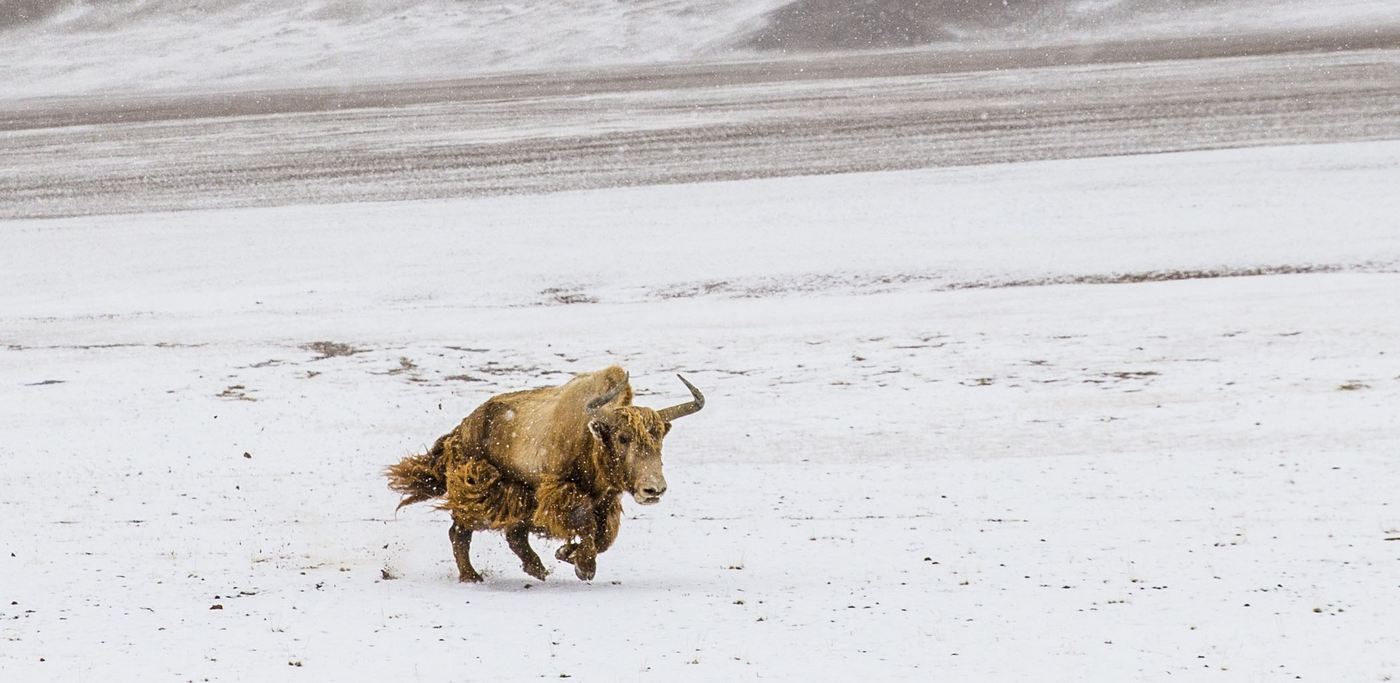
High on the Qinghai-Tibet Plateau, where legend says seven golden yaks were given as a dowry when two mountains were married, scientists have just achieved the first successful cloning of wild yaks—a breakthrough that could save one of Earth's rarest and most extraordinary creatures from extinction.
The golden wild yak, a genetically distinct subspecies with coats that flush a brilliant burnished gold, has been hunted, outcompeted, and outbred to the brink of oblivion. Today, fewer than 300 individuals remain in their high-altitude strongholds, making them critically endangered. Yet this animal represents something irreplaceable: a subspecies that evolved over thousands of years to thrive in the planet's harshest environments, carrying unique genetic traits for hypoxia tolerance, reproductive function, and immune response that no other population possesses. The stakes of losing them extend far beyond a single species—it means losing a genetic library written by millennia of mountain survival.
In 2023, researchers at Zhejiang University and the Institute of Plateau Biology of Xizang launched an ambitious partnership, sequencing the whole genomes of nearly 9,000 wild yaks to create a complete genetic inventory before attempting anything so audacious as cloning. That groundwork paid off spectacularly. Last July, the team achieved the first wild yak cloning in history. Then, just recently, they surpassed even that milestone by cloning 10 at a time—a feat that required delivering yak embryos to wild yak females, who carried and birthed them organically without any artificial assistance. This is no mere duplication of living animals, as cloning is sometimes misunderstood. Each cloned calf carries entirely different genetics, drawn strategically from across the wild yak gene pool to maximize genetic diversity.
The parallel is instructive: in 2008, American conservationists used cloning to rescue the black-footed ferret from the brink of extinction due to dangerously limited genetics. The offspring of that animal have since reproduced naturally in captivity, proving the technique viable. Now China is applying the same powerful tool to an animal that local communities have protected with extraordinary dedication. Over 700 herders and farmers are employed in keeping domesticated yaks away from golden yak strongholds in Changtang National Park and conducting poaching patrols across the vast landscape.
The scientists involved are not claiming victory prematurely. They've identified the golden yak as an "Evolutionarily Significant Unit of high conservation value," and they've noted a sobering challenge: the small population suffers from inbreeding, which threatens genetic health. The researchers stress the urgent need to prevent genetic deterioration while avoiding the risk of genetic swamping through hybridization with common wild yaks. These are delicate genetic waters to navigate.
The vision ahead is ambitious but clear: establish a new wild herd with genes drawn from across the entire wild yak population, rebuild their numbers, and then focus intensively on the golden subspecies itself. With time, advanced biology, and sustained commitment from both scientists and local communities, the beautiful mountain creatures of legend may yet maintain their place in the Tibetan Plateau's wild reaches—no longer figures of folklore alone, but living proof that even the rarest animals can be brought back from the edge of extinction.