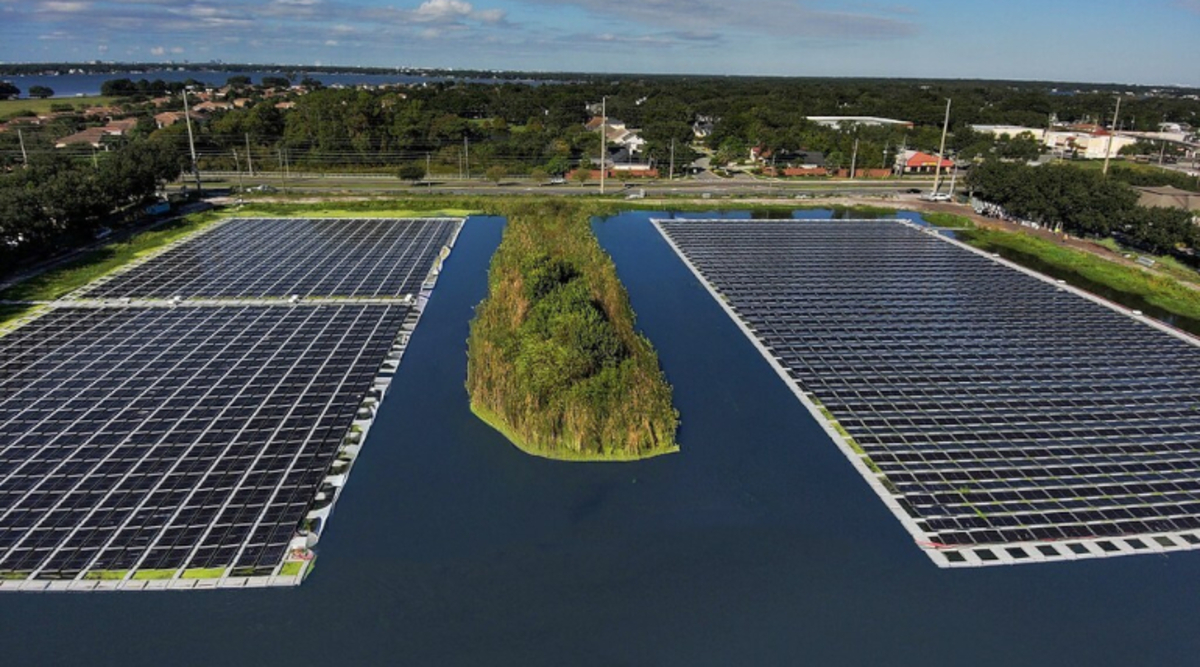
On a stormwater pond in Orlando, Florida, a groundbreaking solution to one of clean energy's most stubborn problems is now quietly generating power: floating solar panels. D3 Energy, a company specializing in floating solar systems, has secured an exclusive statewide master lease agreement with Florida's Department of Transportation to develop floating solar across FDOT-owned stormwater ponds—a breakthrough that sidesteps the land scarcity that has long strangled solar expansion in the state.
For years, Florida has faced a peculiar paradox. Solar technology is cheap and efficient, capital is readily available, yet new installations crawl forward at a frustrating pace. The culprit is deceptively simple: there isn't enough available land. Ground-mounted solar requires large, contiguous spaces that often compete with residential development, agriculture, and environmental conservation. Site-by-site negotiations have meant years of delays, fragmented approvals, and redundant bureaucratic hurdles. The D3 Energy agreement with FDOT changes that calculus entirely.
"In Florida, the bottleneck on new solar is rarely capital or technology—it's available land. This lease solves that at the state level," said Stetson Tchividjian, managing director of D3 Energy. The master lease replaces piecemeal site negotiations with a single, consolidated framework for statewide coordination, eliminating the fragmentation that has historically slowed renewable energy projects across Florida. The first installation under the agreement, deployed on an FDOT pond in Orlando, was fully commissioned earlier this year.
The scale of what's possible is striking. D3 Energy estimates that FDOT's statewide pond inventory can support more than 1 gigawatt of floating solar capacity—enough electricity to power more than 200,000 Florida homes. This development would preserve roughly 5,000 acres of Florida land that would otherwise be converted to ground-mounted solar installations. The arrangement also creates a new revenue stream for the state through recurring lease payments, turning passive infrastructure into an asset with no cost to taxpayers.
Beyond the numbers, the deal addresses a fundamental efficiency problem. Floating solar systems will be deployed on ponds located alongside substations, highways, and existing customer infrastructure—essentially placing generation capacity where demand already exists. This proximity dramatically reduces interconnection costs and accelerates grid integration. The systems complement rather than compete with Florida's existing land-use regulations, making clean energy expansion politically and logistically smoother.
For Florida's investor-owned and municipal utilities, the arrangement offers rare good news in an energy landscape shaped by competing interests and regulatory complexity. The lease provides a clear pathway to scale solar capacity without the drawn-out site-by-site negotiations that have historically derailed projects.
The achievement is particularly notable given the political headwinds facing renewable energy in Florida. That a statewide renewable energy infrastructure deal could advance despite the challenging policy environment speaks to the practical necessity of the solution and the persistence of those who engineered it. The initial Orlando project demonstrates the viability of the approach. If the model succeeds at scale, Florida's grid could see thousands of acres of new solar capacity while preserving the land itself—a rare win-win in the energy transition.