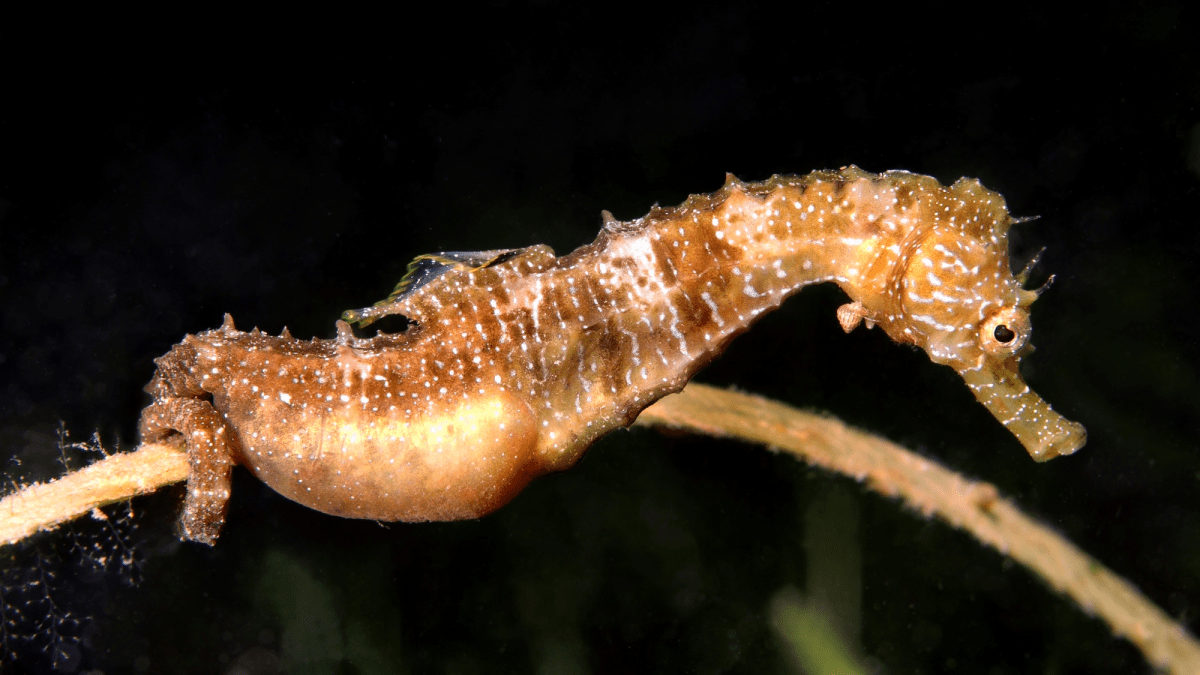
The net trembled in the hands of the Marine Lab students as a tiny male seahorse, no longer than a child’s pinky, began to convulse—then, like a living snow globe shaken to life, dozens of minuscule fry tumbled into the shallow waters of Florida Bay near Nest Key. In that instant, during a routine seining exercise, the students witnessed something few ever do: a male seahorse giving birth in the wild.
Seahorses are among nature’s most unusual parents. Unlike nearly all other animals, it’s the males who carry and deliver the young. After an intricate courtship dance, the female deposits her eggs into a specialized brood pouch on the male’s tail using an ovipositor. Fertilization happens internally, and the male nurtures the embryos for up to six weeks, regulating the salinity and providing oxygen through a placenta-like structure. When the time comes, muscular contractions expel the fully formed fry—one by one—into the world, where they swim away, entirely independent.
The sighting occurred during a field trip organized by Marine Lab, an environmental education nonprofit based in the Florida Keys. Students were seining—dragging a long net through seagrass beds to study marine life—when they spotted two seahorses in their catch. One, a male, was visibly distended with eggs. "We would not describe them as something students see on every trip," said Kristen Prado, a representative for Marine Lab. "But witnessing a male seahorse giving birth during the activity was very rare and exciting for both our students and instructors."
The event wasn’t just a biological marvel—it was a powerful lesson in conservation. Nest Key’s shallow seagrass meadows are nurseries for countless marine species, from juvenile fish to crustaceans. These habitats are under threat globally, with seagrass coverage declining due to pollution, coastal development, and climate change. Yet here, in this protected corner of the Florida Keys, life unfolded in full complexity.
After observing the birth, the students gently returned the seahorses and other captured organisms to the water. The moment underscored Marine Lab’s mission: to foster stewardship through direct, awe-filled encounters with nature. "Experiences like this help students understand that healthy seagrass habitats are full of life," Prado said, "and that even a routine field activity can become a powerful connection to the natural world."
As oceans face mounting pressures, moments like this remind us that wonder still thrives in the shallows—if we’re willing to look.