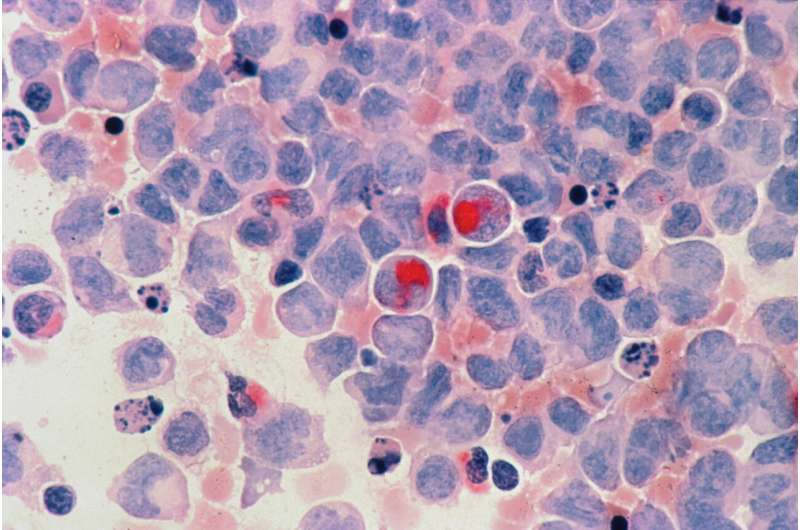
Scientists in Houston, Texas have found a surprising second way that a group of cancer drugs kills leukemia cells — a discovery that could help patients who have become resistant to treatment. The researchers at Baylor College of Medicine discovered that FLT3 inhibitor drugs, which are already used to treat a aggressive blood cancer called acute myeloid leukemia (AML), work not just through one self-destruct mechanism that was already known, but through a second one that had never been linked to these drugs before.
AML is a cancer of the blood and bone marrow. According to the American Cancer Society, roughly 20,000 new cases are diagnosed in the United States each year. Many of these cancers are driven by mutations in a gene called FLT3, one of the most common genetic drivers of the disease. Drugs that block FLT3 have been shown to stop cancer cells from dividing and to kill them by triggering apoptosis, a natural process where damaged cells destroy themselves.
But as with many cancer therapies, resistance to FLT3 inhibitors often develops, and patients frequently relapse. Dr. Daisuke Nakada and his team wanted to understand if the drugs were working in other ways that researchers might be able to exploit to overcome this problem.
The answer turned out to be yes. In a study published in Nature Cell Biology, the team found that FLT3 inhibitors also kill AML cells by triggering ferroptosis. This is a different type of cell death that happens when oxygen damages tiny fat molecules inside cells, causing them to rupture. This is the first time FLT3 has ever been connected to ferroptosis.
Digging deeper, the researchers found that mutated FLT3 proteins in leukemia cells activate a protein called GPX4, which normally blocks ferroptosis. FLT3 inhibitors reduce the production of GPX4, leaving cancer cells vulnerable. When the researchers tested this in mouse models and in patient-derived leukemia samples grown in animals, the same pattern appeared.
The discovery also revealed an unexpected wrinkle about diet. The team found that vitamin E, which dampens ferroptosis, can markedly reduce how well the FLT3 inhibitor gilteritinib works. Patients taking these drugs may want to discuss their vitamin intake with their doctors.
The findings open a potential new path forward for treating AML patients who have developed resistance to existing drugs. By targeting the ferroptosis pathway alongside the already-known apoptosis route, doctors might be able to attack the cancer from two angles at once, increasing the chances of success.