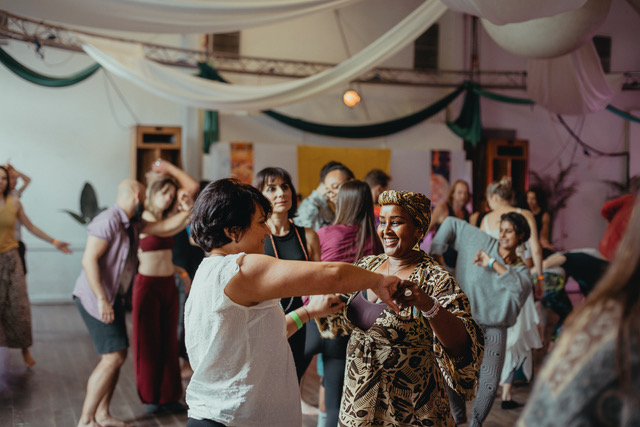
A merman in glittery fish-scale armbands spins past dancers in the chaos stage—and nobody blinks. At The Bath House in Hackney Wick, east London, 100 people have gathered on a Sunday morning not for cocktails but for ecstatic dance: a sober, mindful movement experience that's quietly revolutionizing how people find joy, connection and mental wellbeing outside the traditional nightlife scene.
Ecstatic dance events are booming across the UK, blending spirituality, fitness and emotional expression into what participants describe as "engaged, interactive movement therapy." The practice combines roving DJs, free-form movement and a core ethos captured in Richard Batts's simple rhyme: "No booze, shoes, no chit chat." Batts, co-founder of Ecstatic Dance UK, sees these gatherings as a joyous alternative to late-night parties—offering something especially meaningful for parents, introverts and those living a sober lifestyle who want to dance, sweat and process emotion without alcohol or judgment.
The movement has roots in the 1960s and '70s, when the '5Rhythms' style of dance was developed as a free-form practice centered on exploring one's inner landscape. Sessions move through five distinct stages—flowing, staccato, chaos, lyrical and stillness—allowing bodies and minds to flow naturally through the experience. What makes ecstatic dance accessible is its radical inclusivity: participants span all ages, from young families with infants strapped to their chests to older generations moving at their own pace. Some gyms, including David Lloyd Clubs, have begun offering their own "spirit dance meditation" classes, bringing the practice into mainstream fitness spaces.
For Valerie Chartrand, a regular at Ecstatic Dance UK's weekly events, the transformation has been profound. Turned off by the often rigid structure of conventional dance classes, she found in ecstatic dance a chance to exercise and move freely while processing emotion through her body. "When I'm doing it, it's absolutely wonderful, very liberating, very freeing," she says. "For days afterwards I feel I'm in a better state of mental health." As an introvert, she also values the absence of pressure to make conversation while still experiencing a deep sense of social connectedness—a combination rarely found in social gatherings.
The mental health benefits proved especially vital during the pandemic. When lockdown hit, Ecstatic Dance UK moved everything outdoors, dancing in groups of six within government guidelines. Batts recalls the profound impact: "It was a legal, healthy, fun dance practice outside in nature. Some people would literally say, 'this has saved my life.'"
At the heart of the experience lies a willingness to embrace discomfort. Batts is candid about this: "People are sober—it can feel very edgy. You might feel really silly doing this, and that's okay. If you don't want to do it, then don't. But lean in if you can." Onsite vendors enhance the ritual, serving "ceremonial cacao"—a warm, minimally processed drink with South American origins, sometimes infused with CBD or blue lotus flower to help participants feel more present and heart-open before entering the dance space.
What emerges from these gatherings is something increasingly rare: a judgment-free space where bodies of all shapes, ages and abilities move together, where a pregnant woman in spandex dances beside a merman in glitter, where endorphins and connection flow freely—all before noon on a Sunday.