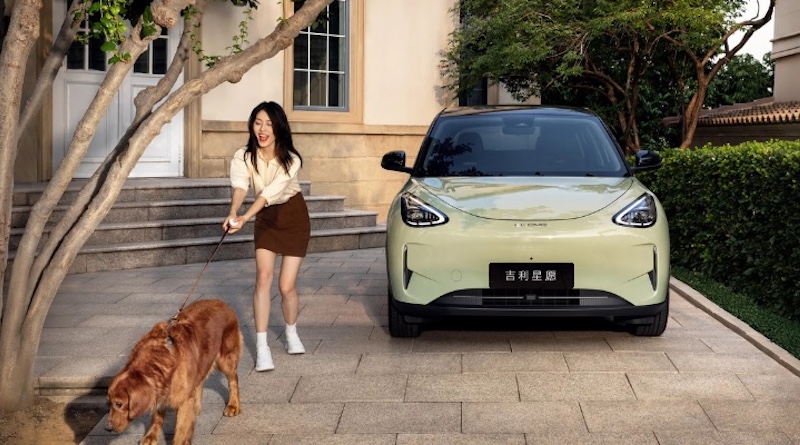
Ford's sprawling Valencia factory in Spain is about to welcome a new tenant—and a fresh chapter in Europe's electric vehicle revolution. The automaker is in advanced talks to sell assembly space at the facility to Geely, the Chinese automotive giant, marking what would be the Chinese company's first European manufacturing foothold.
The space in question is the Body 3 assembly hall, where Ford once built the Mondeo, Galaxy, and S-Max. Currently, the facility operates well below its capacity, producing only the Ford Kuga while maintaining the potential to manufacture 300,000 vehicles annually. That untapped potential has caught Geely's attention at a pivotal moment for the EV industry, as Chinese automakers increasingly establish themselves on European soil.
Geely plans to start production with the Galaxy EX2, a compact electric crossover that was China's best-selling car last year under the name Galaxy Xingyuan. But this won't be a single-model operation. The Chinese manufacturer intends to build a range of battery-electric vehicles and plug-in hybrids based on the GEA platform at the Valencia location. In a twist that speaks to modern automotive partnerships, Geely could even produce vehicles wearing the Ford badge—leveraging the same playbook Ford has already embraced with Volkswagen and Renault, where the American manufacturer slaps its branding on cars developed and built by partners abroad.
The deal underscores a broader shift reshaping European manufacturing. With legacy automakers struggling to match Chinese competitors' EV capabilities and production efficiency, selling off underutilized factory space has become an attractive hedge. Ford is already banking on partnerships with other European giants: it's using Volkswagen's MEB platform for the plug-in Capri and Explorer, and collaborating with Renault on two electric models based that company's Ampr architecture. Adding Geely to this web of partnerships represents pragmatism as much as innovation.
For Spain, the arrangement could prove significant. Geely's suppliers are already being contacted about establishing operations near Valencia, suggesting the company is ready to move fast. A fully operational European manufacturing hub would allow Geely to sidestep tariffs, reduce shipping costs, and embed itself deeper into the world's second-largest automotive market. It's a move that mirrors how other Chinese EV makers have approached European expansion—finding idle capacity and breathing new life into it.
The deal also reflects a moment of reckoning for Ford. Rather than sink resources into competing head-to-head with Chinese competitors on EV development, the company is monetizing its assets and placing strategic bets on partnerships. Whether that strategy ultimately proves wise won't be clear for years. But for now, as another Chinese automaker prepares to establish its first European factory, the trend is unmistakable: the global EV landscape is being redrawn, and Europe's industrial heartland is becoming a magnet for Chinese automotive ambition.