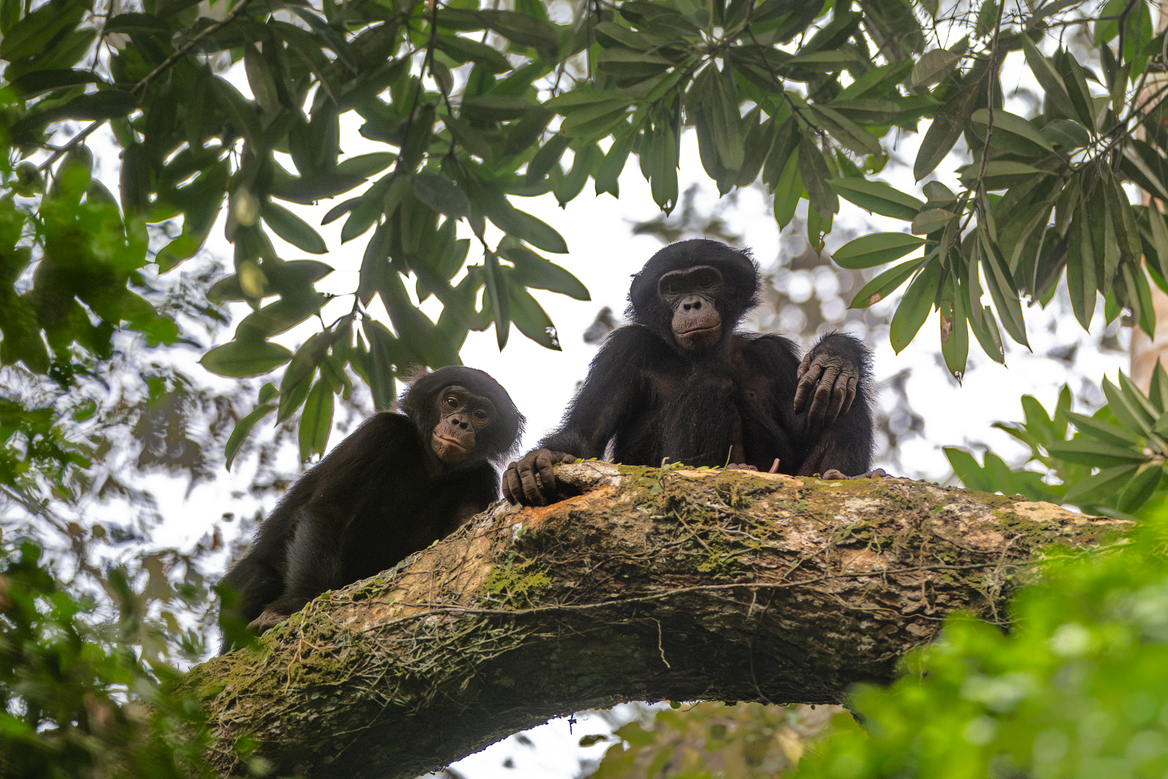
Before dawn breaks over Salonga National Park, when the rainforest is still cloaked in darkness, Felix Bofeko and his team of trackers and researchers set out from the Inkomu research camp toward the nesting sites of wild bonobos deep in the Democratic Republic of Congo. Some of these trackers are former poachers whose intimate knowledge of the forest has become essential to conservation itself. Their mission, unfolding across hours and months and years, is deceptively simple: to persuade one of Africa's most endangered great apes to accept human presence as a natural part of their world.
Bonobo habituation—the painstaking process of earning trust through repeated, consistent, non-interactive contact—is a critical tool for protecting Pan paniscus, humanity's closest living relative alongside chimpanzees. Bonobos exist nowhere else on Earth except in the DRC, and much of what scientists know about them comes from a handful of research sites scattered across the country. In Salonga, the largest tropical rainforest national park in Africa and a World Heritage Site, researchers selected a group of approximately 60 bonobos in late 2023 and began what would become a marathon of daily forest pursuit, starting at 3 a.m. and continuing until the apes built fresh nests for the night. It is work that requires thousands of hours, unflinching patience, and consistency through the most remote rainforests on Earth.
The transformation has been slow but genuinely encouraging. When researchers first started in late 2023, the bonobos fled at the sight of people. Now, after months of daily presence, the group tolerates limited human contact and occasionally allows observers to watch them feed, rest, and play. "The whole idea of habituation is that you meet the group every day in a very friendly, non-interactive way so they accept you as part of the forest," Bofeko explains. "You slowly get closer and closer until they accept your presence." Currently, the bonobos remain relaxed with just two human observers nearby. Researchers hope that within one year, they will tolerate three or four.
This work matters far beyond the forest. Habituation enables scientists to monitor bonobo health, behavior, and social dynamics while strengthening long-term conservation efforts—gains that are increasingly vital. In 2024, researchers estimated the wild bonobo population at 12,000 to 18,000 individuals, not including infants, numbers published in the International Journal of Primatology. The last comprehensive IUCN assessment, conducted in 2016, classified bonobos as endangered and declining.
Park officials acknowledge real risks, particularly as the Democratic Republic of Congo contends with renewed Ebola outbreaks in its eastern regions. The threat of zoonotic disease transmission is ever-present. Yet when conducted under strict biosecurity protocols, bonobo habituation offers significant conservation, scientific, and ecotourism benefits that outweigh those dangers. The project ultimately aims to create one of the few places in the world where visitors can observe wild bonobos in their natural habitat—supporting both research opportunities and local livelihoods while strengthening protections for a species that exists nowhere else on the planet.