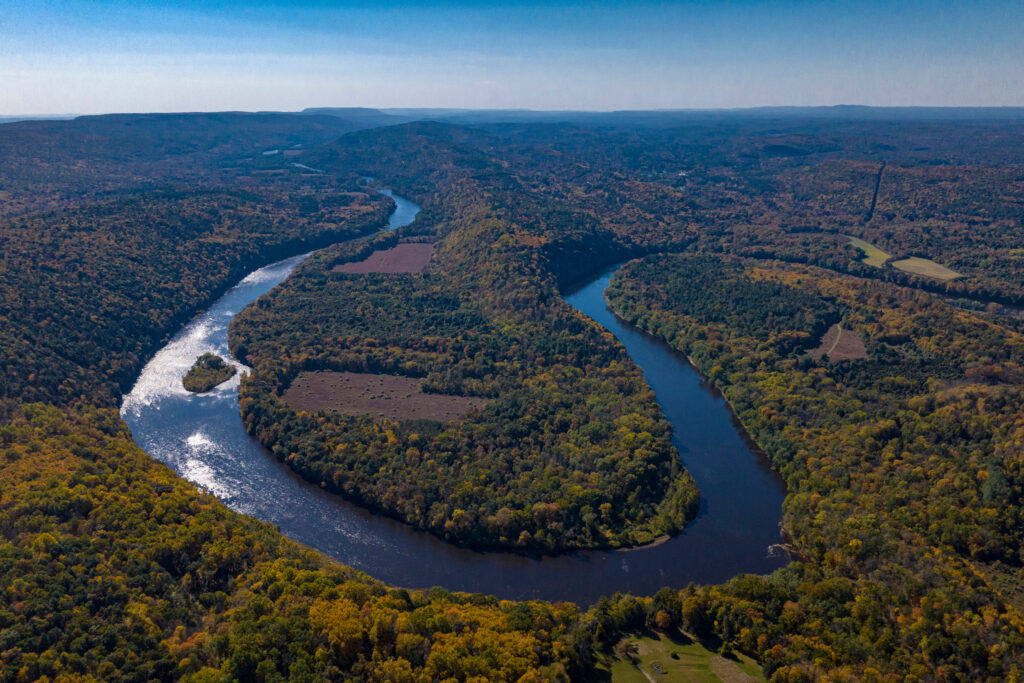
Fifteen million people drink water from the same river. That's how many people rely on the Delaware River Basin — a 330-mile watershed stretching from upstate New York to the Delaware Bay — for their tap water. It quenchers thirst for New York City, Philadelphia, Trenton, and Wilmington, among other communities. And for now, that water will stay protected from fracking.
A Republican amendment that would have lifted the long-standing ban on fracking in the Delaware River Basin was not brought to a vote in Congress this week, letting the protection stand. The amendment, authored by U.S. Rep. Scott Perry of Pennsylvania, would have stripped the Delaware River Basin Commission (DRBC) of its authority to regulate hydraulic fracturing — a method of extracting oil and natural gas from rock by injecting water and chemicals underground at high pressure.
The DRBC is an interstate agency representing Pennsylvania, New York, New Jersey, Delaware, and the federal government. It has banned fracking in the basin informally since 2010 and formally since 2021, after a decade of public comment and scientific review. The commission concluded that allowing fracking would pose "significant, immediate and long-term" risks to water quality throughout the region.
Perry's measure would have also blocked two other river basin commissions — the Susquehanna River Basin Commission and the Potomac River Basin Compact — from imposing their own fracking bans. The Republican had tried before: in 2025, he introduced the DRILL Now Act, arguing that "unelected bureaucrats" should not restrict states from developing natural gas. Perry's office did not respond to requests for comment.
The amendment's withdrawal is being hailed by environmental groups as a victory. "We made clear to members of Congress that the DRBC frack ban was critical for protecting our communities, was based on sound science, and the reality of devastation we can see playing out elsewhere in the region and the nation when fracking for fossil fuels happens," said Maya van Rossum, leader of the Delaware Riverkeeper Network, calling the outcome an "amazing success."
The DRBC itself noted that its joint management has "protected and improved water supply and water quality for millions of water users for more than six decades" — since Congress established the commission in 1961.
But supporters are not expecting the fight to be over. Tracy Carluccio, deputy director of the Delaware Riverkeeper Network, said she anticipates another attempt. "We have no doubt they will try again through whatever means they can conjure," she said. The Trump administration's push for expanded fossil fuel production has emboldened some elected officials to challenge environmental protections, she noted.
For now, however, the ban holds — and 15 million people can continue turning on their taps without worry.