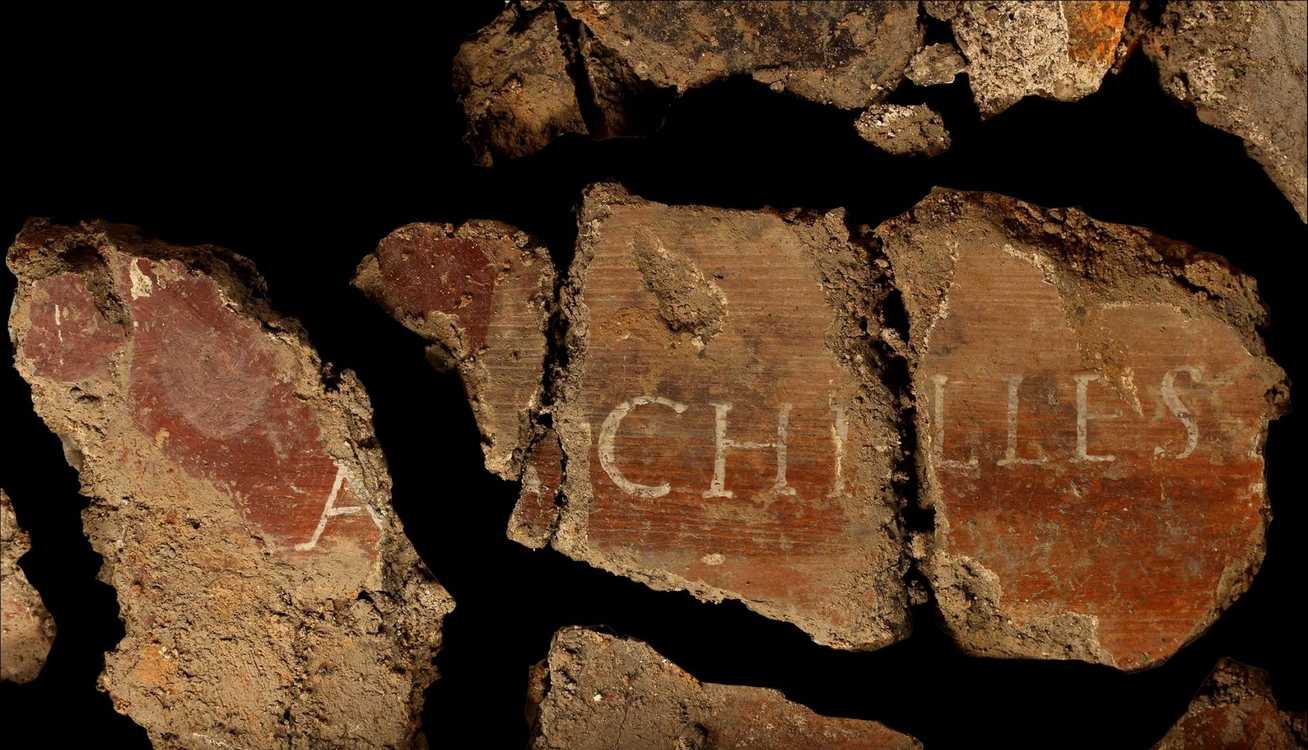
In a humid corner of Roman Gaul, half a mile from the bustling forum of Durocortorum, archaeologists have unearthed fragments of something extraordinary: a wall-to-wall fresco depicting Achilles, the legendary hero of Homer's Iliad, rendered larger than life and bearing his name in painted script.
The discovery, made by France's National Institute for Preventative Archaeology (INRAP) during excavations near Reims, reveals a sprawling Roman villa whose artistic treasures and architectural grandeur challenge what scholars thought they knew about wealth and culture in 2nd-century northern Gaul. The remains suggest that sophisticated artistic expression was not confined to Rome itself, but flourished even in the provinces, among well-to-do families who settled far from the capital.
The villa, known as a domus, stood as a statement of status on the outskirts of Durocortorum, an important settlement in the Roman empire by the second century. Its columned facade—of which two stone columns remain—faced the street, a deliberate architectural choice that announced the owner's prosperity to passersby. Positioned near the Vesle River in a low-lying, humid area, the building would have required considerable resources to maintain. But its owners were not merely wealthy; they were cultured patrons of the highest order.
Among the fragmented frescoes discovered in the rubble layer that protected them for nearly two thousand years is a depiction of a mythological scene from Achilles' life—the story of Deidamia, a priestess on the island of Skyros. According to legend, Achilles' mother, knowing prophecy foretold his death at Troy, disguised her son as a girl and hid him among priestesses. There he fell in love with Deidamia and fathered a son. The scene appears to show the moment when the Greek hero Odysseus tricks Achilles into revealing himself by laying weapons among merchant wares and staging a false alarm. Only four such depictions of this particular mythological moment have ever been recorded in frescos—the other three are in Aquileia, Pompeii, and Rome, all in Italy. This discovery in Reims is the first north of the Alps.
The villa also yielded exquisite bronze statuettes that testify to the owners' refined taste. A statue of Mars, the Roman god of war, gleams with silver-inlaid eyes and wears a breastplate adorned with a Medusa's head above a shield bearing the relief of the Capitoline wolf nursing Romulus and Remus. A bronze bull, similarly detailed with silver eyes that convey striking expressiveness, rests on a rectangular base. A goddess figure, her identity still unknown to researchers, stands draped in flowing robes, wielding the club of Hercules, crowned with a sphinx helmet, and bearing the symbols of both martial and divine authority.
The quality of these objects and the rarity of such a rich decorative program speak to owners who were either Romans themselves or so deeply embedded in Roman culture that such distinctions blurred. In Durocortorum, far from the capital, they commissioned art that rivaled anything created in the empire's heartland. A fire eventually destroyed the villa and led to its demolition, but the ash and rubble that followed preserved these treasures in a sealed time capsule—a gift to archaeologists nearly two millennia later.