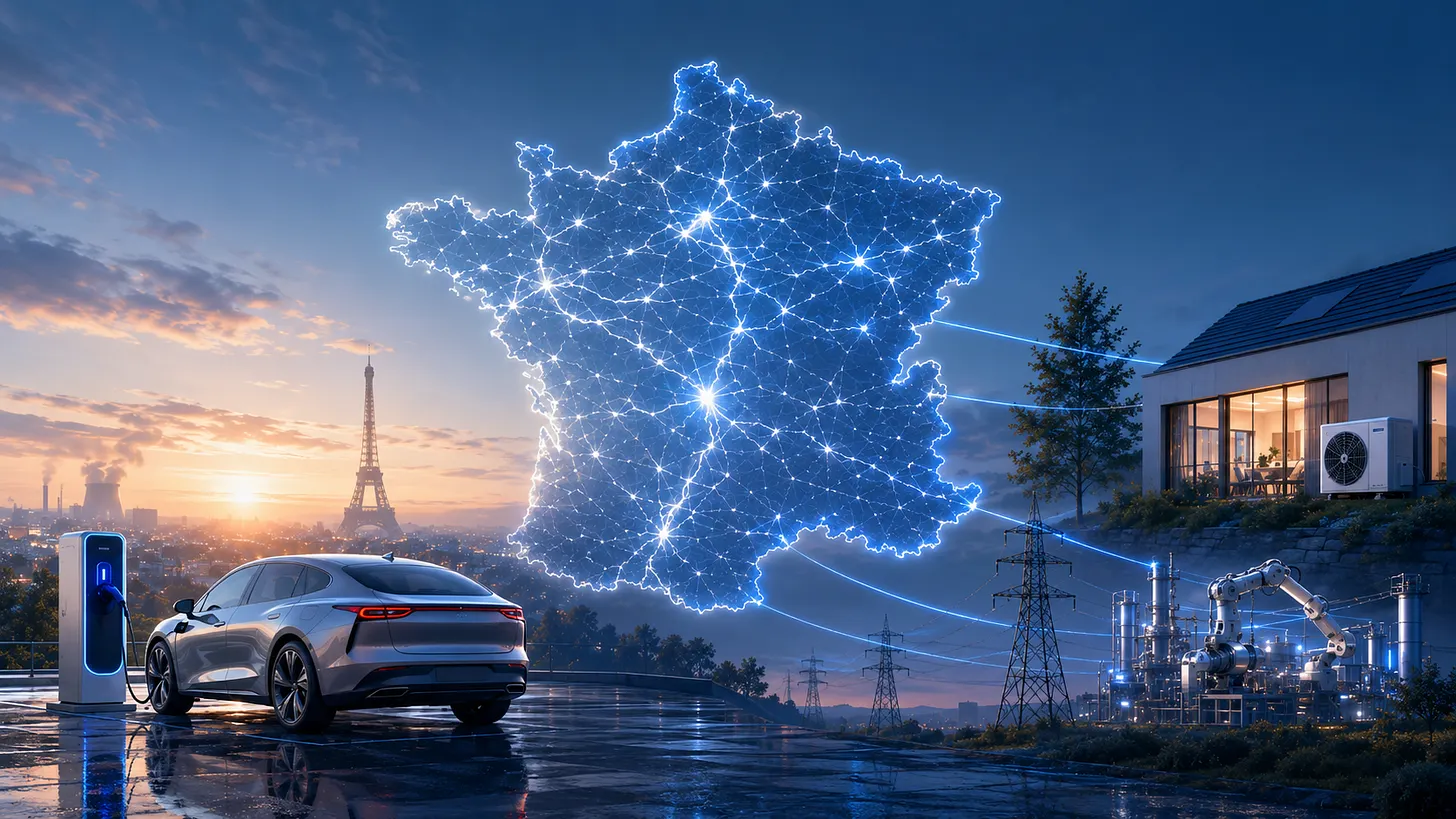
President Emmanuel Macron has signed a national electrification pact that treats power—not molecules—as the answer to France's energy future. The ambitious plan aims to lift domestically produced electricity to 60% of France's energy mix by 2030, a shift that reframes electrification not as climate decoration, but as economic security, industrial strategy, and protection against the fossil fuel price shocks that have battered European households for years.
The reasoning is strategically sound. A country that replaces imported oil and gas with domestically produced low-carbon electricity gains multiple advantages at once: lower emissions, insulation from global fuel price volatility, tighter control over its own energy system, and new industrial possibilities. France is uniquely positioned to make this argument because its electricity system is already heavily decarbonized by nuclear power, with renewables steadily adding more low-carbon supply.
The scale of the commitment is substantial. The French government will double public support for electrification to €10 billion per year through 2030, funding initiatives across power generation, heating, transport, and industry. The government claims the push will create or maintain more than 600,000 jobs. The concrete targets show the breadth of ambition: France plans to deploy one million heat pumps annually by 2030, is moving against gas heating in new buildings, is restarting social leasing programs for electric vehicles targeting high-mileage lower-income drivers, and is supporting charging infrastructure, domestic EV production, grid expansion, and industrial electrification.
What makes this plan strategically different from much energy policy is what it explicitly rejects. Instead of debating which imported molecule to subsidize or rename—whether LNG becomes "transition fuel," hydrogen becomes "strategic," or synthetic fuels keep old combustion pathways alive—France is choosing direct electrification where it works. Heat pumps move several units of heat for each unit of electricity consumed. Battery-electric vehicles convert far more input energy into motion than combustion engines do. Electric industrial heat increasingly works across wider temperature ranges. Electric rail, buses, ferries, delivery vehicles, and warehouse systems all eliminate the need for new fuel chains entirely. Direct electrification wins because efficiency compounds the economic case.
Yet the plan faces a hard test: the 2030 timeline. A significant shift in final energy mix within six years is theoretically possible but operationally demanding. Heat pump supply chains must scale rapidly. Installation capacity must expand dramatically. Thousands of electricians and technicians need training. EV charging infrastructure must keep pace with vehicle adoption. Industrial firms require long-term power contracts and reliable grid connections. Distribution networks need reinforcement. Permitting processes must accelerate to industrial speeds. Buildings are diverse and often old, requiring tailored approaches. Trucking sectors and industrial sites do not electrify simply because a national pact has been signed—they move when economics, supply chains, infrastructure, financing, and customer confidence align.
The plan's strength lies in its diagnosis: fossil fuel dependence is a genuine economic and security vulnerability. Its coherence lies in pursuing electrification across heat, transport, industry, grids, and generation simultaneously. Its vulnerability lies in asking an interconnected system to transform at a pace that historically has been difficult to sustain. What France gets right is the direction. Whether it gets the timing right depends on execution that extends far beyond policy announcements.