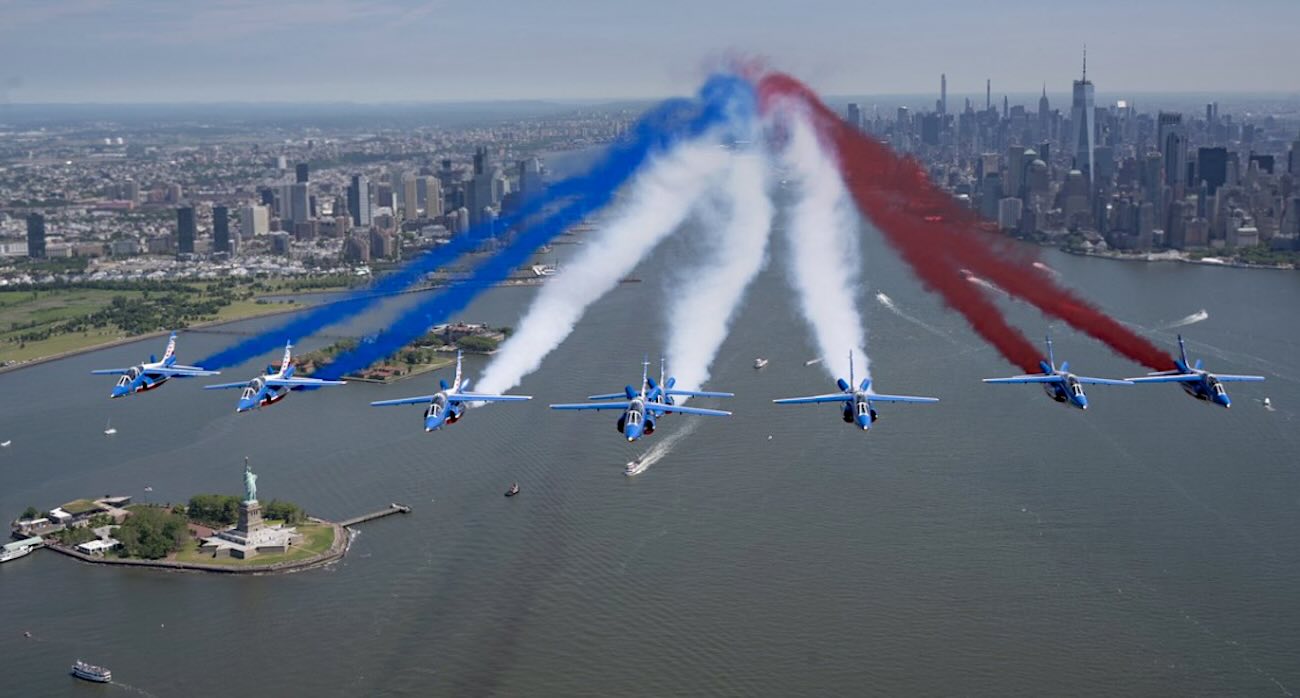
The skies above New York City shimmered red, white, and blue on Tuesday as France's precision aerobatics team, the Patrouille de France, traced a patriotic tribute across the Hudson River. The flyover marked the launch of Mission #Liberté250—a month-long celebration of America's 250th anniversary and a bold declaration that the alliance between these two nations remains as vital now as it was a quarter-millennium ago.
The symbolic power of that moment, captured by the Embassy of France and shared across the world, points to a historical truth many Americans take for granted: without France, there might be no United States at all. The connection runs far deeper than the Statue of Liberty, that bronze gift from Paris presented on July 4, 1884, to mark the centennial of American independence. It reaches back to the very moment the Declaration of Independence was drafted in 1776—a document fundamentally designed, as historian Thomas Paine explained in his January 1776 bestseller Common Sense, as a "call to arms" to French King Louis XVI. The colonies needed a formal declaration of sovereignty to transform their rebellion from an illegal insurrection into a legitimate war between nations, the only scenario under which France could legally intervene without inviting British wrath.
France moved with stunning speed and secrecy. On May 2, 1776—even before the Declaration was signed—King Louis XVI authorized one million livres to purchase munitions for the Americans. By June 1776, the French government had orchestrated something audacious: a fictitious trading company that became a covert supply line, channeling gunpowder, muskets, tents, and uniforms to George Washington's Continental Army while maintaining the official facade of neutrality. That lifeline proved decisive. An estimated 90 percent of American troops at the pivotal Battle of Saratoga carried French firearms and depended entirely on French gunpowder. Without those shipments that summer, the revolution likely would have collapsed into a failed rebellion.
But material support alone cannot explain the intimacy of what emerged between these nations. The Marquis de Lafayette embodied it. The 19-year-old French aristocrat arrived in 1777 ready to serve without pay, a stark contrast to other foreign officers who demanded high salaries and immediate rank. When Lafayette was shot in the leg at the Battle of Brandywine while rallying retreating American soldiers, Washington responded with a gesture that would define their relationship: he ordered his personal surgeons to treat the young Frenchman as if he were Washington's own son. That winter, Lafayette shared the frozen misery of Valley Forge with Washington's troops, cementing what became a lifelong father-son bond.
In 1780, having lobbied the French king for massive reinforcements, Lafayette returned with news that changed everything: General Rochambeau was bringing 6,000 French soldiers to fight under Washington's direct command. Washington's trust in his young friend ran so deep that in 1781, he granted the now 23-year-old Lafayette independent command of Virginia—a decision that led to the strategic brilliance of Yorktown and the final, decisive victory.
"250 years of shared history," French President Emmanuel Macron observed, watching the aerobatic display. Today's celebration honors not just what these nations accomplished together, but the human bonds—forged in hardship and sealed in blood—that transformed two distant peoples into enduring allies.