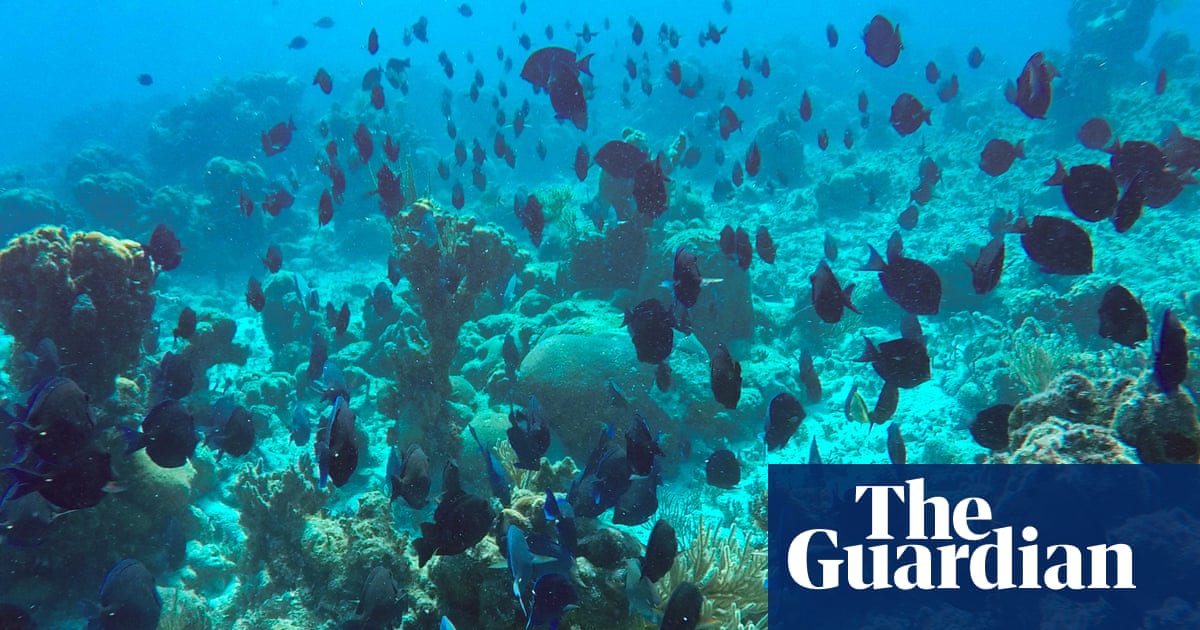
On a morning in Ciénaga de Zapata, a sprawling biosphere reserve in southeastern Cuba, volunteer divers slip into the Caribbean to collect what the island's economy cannot afford to ignore: plastic bottles, aluminum cans, and marine debris sinking toward some of the world's most pristine coral reefs. In just a few hours of cleanup at Playa Larga, they fill five sacks with trash—a small act of care that speaks to something larger happening across this island nation. While economic scarcity and a decades-long US blockade have starved Cuba of fuel, equipment, and scientific resources, its marine scientists and community conservationists refuse to abandon their reefs.
The stakes have never been higher. Coral cover across the entire Caribbean has plummeted by 48 percent since 1980, according to the Global Coral Reef Monitoring Network. What once seemed like an abstract global crisis became urgent and personal in 2023, when stony coral tissue loss disease and intense bleaching events swept across Cuban waters, destroying corals that had resisted such devastation for years. For decades, Cuba's isolation had been its reef's unlikely shield: limited industrial pollution, minimal oil spills, restricted maritime traffic, and long-standing agroecological farming practices meant Cuban coral ecosystems faced fewer direct human threats than their neighbors. But climate change and disease know no embargo.
"Compared with other places, we don't have major polluting sources," says Marileidy Albertus, a specialist in exotic and wild species at the National Aquarium in Havana. "We don't have big industries, oil spills are almost nonexistent, maritime transport is also limited, and for many years, agroecological practices have been implemented." Yet this natural advantage is unraveling. When 2023 brought coral tissue loss disease and bleaching to Cuban reefs—likely carried on international shipping routes—the Cuban government was forced to adopt emergency conservation policies.
The real challenge isn't ignorance or apathy. It's scarcity. At the National Aquarium, scientists manually pump oxygen into fish tanks during power cuts. They cannot easily access equipment manufactured in the US or imported through American companies. Scientific journals are difficult to obtain. NGOs struggle to fund Cuban researchers or send them to international conferences. The US oil blockade has meant less fuel for monitoring projects, less capacity to patrol against illegal fishing, and less mobility for volunteers traveling long distances to conservation work.
Yet Cuba's scientists and divers have turned constraint into ingenuity. Luis Mesa, a conservationist scuba diver in Ciénaga de Zapata, describes their predicament with a striking metaphor: "With scuba diving gear there are so many possibilities: you can go deeper and stay underneath the water for longer. But to protect the ecosystem, our resources are limited." So they adapted. Marine biologists at the National Aquarium now use freediving techniques to conduct experiments at 17 metres depth, swimming from their workplace to study coral restoration and resilience. A growing network of local conservationists—some, like Jorge Sánchez, who transitioned from military to recreational diving—monitor reef conditions and report findings to researchers, extending the reach of professional science through community commitment.
Daniel Whittle, director of the Resilient Caribbean initiative and an expert in US-Cuban environmental law, calls the US strategy toward Cuba "extremely misguided and self-defeating." Cuba contributes negligibly to global climate pollution yet stands as an island nation profoundly vulnerable to its consequences. The reefs they protect are common resources that benefit the entire Caribbean and the world. As volunteer divers continue filling sacks with plastic, as scientists continue experimenting with the tools they have, Cuba's conservation movement offers a quiet rebuke to the idea that environmental protection requires abundance—or that environmental damage respects political boundaries.