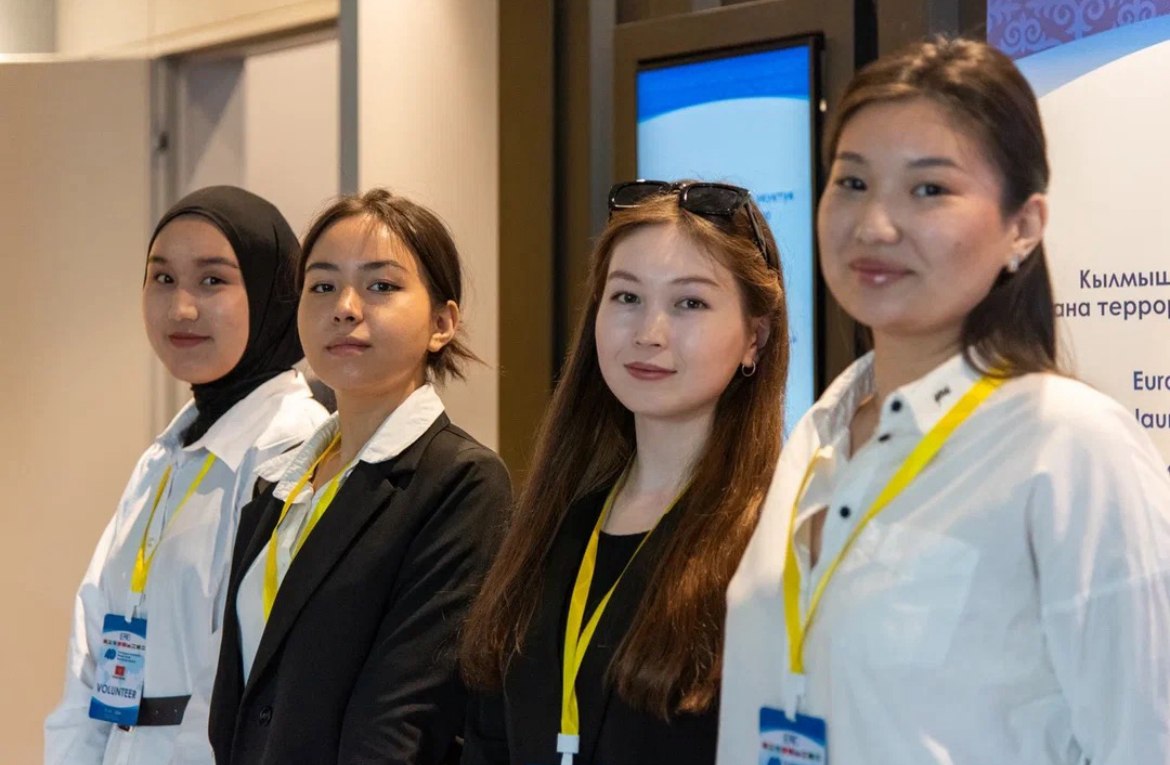
In 2017, a student named Bekbolot Stalbekov had a simple idea: give young people in Kyrgyzstan a place to develop beyond the classroom. What began as a small group of university volunteers has become something far larger—a nationwide movement that is reshaping how young people across the country see their role in society.
The story of Active Volunteers reflects a broader transformation happening in Kyrgyzstan. Nearly 100 youth and volunteer organizations are now active across the country, according to data from UN Volunteers. In 2023, the government formalized this momentum by adopting a law establishing the legal basis for volunteer activity. That same year, the Ministry of Culture, Information and Youth Policy was named Kyrgyzstan's focal point for the International Year of Volunteers 2026—a recognition of how far the sector has come.
Aruuke Karmyshakova, executive director of Active Volunteers, has watched this transformation firsthand. What started as a platform where students could "try themselves in real projects" and gain practical experience has evolved into a comprehensive foundation working across charitable assistance, education, culture, and civic engagement. The organization now supports young people developing skills in science, art, media, leadership, and ecology—each participant encouraged to unlock their potential while contributing to the country.
The volunteers themselves have changed dramatically. Before 2023, most were university and college students. Today, Karmyshakova notes, the picture has shifted noticeably. School students as young as 13 or 14 now volunteer alongside university students, young professionals, and middle-aged people. Everyone finds their own niche, from educational projects to cultural events to social work. What unites them is something simpler: what Karmyshakova calls "a sincere desire to contribute to the development of Kyrgyzstan."
The reasons young people are stepping forward run deep. Many see volunteering as far more than charity—it is a powerful source of experience, networking, and a way to step outside their comfort zones. They want to influence what happens around them and see real results. There is also a growing understanding that volunteering is an investment in oneself, building leadership, communication, project management, and teamwork skills valued in both education and careers. For many, it is about finding meaning and becoming part of something bigger than themselves.
Active Volunteers' work with international projects illustrates the real-world impact. Team members including Malika Baibolotova, Nurzhigit Kazygulov, Sofya Khurshudova, and Elaman Zhusupov are participating in the "Strong Youth – Strong Country" program, funded by the European Union and UNICEF through the Civic Participation Foundation. They are undergoing regular training that will continue until 2027-2028, preparing them to establish and implement their own initiatives.
One vivid example came during the international Meikin Asia festival, where Active Volunteers fielded not only a main team but a dedicated group of translators working in English, French, Spanish, and Uzbek. These volunteers accompanied foreign artists everywhere—to hotels, soundchecks, backstage areas, and official receptions. Many have kept in touch with the artists and received personal invitations to other countries. "Such experience is priceless," Karmyshakova reflects.
As Kyrgyzstan looks toward 2026, the volunteer sector faces real challenges, particularly around sustainable funding. Yet the transformation from a 2017 student idea into a movement engaging nearly 100 organizations suggests something more durable is taking root—a generation of young people who have discovered that contributing to their country is not burden, but opportunity.