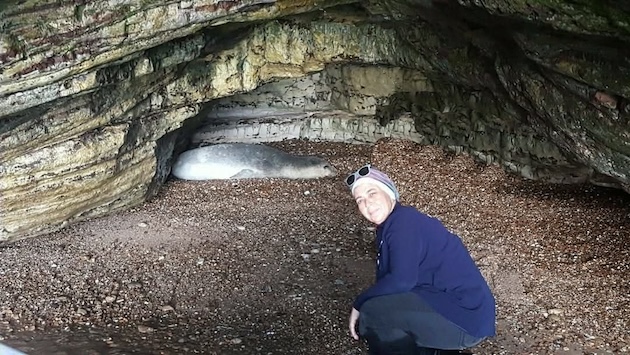
At the Raouche cave in Beirut, where Lebanon's sole population of Mediterranean monk seals once thrived, Iffat Rachid Edriss spent three decades pursuing a singular mission: keeping her country's coastline and seas alive. She organized cleanups, conducted research, and coordinated rescues of turtles, dolphins, and seals. Through wars, economic collapse, and relentless environmental pressure, her work persisted through sheer community determination. "We worked very hard and kept our land and marine litter-free," she says. Then, in a matter of days, the Israel-Hezbollah war transformed everything.
"The weapons, the attacks and the destruction, the debris and litter everywhere, the trees were gone and the soil is contaminated," Edriss recalls. The environmental devastation forced her to shift her mission entirely. Now, speaking at the 71st Council Meeting of the Global Environment Facility in Samarkand, Uzbekistan in June, she carries a new message: communities emerging from conflict need rapid, direct funding to restore what war has shattered. "In normal times, we do not need a penny from anyone, but we have been thrown into a different situation now. Now we need support – to restore our land, our water and our environment," she told IPS.
Her story echoes a broader crisis that civil society organizations gathered at the GEF meeting are raising with urgency. Communities facing environmental emergencies—from war zones to climate-impacted regions—struggle to access the very funding mechanisms created to support them. Before the conflict, Edriss's team had developed an innovative approach to marine pollution by incorporating collected marine litter into construction materials. Working with the American University of Beirut, they proved that construction materials could safely incorporate 5 to 10 percent marine litter, simultaneously reducing demand for natural gravel and clearing debris from the sea. That innovation now pales against the scale of current need. "Now there are weapons, chemicals and heavy metals. This will cost billions," she says. "We need to work on soil and water restoration and greening Lebanon."
The urgency intensifies as countries negotiate contributions to GEF-9, the facility's next four-year funding cycle covering 2026 to 2030. According to Faisal Parish, Chair of the GEF Civil Society Organization Network, current pledges total 3.9 billion dollars, with hopes of reaching at least 4.5 billion. Yet for civil society representatives, fund size tells only part of the story. "How that money will be dispersed and how quickly and whether it will reach the right levels—those are the key questions," Parish explains.
The funding process involves multiple stages: concept development, council approval, project design, and implementation through UN agencies and development banks. These safeguards aim to ensure accountability but create delays that leave communities waiting. "Some entities do not have easy mechanisms to give money directly to civil society," Parish notes. The problem deepens in countries where national institutions lack reach into local communities, leaving the most vulnerable populations furthest from support.
The gap is particularly acute for Indigenous Peoples and Local Communities, who must lead biodiversity efforts to meet global targets. Although GEF-9 includes a target that at least 20 percent of funding reach these groups, progress lags dangerously. "We are already getting closer to 2030, and no significant funding is flowing yet into our territories," says Giovanni Reyes, who leads the GEF Indigenous Peoples Advisory Group. As climate breakdown and conflict continue reshaping the planet's ecosystems, voices like Edriss's and Reyes's are calling for something radical: cutting through the intermediaries and layers that delay help, allowing funds to reach the people actually restoring the land.