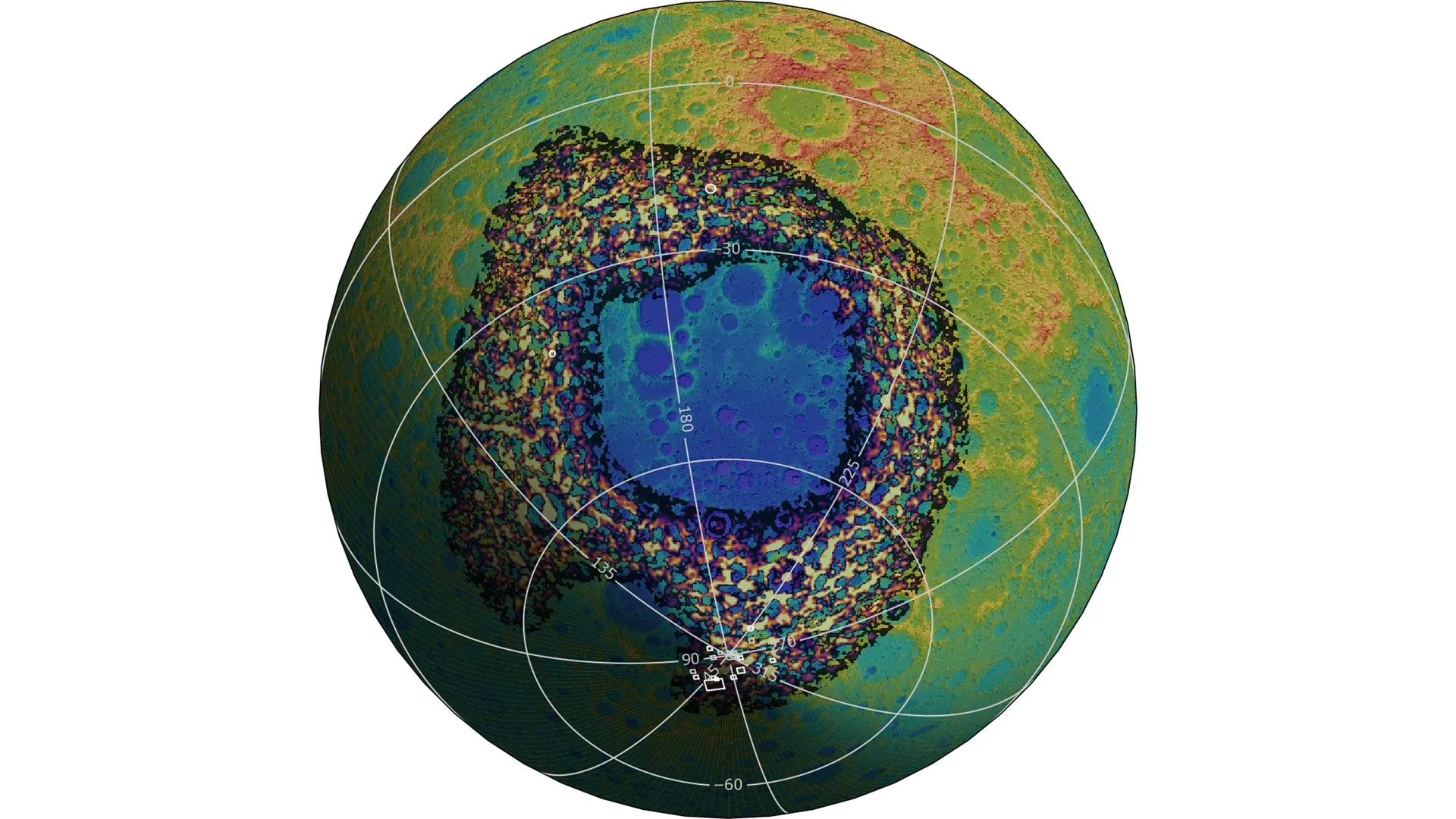
When Shigeru Wakita ran the simulation, the screen filled with a slow-motion cataclysm: a southward-traveling iron-rich projectile, twice the size of Mount Everest, striking the Moon at a shallow angle 4.3 billion years ago, carving out a scar 2,500 kilometers long and blasting deep into the lunar mantle. This moment, recreated in vivid detail by researchers at the Center for Lunar Origin and Evolution (CLOE), is now reshaping how scientists understand the Moon’s most ancient wound—the South Pole-Aitken (SPA) basin—and where future Artemis astronauts might find rocks from the Moon’s hidden interior. Spanning nearly a quarter of the lunar surface and buried in time, the SPA basin has long been a geological enigma. But thanks to two new studies, it’s emerging as a treasure map to the Moon’s deep past.
The basin, located on the Moon’s far side, is one of the oldest and largest impact structures in the solar system. For decades, scientists have debated how it formed and whether it could have exposed material from the Moon’s mantle—the rocky layer beneath the crust. Now, advanced simulations led by Dr. Wakita of Purdue University reveal that the impact came from a differentiated body—an early protoplanet with a dense iron core—slamming into the Moon from the north and traveling south at a mere 30-degree angle. This low-angle collision not only explains the basin’s elongated, teardrop shape but also suggests that the impact was powerful enough to excavate vast amounts of mantle material, hurling it across the lunar surface.
In a companion study, Dr. Gabriel Gowman of the University of Arizona and his team used high-resolution gravity data from NASA missions to trace where that deep material landed. Their models show that mantle-derived rock is not buried beyond reach but likely mixed into the ejecta blanket surrounding the basin—and possibly within reach of future explorers. Crucially, some of these deposits may extend into regions near the lunar south pole, where NASA plans to land Artemis astronauts in the coming years. "Our models indicate that the SPA impact ejected enough deep material to form a significant deposit that should still be accessible today," said Dr. William Bottke of Southwest Research Institute, a co-author on both studies.
This convergence of impact modeling and gravity analysis offers more than just a scientific breakthrough—it’s a practical guide for exploration. If astronauts can collect even trace amounts of mantle material, they could unlock secrets about the Moon’s formation, its internal structure, and the violent early history of the solar system. The findings, published in Science Advances and the Journal of Geophysical Research: Planets, transform the SPA basin from a distant curiosity into a reachable destination. As humanity prepares to return to the Moon, the rocks beneath astronauts’ boots may not just be lunar surface debris—they could be fragments of the Moon’s very heart, waiting to tell their story.