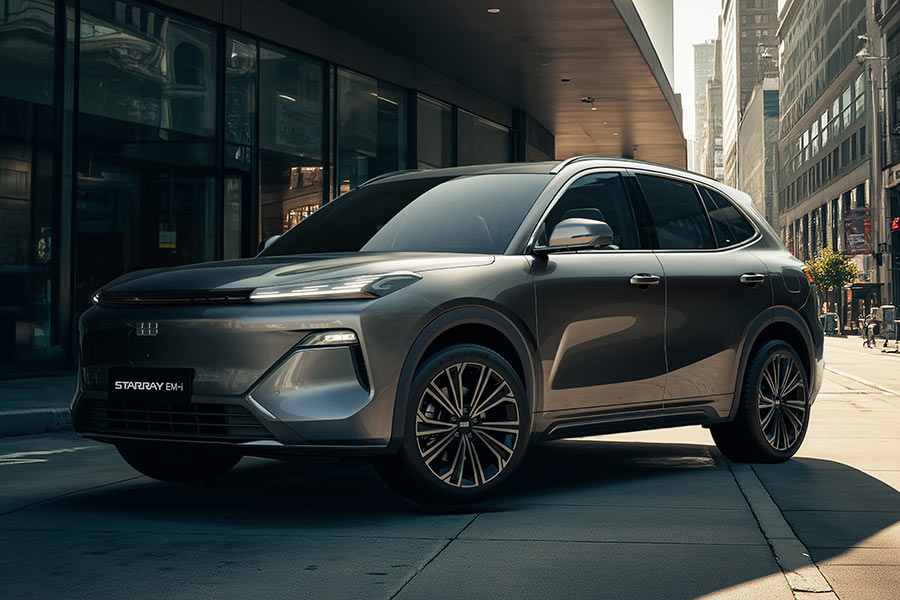
At a testing facility in France, a Geely Starray EM-i electric vehicle collided with a rigid pole at 60 kilometers per hour—not just once, but as part of a two-stage crash test that pushes far beyond what European safety standards currently require. This deliberate choice to exceed compliance speaks volumes about how Chinese automakers are reshaping perceptions about electric vehicle safety in Europe.
For years, European and American consumers have voiced concerns about the safety of Chinese-made electric vehicles. Yet this skepticism often overlooks a simple fact: Chinese automakers must meet rigorous European and U.S. safety standards to sell in those markets, and they have consistently performed well in official testing. Still, perception lags behind reality, and Geely has decided not merely to match competitors but to demonstrate superiority through innovation.
The test itself reveals engineering ambition. A moving deformable barrier strikes the vehicle's side at 60 km/h, forcing it into the rigid pole on the opposite side—simulating the kind of severe, multi-vehicle chain collision that happens on real roads. The challenge tests three critical systems simultaneously: the vehicle's structural integrity, airbag deployment algorithms operating at millisecond precision, and battery protection systems unique to electric vehicles. When the test concluded, the Geely Starray EM-i had maintained an intact passenger cell. The restraint systems deployed with pinpoint accuracy, the e-CALL emergency system triggered instantly, and the doors unlocked automatically—a cascade of safety features performing exactly as engineered.
What made this test noteworthy was its context. Geely was the sole automaker invited to conduct a live safety demonstration during the "Automotive Safety Tech Globalization & Innovation in the Smart Driving Era" summit, co-hosted by the China Automotive Engineering Research Institute and UTAC (Europe's testing authority). As Europe's first-ever side-impact test combined with a far-side rigid pole intrusion, it represents a test protocol more severe than the current Euro NCAP standard—deliberately compounding difficulty to replicate real-world complexity.
This move signals a deeper confidence in electric vehicle architecture. Geely has accumulated three decades of automotive manufacturing experience and frames safety as its foundational philosophy: "Consumer First, Safety First." The company has achieved five-star ratings across C-NCAP, Euro NCAP, ANCAP, ASEAN NCAP, and C-IASI—eight recognized safety assessment bodies in all. Beyond testing, Geely has opened critical safety patents to industry peers, including one-touch window-breaking technology and underbody battery protection systems, positioning itself as a collaborative force in raising safety standards across the sector.
The company has also woven artificial intelligence throughout its safety architecture. Its Comprehensive Safety System 2.0 represents a shift from traditional "vehicle-centric safety" to an ecosystem-wide perspective spanning "People-Vehicle-Road-Cloud-Satellite," anchoring what Geely describes as four distinct zero-accident mobility visions. Whether through AI-enhanced crash prediction or cloud-connected emergency response, the strategy suggests that vehicle safety in the electric age extends beyond metal and glass to digital systems and data networks.
Whether this demonstration changes consumer minds remains uncertain. Perceptions built over years shift slowly, and skeptics may question any self-conducted test. Yet objectively, what Geely has done—voluntarily exceeding requirements, opening patents, and investing in safety infrastructure that benefits competitors—represents a genuine commitment to proving that Chinese electric vehicles belong on European roads with equal confidence to any vehicle built elsewhere.