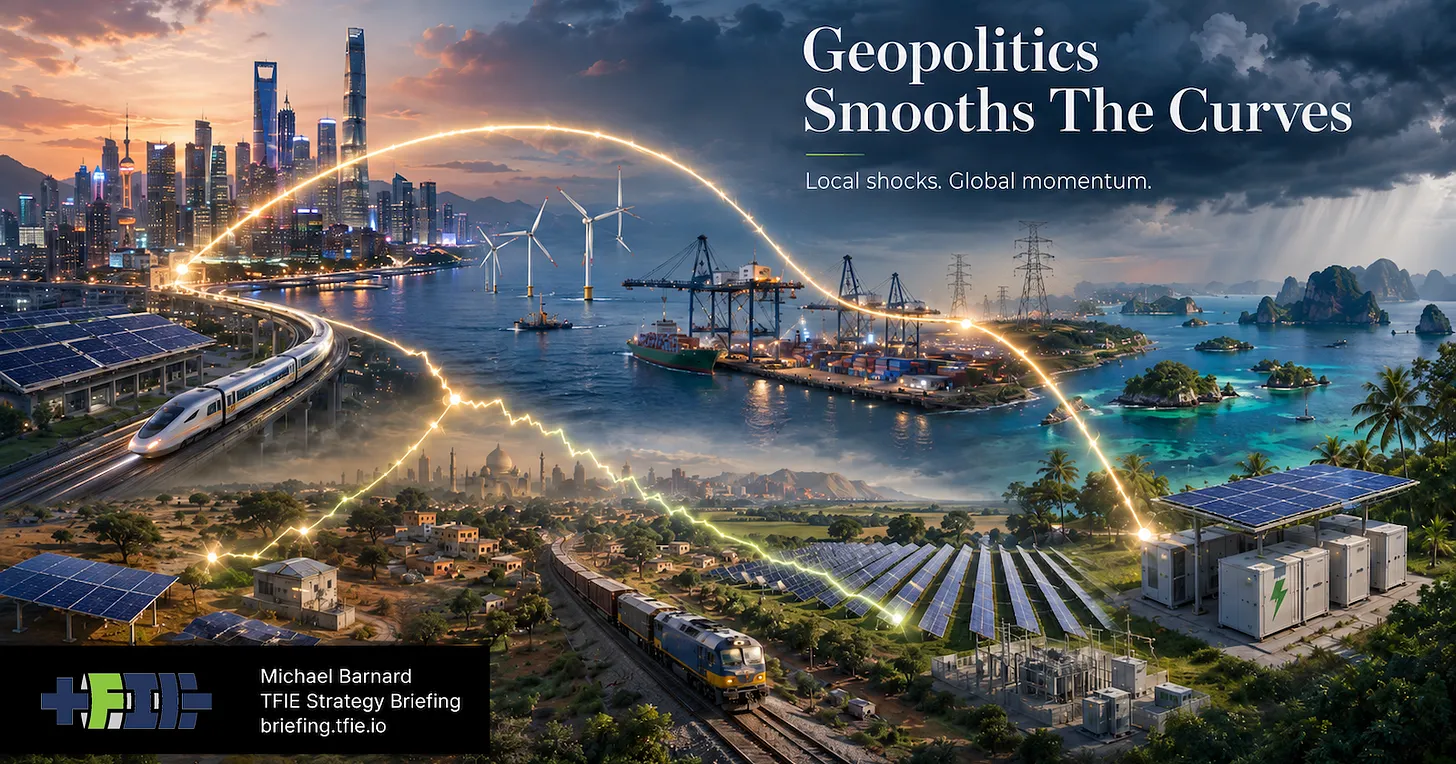
When India’s Rewa Ultra Mega Solar Park began feeding 750 megawatts into the grid—powering Delhi’s metro and displacing millions of tonnes of coal—few outside the country noticed, but the moment captured a truth often missed in global climate conversations: the energy transition isn’t waiting for any one nation to catch up. The shift from fossil fuels isn’t dictated by U.S. election cycles, European permitting delays, or Middle Eastern oil politics. It’s being shaped by the sum of hundreds of national decisions, industrial strategies, and local innovations—some faltering, some surging, but collectively unstoppable. From China’s unmatched solar manufacturing to India’s rapid rail electrification and Africa’s leap into distributed solar, the global curve is being smoothed not by consensus, but by competition, security concerns, and the relentless drop in clean tech costs.
The myth that the world’s climate fate hinges on Western policy is crumbling. While the U.S. may retreat or stall, China installed 300 gigawatts of solar capacity in 2023 alone—more than the total solar power in the U.S. and Europe combined. Meanwhile, India is electrifying 100% of its vast rail network by 2025, a move that will eliminate the need for 24 million tonnes of diesel annually. Europe, despite its fragmented politics and slow permitting, continues to enforce binding carbon pricing and border adjustments that are reshaping global trade. Even smaller nations are acting: Namibia is building green hydrogen hubs, Chile dominates lithium innovation, and Vietnam has become a solar powerhouse almost overnight.
Fossil fuel dependence once tied nations to volatile shipping lanes, price spikes, and geopolitical coercion. Today’s clean energy infrastructure offers a different kind of security—one rooted in durable assets rather than daily fuel imports. A wind turbine doesn’t need to be shipped, insured, and burned; it generates power for decades. But this new system brings its own challenges: supply chain concentration, critical mineral access, and cyber risks. China’s dominance in battery and solar manufacturing, for instance, is a strategic reality, not just an economic footnote. Yet this risk is fundamentally more manageable than the perpetual vulnerability of fossil dependence. Through recycling, diversification, and industrial policy, countries are learning to build resilience into the new energy order.
What’s clear is that the transition doesn’t require global wisdom—just momentum. It’s powered by competition as much as cooperation, by national interest as much as climate concern. And while no single country can steer the entire process, every nation that builds clean infrastructure bends the global curve. The energy future isn’t being decided in one capital. It’s being wired, panel by panel, turbine by turbine, in dozens of them.