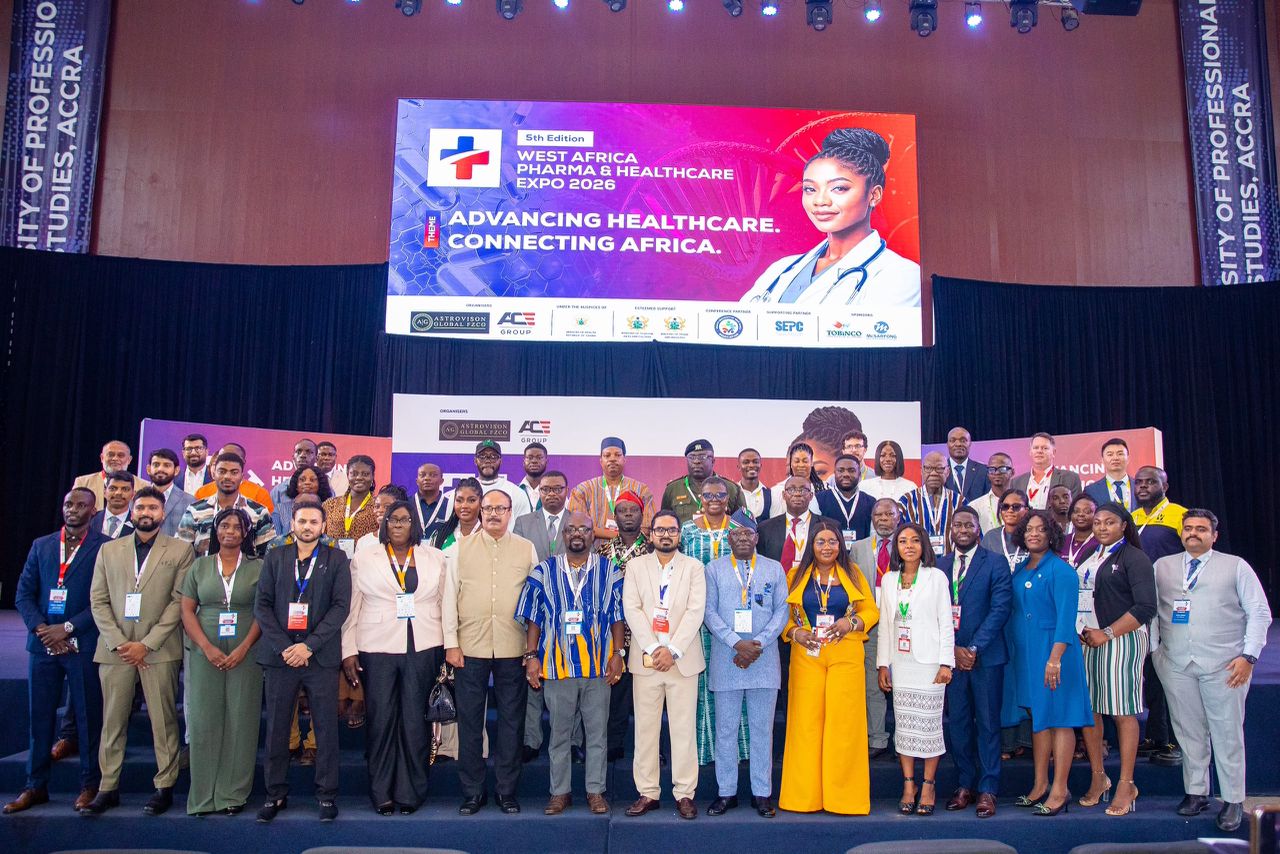
In Accra this week, more than 100 exhibitors from India, Turkey, the United States, Egypt, Italy and Ghana gathered for the 5th West Africa Pharma and Healthcare Expo, drawing between 4,000 and 5,000 professional visitors — the largest and most international in the event's four-year history. The exhibition, organized by Astrovision Global FZCO and ACE Group under the auspices of Ghana's Ministry of Health, signaled something larger than a trade show: a continent stepping forward to claim a different future.
Dr Hafiz Adam Taher, Director of Technical Coordination at Ghana's Ministry of Health, delivered the opening message on behalf of the Minister of Health. His words were direct: Africa has for too long remained a consumer in a health economy designed, produced and controlled by others. "This gathering signals a different ambition – our determination to move from the periphery to the centre of global health innovation," he told delegates, industry leaders and development partners.
The ambition is backed by concrete initiatives. Ghana is pursuing investments in pharmaceutical manufacturing, vaccine production, medical technologies and healthcare infrastructure. The Free Primary Healthcare Programme and the Ghana Medical Trust Fund, known as MahamaCares, aim to remove financial barriers for households facing serious medical conditions. Progress continues toward local vaccine production through the National Vaccine Institute — a goal that Dr Taher said the COVID-19 pandemic made urgent. "We saw what happen when vaccines became available globally. Africa was among the last regions to receive supplies. That is a lesson we cannot afford to forget," he stated.
At the Expo, Ghana found a willing partner in India. Mr V.N Parameswaran, Chargé d'Affaires at the High Commission of India in Ghana, noted that India has become known globally as the "pharmacy of the world" — with one in three tablets consumed in Africa manufactured in India, and more than half of vaccines originating from Indian laboratories. He encouraged participants to build on that relationship through partnerships for local production, knowledge transfer and skills development. "Ghana and India share similar healthcare challenges," he said. "We are here to act."
Mr Praveen Singh, Chief Executive Officer of ACE Group, said the Expo has grown steadily since its inception in 2022, evolving into one of West Africa's leading healthcare exhibitions. "Our biggest competitor is ourselves," he noted. "Every year, we challenge ourselves to do better than the previous year."
The stakes extend beyond commerce. Emerging technologies — artificial intelligence, digital health platforms, biotechnology — are reshaping healthcare delivery worldwide, and Ghana has declared its intention to be an active participant, not a passive observer. "We are committed to moving from discussion to agreements, from ideas to impact, and from decisions to investment," Dr Taher said. For a continent that has waited too long at the back of the line, that shift from words to action may be the most significant measure of success.