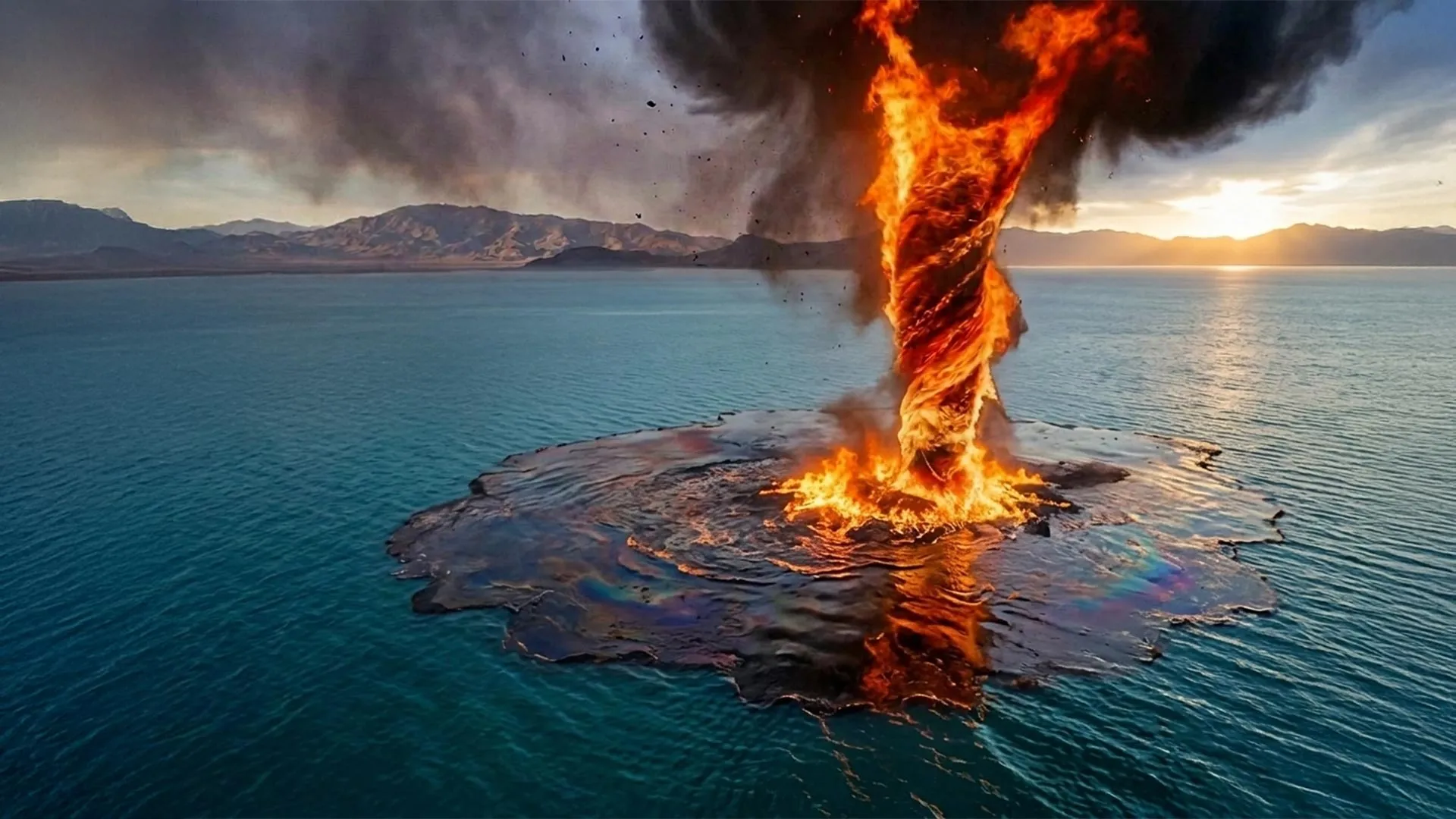
When oil ignites on open water, it's a brutal choice: let the slick spread and choke coastlines, or burn it and fill the sky with toxic smoke. Now researchers at Texas A&M University and UC Berkeley have found a third way—by creating massive spinning columns of flame that burn crude oil nearly twice as fast as traditional methods while cutting soot emissions in half.
The technique, called a fire whirl, resembles a tornado made of fire. It works by drawing in enormous amounts of oxygen through its rotating vortex, creating a hotter and far more efficient flame. The discovery matters because oil spills remain one of the ocean's most catastrophic threats. The 2010 Deepwater Horizon disaster killed eleven workers, devastated thousands of marine animals, and scarred ocean ecosystems across the Gulf of Mexico—a reminder of why speed and efficiency in cleanup operations can mean the difference between recovery and ecological collapse.
Led by Dr. Elaine Oran and Dr. Qingsheng Wang of Texas A&M's College of Engineering, alongside Dr. Michael Gollner of UC Berkeley, the team conducted the first large-scale test of fire whirls for oil spill remediation, with support from the Bureau of Safety and Environmental Enforcement. Their experiment was deliberately ambitious. They built a 16-foot-tall triangular structure with carefully controlled airflow and placed a 1.5-meter-wide pool of crude oil at its center. When ignited at the Texas A&M Engineering Extension Service's Brayton Fire Training Field, the setup generated a fire whirl that reached nearly 17 feet high—orders of magnitude larger than any previous laboratory study.
The results, published in Fuel, were striking. Fire whirls burned crude oil about 40 percent faster than conventional in situ fire pools, cut soot emissions by 40 percent, and achieved up to 95 percent fuel consumption efficiency. That last number matters enormously: traditional burning leaves behind toxic tar-like residue floating on the water. Fire whirls vaporize most of the oil before it can settle, acting like a giant incinerator that destroys the particles responsible for dense smoke plumes.
The speed advantage alone could reshape emergency response. Faster oil removal gives crews critical time to contain spills before they spread into sensitive habitats and protected coastal regions—time that, during a real disaster, can mean protecting entire ecosystems. Oran emphasizes the stakes: "We are looking at environmental disasters like oil spills, and identifying ways to remediate them in faster, greener and more sustainable ways."
Fire whirls remain temperamental. Researchers are still learning to control them reliably and identify what Oran calls the "Goldilocks zone" where conditions produce maximum efficiency. Yet the potential extends beyond spill cleanup. A deeper understanding of how fire whirls form and behave could improve combustion systems, help engineers design more efficient engines, and even aid wildfire prediction and management.
"This is the first time anyone has conceived using fire whirls for oil spill remediation, and it's really just the beginning," Oran said. "Our goal is to harness the chaotic nature of fire whirls as a powerful, precise restoration tool, to protect coastlines, marine ecosystems and the environment as a whole." For a technology that barely existed in practical application months ago, that ambition no longer sounds far-fetched.