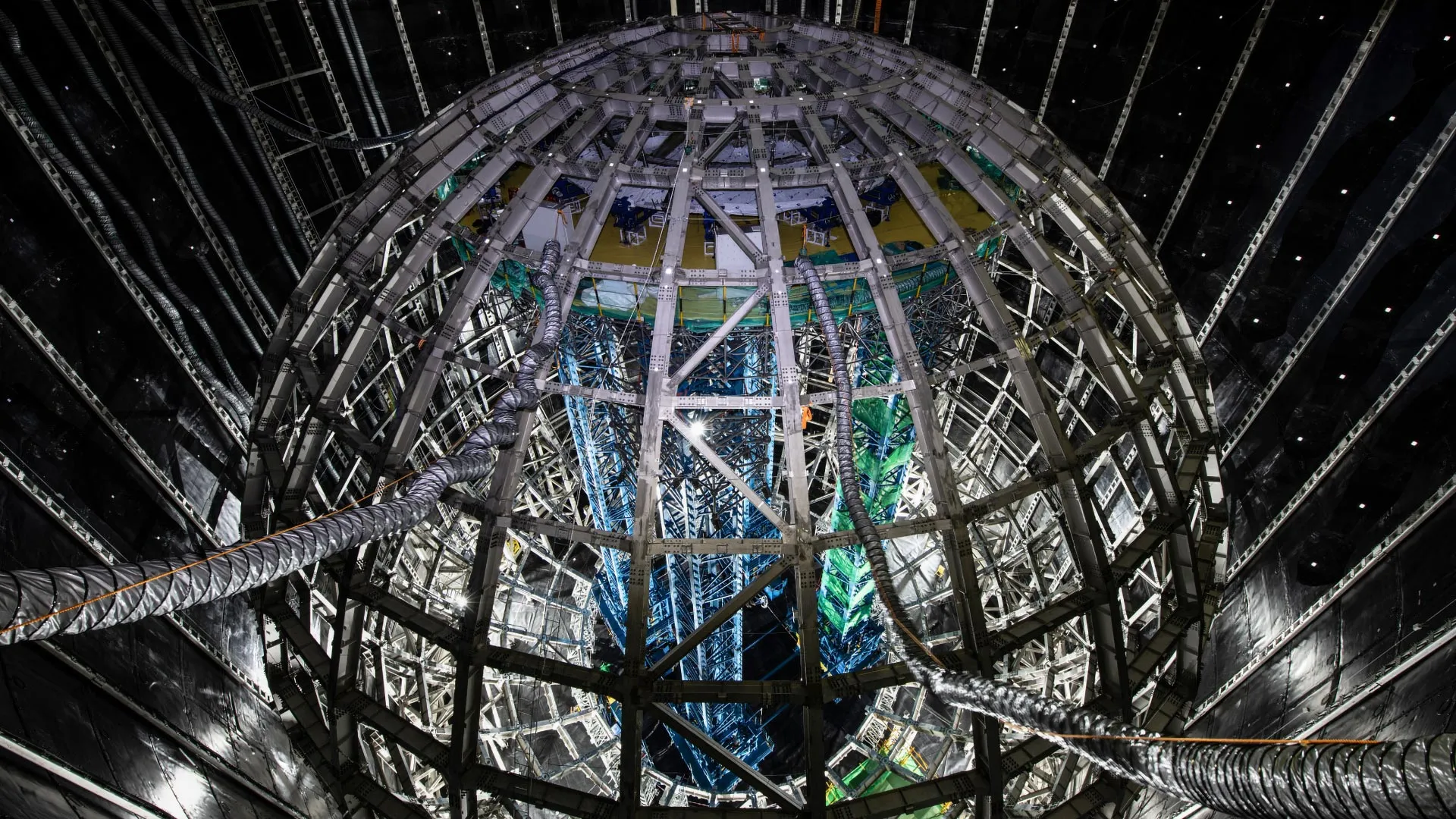
Seven hundred meters beneath the city of Jiangmen in southern China, a monument to scientific patience sits waiting in the dark: a 20,000-ton vat of liquid scintillator, ringed by 45,600 light-sensitive tubes, designed to catch the rarest whispers of the universe. On June 10, 2025, the Jiangmen Underground Neutrino Observatory published its first major finding—a milestone that marks the beginning of a new era in our quest to understand the most elusive particles nature has created.
The announcement arrived as a cover article in Nature, a rare honor that signals the weight of what the international JUNO Collaboration has accomplished. Using just 59 days of data collected between August and November 2025, the team led by the Institute of High Energy Physics of the Chinese Academy of Sciences made measurements of neutrino oscillation parameters with unprecedented precision. Their work reduced uncertainty in these measurements by a factor of 1.6 compared with decades of accumulated results from previous experiments—a leap forward in understanding fundamental physics.
Why this matters is almost philosophical. Neutrinos are among the universe's most mysterious particles. They carry no electric charge, possess almost no mass, and interact so weakly with matter that trillions pass through your body every second without a trace. Because they are so difficult to detect, they remain the least understood of all known elementary particles. Understanding their behavior is paramount to developing a complete description of matter and forces at the smallest scale—as Nature's editors wrote—and essential to answering some of the deepest questions in physics.
JUNO's design is extraordinary. At its heart sits an acrylic sphere 35.4 meters in diameter, surrounded by a water pool 44 meters deep, all housed within a stainless steel structure 41.1 meters wide. When a neutrino occasionally collides with atoms inside the scintillator, it produces a tiny flash of light. The 20,000 large photomultiplier tubes and 25,600 smaller ones detect this faint glow simultaneously, converting photons into electrical signals that researchers can analyze with exquisite precision. By measuring the energy of these rare interactions, JUNO can determine key oscillation parameters and investigate fundamental properties of these elusive particles.
The scientific community has responded with genuine excitement. Prof. Arthur McDonald, who received the 2015 Nobel Prize in Physics for discovering solar neutrino oscillation, noted that JUNO "has met its design objectives, achieving exceptional radiopurity, energy resolution, and detector stability." A Nature peer reviewer called the results a validation that establishes JUNO "as a key player in the emerging precision era of neutrino oscillation physics."
One of JUNO's primary goals is determining the mass ordering of neutrinos—essentially asking whether one type of neutrino is heavier than the others, a question that has eluded physicists for decades. The experiment is also designed to measure three of the six neutrino mixing parameters with better than 1% precision and to study neutrinos from supernovae, Earth's interior, the Sun, and the atmosphere. After nine months of smooth operation, the collaboration expects to release a series of new results beginning this summer, each one potentially bringing us closer to understanding what these ghostly particles can teach us about the nature of reality itself.