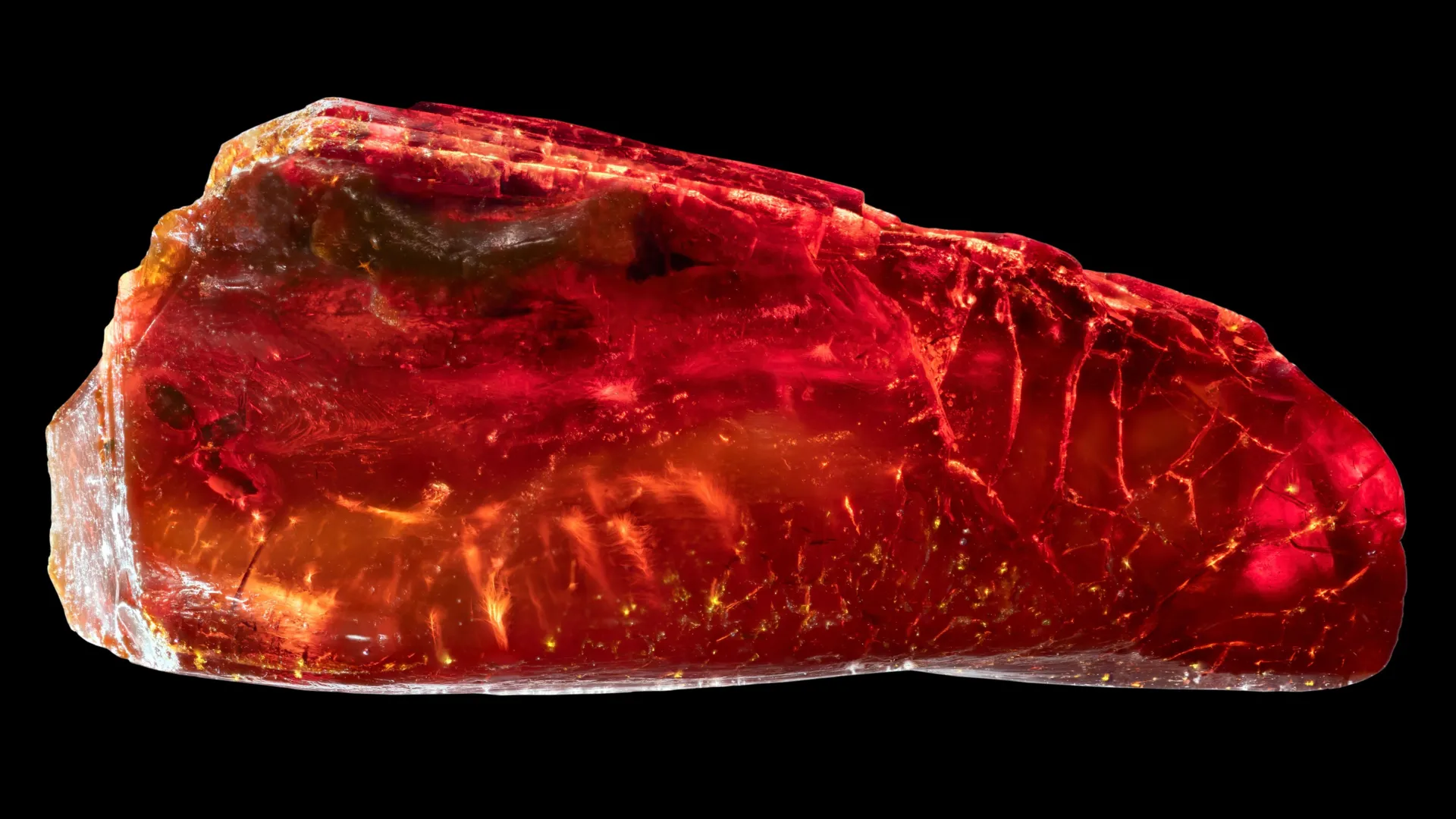
Johann Wolfgang von Goethe never polished the amber pieces in his collection—a decision that unknowingly preserved some of nature's finest secrets for modern science to rediscover. Hidden inside rough, unpolished fragments now housed at the Goethe National Museum in Weimar are three fossil insects frozen in fossilized tree resin for 40 million years, invisible to the naked eye until researchers armed with synchrotron technology brought them into view.
The discovery matters because it demonstrates how historical collections, assembled by curious minds centuries ago, can suddenly become invaluable research resources through technological innovation. Goethe's amber collection of 40 pieces from the Baltic had sat relatively unstudied in this regard, overshadowed by Goethe's own interest in amber's optical properties—he famously ground lenses from fossilized resin to explore color theory. But what Goethe saw as a tool for understanding light, today's scientists see as a window into prehistoric life.
A team from the University of Jena used synchrotron micro-computed tomography at the German Electron Synchrotron (DESY) in Hamburg to create detailed three-dimensional images of the hidden fossils. The scans revealed a fungus gnat, a black fly, and the specimen that captured researchers' deepest attention: an ancient ant belonging to the extinct species Ctenobethylus goepperti, which is quite common in amber but had never been examined with such precision before.
What makes this ant remarkable is not simply that it exists, but what its exceptional preservation reveals. Bernhard Bock from the Phyletisches Museum of the University of Jena explained that the team documented fine body hairs on the worker ant and visualized internal skeletal structures within the head and thorax—anatomical details never before captured at this level of detail. These observations provide crucial new information about the species' anatomy and evolution, enriching our understanding of how ants lived and thrived millions of years ago. The researchers even created a complete three-dimensional digital reconstruction, now available online for scientists worldwide to use for identification and comparison of other fossils from the species.
By comparing the extinct ant with its modern cousin, the North American genus Liometopum, researchers gained insight into how Ctenobethylus goepperti likely lived. The evidence suggests these ancient ants built large nests in trees, which may explain their remarkable frequency in amber deposits—when trees oozed resin, the insects were there to be trapped.
What strikes hardest is that this discovery came from objects Goethe himself handled, curated during an era when the broader scientific importance of these fossils had not yet become clear. Bock reflected that Goethe, regarded as the founder of morphology, would likely have been delighted to witness how modern methods could extract such valuable insights. The findings underscore a simple but profound truth: that objects originating from one person's hand in one era, when a science was merely beginning, can still enrich us deeply when we finally have the tools to understand them.
In an age of rapid technological change, Goethe's unpolished amber reminds us that patience—and the careful preservation of historical collections—can yield unexpected scientific treasures for generations yet to come.