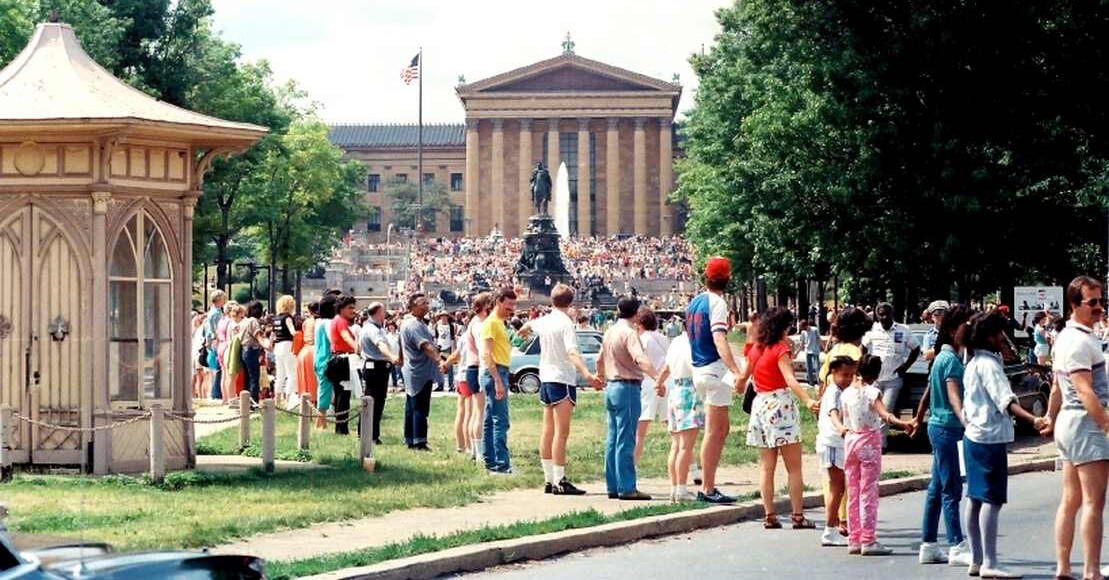
On May 25, 1986, 5.5 million Americans stood shoulder to shoulder in a human chain stretching across the continental United States, united by a simple but audacious idea: that holding hands together could help fight hunger and homelessness. Organized over Memorial Day weekend by Ken Kragen, Hands Across America became one of the largest coordinated fundraising events in American history, proving that ordinary citizens could mobilize en masse for a cause that mattered.
The logistics were staggering. Volunteers were encouraged to donate for their spot in the chain, and organizers hoped to raise tens of millions of dollars. As the event unfolded, participants tuned in on portable radios and boomboxes to a nationwide simulcast broadcast across thousands of radio stations. The lineup leading up to the 3:00 p.m. EDT kickoff included singalongs to "I Want to Hold Your Hand" and "Dancing in the Street"—songs meant to build momentum and connection. When Kragen spoke from New York to instruct participants to join hands, the moment carried symbolic weight that transcended the logistics of the event itself.
The human chain was never quite unbroken. Gaps appeared across the country, particularly in the southwestern desert and other remote areas where fewer volunteers had traveled. Most participants clustered in major cities, leaving stretches of the intended route sparsely populated. But the organizers found a practical solution: ribbons, ropes, and banners filled the gaps, creating a visual representation of collective intention even where physical presence couldn't reach. Mathematically, if the 5.5 million participants had been evenly distributed along the planned route, they would have formed a continuous chain—a detail that underscored how close America had come to a genuinely unbroken national embrace.
For 15 minutes, the nation sang together. Participants joined their voices to "We Are the World," the official song of the event, creating a brief but powerful moment of shared purpose across time zones and communities. Then it was over—a quarter-hour gesture that somehow encapsulated something larger about American possibility.
The real measure of success wasn't the chain itself, though. When organizers calculated the proceeds after operating costs, Hands Across America had raised approximately $15 million for local charities dedicated to fighting hunger, homelessness, and poverty. That money flowed into communities nationwide, translated into tangible support for those facing the most difficult circumstances. In an era before social media, before viral campaigns could mobilize millions with a hashtag, this event demonstrated that Americans would show up in person, donate their time and money, and participate in something that existed more as metaphor than as logistical necessity.
Forty years later, Hands Across America remains a singular moment in American philanthropy—not because it solved homelessness or hunger, but because it captured a particular kind of hope: the belief that ordinary people, joined together physically and spiritually, could make a concrete difference in the lives of their neighbors.