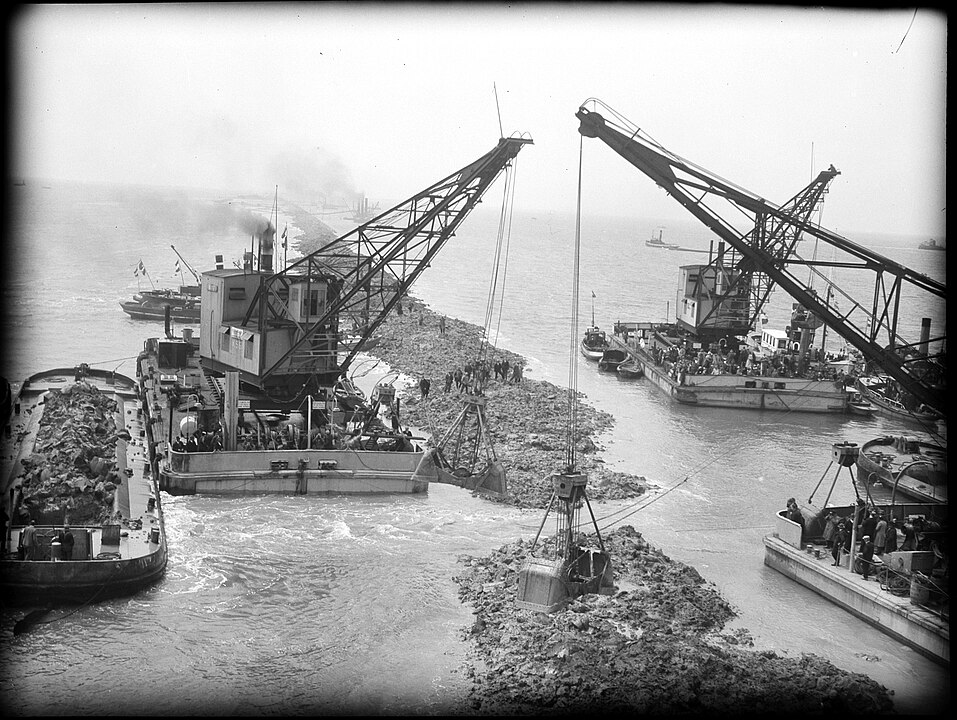
In 1932, ten thousand workers, 27 dredges, 13 floating cranes, 132 barges, and 88 tugs converged on a narrow gap in the Dutch landscape for a race against the tide—the final, frenetic hours of the Afsluitdijk, a dyke that would transform one of Europe's most ambitious engineering visions into solid ground.
The Afsluitdijk represents something profound about human ingenuity and necessity converging at precisely the right moment in history. For centuries, the Dutch had perfected the art of reclaiming land from water, turning wetlands into polder farms. But in the early twentieth century, they faced a new imperative: the North Sea Canal, built decades earlier, had made the old route to Amsterdam through the Zuiderzee obsolete. The shallow bay had been overfished to depletion, and with the Dutch population surging, land was becoming desperately scarce. The 1916 flood and the 1918 famine crystallized opinion—something had to change.
It took nine years of deliberation and parliamentary debate, but in 1927, the work finally began. Workers started by depositing till into open water, watching it breach the surface grain by grain until a skeleton of a dyke emerged. They reinforced it from the land side with basalt rocks and willow-switch mats, layering sand on top, then clay and grass, building upward with each passing month. The engineering was meticulous, but the finish line demanded something more volatile: timing and force.
By late May 1932, with only one narrow gap remaining, the pent-up power of the North Sea bore down on that final opening with tremendous force. The workers and their machinery—the dredges churning, the cranes swinging, the tugs and barges ferrying material—had to close the gap before the tide rose again. They worked frantically in that low-tide window, desperate to seal the divide. Silent video footage captured the moment: the sheer scale of effort, the raw mechanical choreography, the sea being pressed back by human determination.
What emerged was nothing short of transformative. The Zuiderzee, once a salt-water bay of Zuiderzee measuring over 1,400 square kilometers, became IJsselmeer, a freshwater lake. But the real legacy lay in the land that would follow: the province of Flevoland, entirely new territory carved from what had been open water, stretching across 1,410 square kilometers of farmland. It was the creation of an entire Dutch province—the twelfth—born not from conquest or discovery but from engineering and will.
The Afsluitdijk stands today as both monument and lesson. It speaks to an era when newly mechanized societies believed they could reshape nature itself, a confidence that feels distant in our current age. Yet it also embodies something timeless: the power of communities to undertake massive collective projects when necessity and vision align. The dyke still carries traffic across its 32 kilometers, still holds back the sea, still anchors an entire landscape that would not exist without it. Nearly a century later, those ten thousand workers, those 88 tugs and the tons of till and stone, remain present in every field that grows where water once moved.