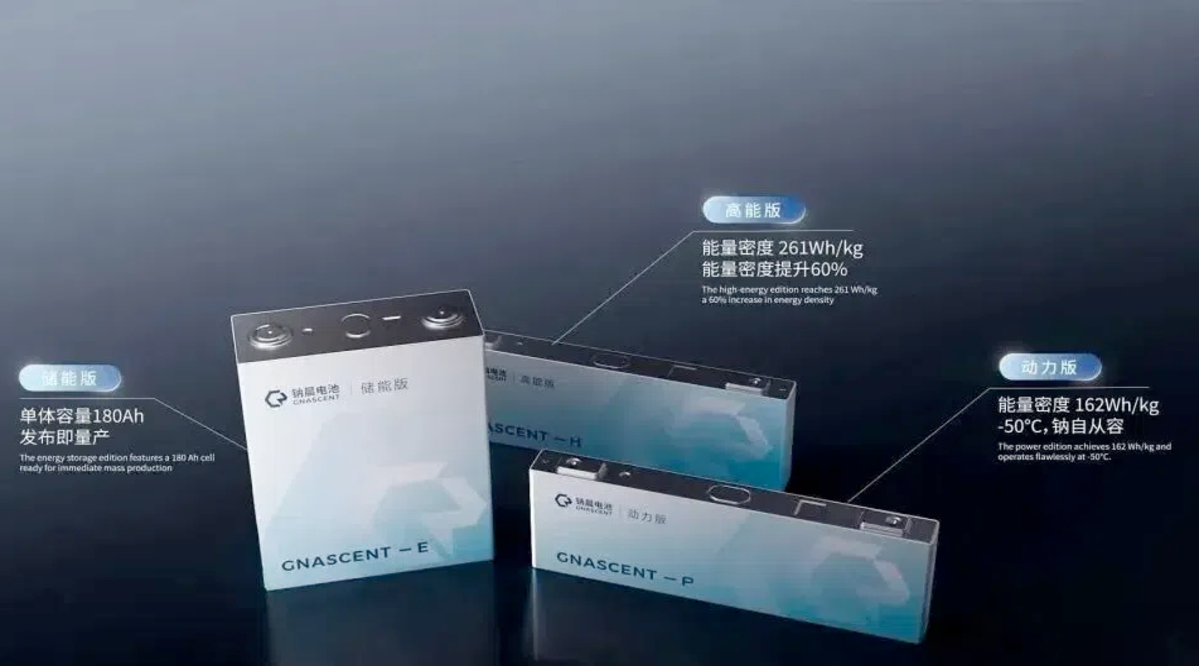
On a stage in China this week, engineers at Gotion High-Tech unveiled three sodium-ion batteries that challenge everything people thought they knew about this emerging technology — and set the stage for a wholesale reimagining of how electric vehicles might be powered in years to come.
Sodium-ion batteries have long been the understudy in the energy storage world. They lack the energy density of lithium-ion alternatives and have been dismissed by skeptics as too heavy for serious automotive work. But the chemistry has profound advantages: sodium is abundant and cheap, manufacturing carries far less fire risk, and the batteries perform beautifully in freezing cold. As climate pressures and supply chain vulnerabilities mount, the case for sodium grows stronger every month. Yet that density problem remained a stubborn barrier — until now.
Gotion, the Chinese battery maker backed by Volkswagen Group, announced this week at the 15th Global Technology Conference that it is ready to begin mass production of three specialized sodium-ion variants under its new Gnascent brand. The high-energy version achieves a remarkable 261 Wh/kg, representing a 60 percent improvement over conventional sodium batteries and finally pushing the technology into genuinely competitive territory. A second variant, the power version, is engineered to discharge reliably in temperatures as low as minus 50 degrees Celsius — a critical feature for commercial vehicles and equipment operating in extreme winter conditions across northern regions. The third, designed for stationary energy storage, delivers cells with 180 amp-hour capacity and an extraordinary cycle life exceeding 20,000 charges, while maintaining 88 percent of its original capacity even at minus 40 degrees.
The numbers speak to more than incremental progress. Gotion has already constructed production lines in Tangshan and Hefei with the capacity to manufacture these batteries at gigawatt-hour scale, and the company supports its innovations with more than 90 patents covering everything from cathode materials to an "anode-free" design that simultaneously cuts material costs and boosts energy density. Founded in 2006 and headquartered in Hefei, Gotion has grown into one of China's top three battery manufacturers, trailing only CATL and BYD. By the end of 2025, the company had assembled 400 GWh of production capacity across 20 manufacturing bases worldwide, with an April market share in China of 6.6 percent.
The Gnascent batteries are not yet destined for electric automobiles — but that moment appears inevitable. Volkswagen Group's backing suggests serious conviction about future automotive applications, and with sodium chemistry advancing at this pace, the barriers to EV adoption are crumbling faster than skeptics can raise objections. When sodium batteries do enter the light-duty vehicle market at scale, they could fundamentally reshape the economics and sustainability of electrification, making EVs more affordable, more durable, and less dependent on the geopolitical chess game surrounding lithium supplies.
For now, the high-energy variant targets weight-sensitive applications like drones and light electric vehicles within the emerging low-altitude economy. But the trajectory is clear. A technology that was merely a laboratory curiosity just years ago has matured into a production-ready alternative that challenges the old certainties. The sodium-ion revolution, it seems, is already underway.