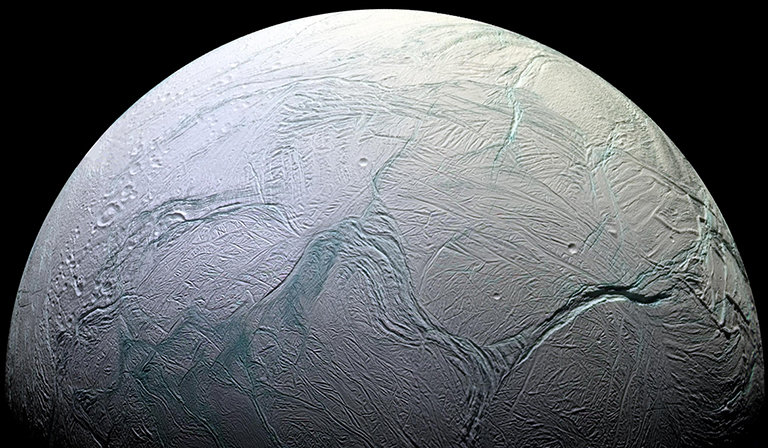
When ice particles from Saturn’s moon Enceladus shot through space at 1,000 kilometers per hour, they carried more than just frozen seawater — they carried a secret. Hidden in those tiny specks of ice is a natural sorting system that could make finding alien life far easier than scientists ever imagined. Frank Postberg, a planetary scientist at Freie Universität Berlin, and his team discovered that as droplets from Enceladus’s hidden ocean rise and freeze slowly, their ingredients separate like layers in a cocktail. Salts split from organic compounds, and even different salts divide from one another. Then, when the ice fragments into micrometer-sized pieces, each particle ends up packed with just one concentrated substance.
This matters because Enceladus has long been a top contender in the search for life beyond Earth. Beneath its icy shell lies a global ocean, warmed by a rocky core and stirred by hydrothermal activity. At its south pole, giant plumes blast water vapor and ice grains hundreds of kilometers into space — and NASA’s Cassini spacecraft flew right through them. For the first time in history, scientists have direct samples from an alien ocean. Those samples already revealed salts, organic molecules, and chemical conditions that could support life.
Now, thanks to Postberg’s study published in Science Advances, we know those ice grains do something extraordinary: they naturally sort and concentrate their contents. That means if microbes exist in Enceladus’s ocean, their remains could be isolated and highly concentrated in just a few ice particles. Future missions wouldn’t need to process complex mixtures — they could detect signs of life with instruments already within reach. The European Space Agency’s upcoming L4 mission could carry such tools, scanning thousands of individual ice grains in the plumes.
Even more encouraging, a second study shows that real microorganisms from Earth can survive simulated conditions of Enceladus’s ocean. This suggests life as we know it — or something similar — might truly thrive there. Postberg’s lab has already tested instruments that can spot microbial material in single ice particles, proving the method works in the lab.
The next step is sending those tools to space. If Enceladus is already doing the hard work of sample preparation, all we need to do is catch the ice and look closely. As Postberg puts it, nature may have handed us the perfect way to answer one of humanity’s oldest questions.