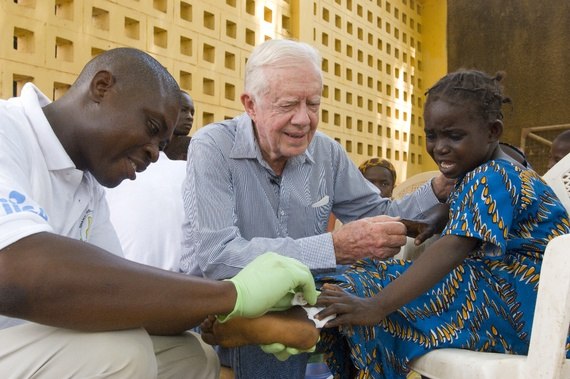
When 6-year-old Adut was bitten by a tiny water flea in a stagnant pond in South Sudan, she had no idea a meter-long parasitic worm would emerge from her leg months later, searing pain with every step—but her story, like only nine others in 2025, is now part of a vanishing chapter in human history. Last year, just 10 human cases of Guinea worm disease were reported worldwide, the lowest number ever recorded and a 33% drop from 2024’s 15 cases. This milestone brings the world closer than ever to eradicating the ancient parasite, which once plagued 3.5 million people annually across 21 countries when The Carter Center launched its campaign in 1986. Now, four decades later, the disease has been reduced by more than 99.99%, averting over 100 million cases—mostly among the world’s most isolated and underserved communities.
Guinea worm, a waterborne parasite, is poised to become the second human disease ever eradicated, after smallpox—and the first without a vaccine or medicine. Instead, victory has been won through community-led education, behavior change, and an army of local volunteers. In villages from Chad to Ethiopia, health workers teach families to filter drinking water and avoid wading into ponds when infected, breaking the worm’s life cycle. The progress is especially poignant in the first year since the passing of former U.S. President Jimmy Carter, who championed the cause since 1986. His legacy lives on in the 200 countries already certified Guinea worm-free by the World Health Organization—six remain uncertified, and eradication requires zero cases in both humans and animals.
While human cases are now confined to South Sudan, Chad, and Ethiopia, a new challenge has emerged: animal infections. Hundreds of cases are still found each year in dogs and other domestic animals, particularly in Chad, threatening to reignite transmission. Yet even here, innovation and persistence are making headway. Community surveillance networks now monitor both people and animals, with rapid response teams deployed at the first sign of infection. Mali, once endemic, has recorded zero human cases for two consecutive years—a hopeful sign of what’s possible.
“Every case is a real person we know by name,” said Adam Weiss, director of the Carter Center’s Guinea Worm Eradication Program. “They are enduring a disease we know how to prevent, and we’ve been given this rare opportunity to wipe it out completely.” The campaign’s success is built not on high-tech solutions, but on trust, dignity, and partnership—values embodied by President and Mrs. Carter, whose grandson, Jason Carter, now chairs the Center’s board. “Seeing Guinea worm cases reach historic lows is one of the clearest expressions of that legacy,” he said.
With only 10 human cases left, the end is in sight. The world has never been closer to eliminating a parasitic disease—a triumph not of a single nation, but of global solidarity, local courage, and four decades of quiet, relentless hope.