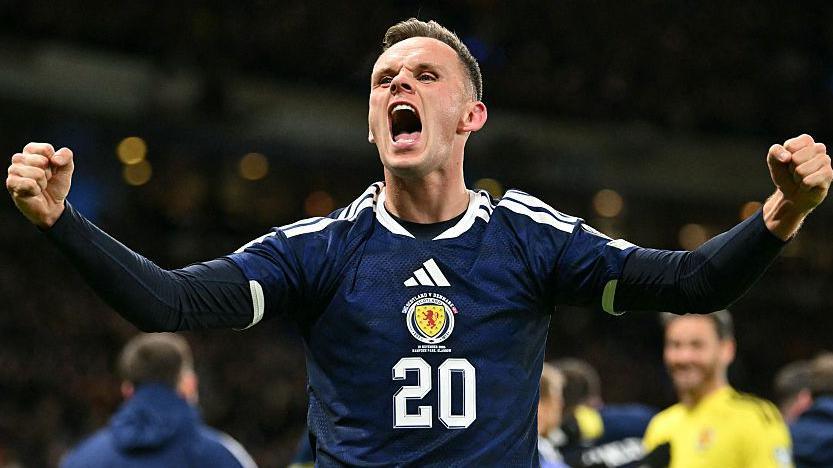
Lawrence Shankland has been averaging a goal involvement every 104.8 minutes for Scotland—a rate that puts the Hearts captain ahead of every other striker in the national squad heading into the World Cup. It's a statistic that would have seemed unlikely just a few years ago, when Shankland was dismissed by many as a one-dimensional finisher, a player who excelled at putting the ball in the net but little else.
The transformation matters because Scotland has a chance to compete at the World Cup, and that demands strikers who can do more than score. Head coach Steve Clarke values work rate, physicality, the ability to occupy defenders, and intelligent link-up play—qualities that Shankland was long perceived to lack. For years, he was pigeonholed: a finisher, not a complete forward. Even now, with improved form, veterans like Lyndon Dykes and Che Adams—who average goal involvements every 205.4 and 209 minutes respectively—might still be favored to start.
But over the last two or three seasons, something shifted. As Hearts captain, Shankland has emerged as a more rounded player. His game intelligence and finesse, those who work with him say, have reached top level. More remarkably, he's demonstrated a willingness to subordinate his individual instincts for the team's good. Coach John Naismith recalls a telling moment during a match against Holland in 2024: Shankland had a clear chance to shoot, but instead passed to Scott McTominay. At Hearts, Naismith told him, he would have taken that shot without hesitation. But Shankland's comfort in the Scotland environment has grown. "Now, I think he's at the point where [he thinks], 'no, I'll do what I need to do to contribute for the team'," Naismith says.
His four Scotland goals came from just eighteen appearances, with only four of those being starts—the rest substitute appearances. Yet his impact in critical moments stands out. Most notably, he scored against Denmark in November when Scotland secured World Cup qualification, a night of raucous celebration at Hampden Park that crystallized the nation's belief.
Naismith, reflecting on Shankland's arc, notes the consistency of his improvement. "He's took a bit of time to get to that point, but in the last two or three years, his progression's been better than probably most in the squad," he says. "He's had challenges and moments where it's not been good, but he's rebounded and come back, had another fantastic season." The message is clear: Shankland enters the World Cup in a markedly different place than he occupied even recently—sharper tactically, more confident in a team environment, and statistically performing at a level that rivals Scotland's established strikers.
Whether Steve Clarke will trust him as a starter over more proven names remains uncertain. The Scotland manager has a reputation for backing players who have delivered for him before. But if the coach looks at the numbers, he'll find compelling evidence that Shankland has evolved into something more than the one-dimensional talent he once was. At twenty-seven, he's becoming the kind of complete striker that international football demands.