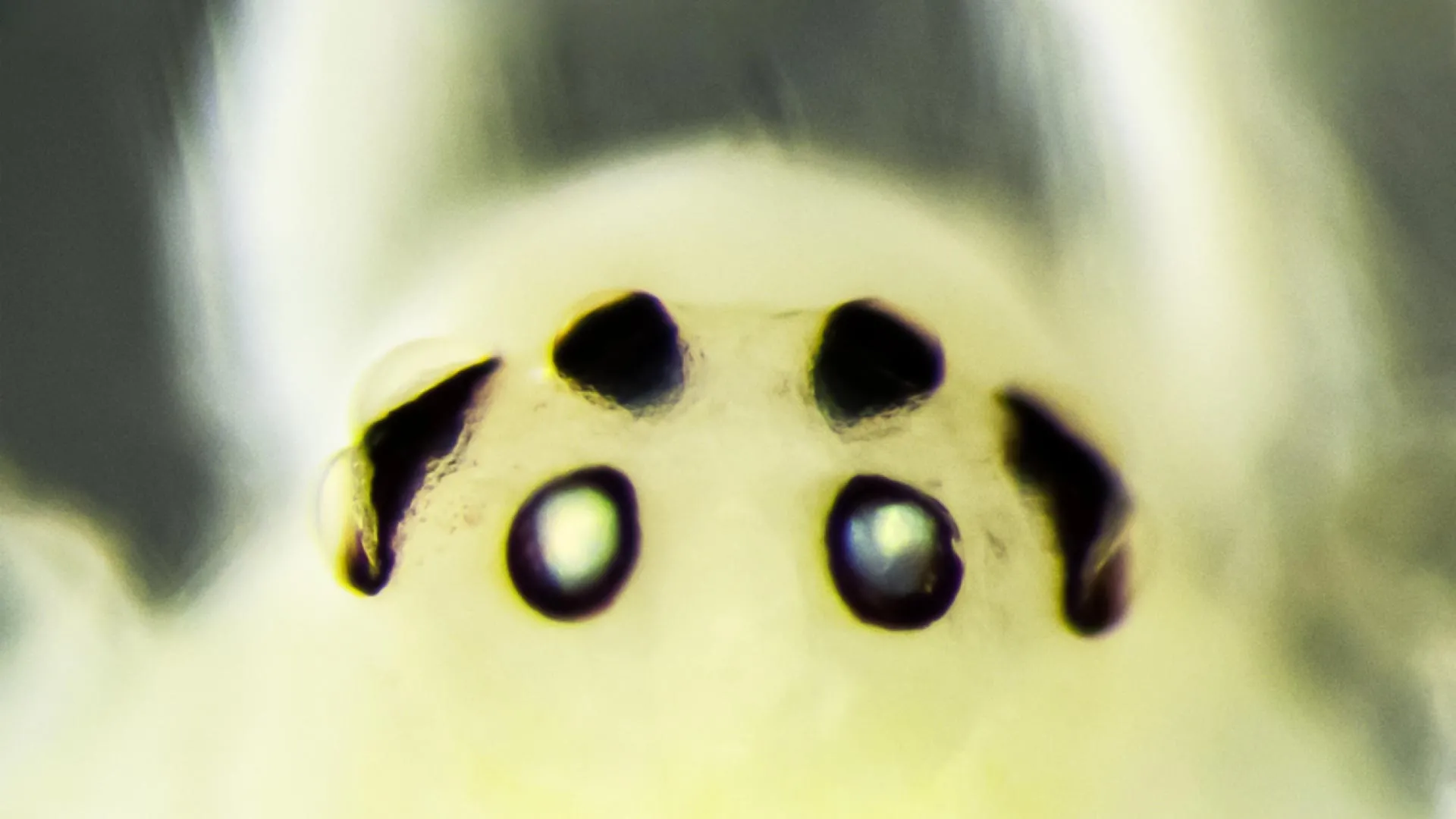
When Devi Priyadarshishi first saw the photo of a tiny spider perched on the underside of a leaf high in the Himalayas, she froze. On its back was a bright red smile — unmistakable, improbable, and almost exactly like the famous Happy Face spider that had been thought to live only in Hawaii for over 100 years.
"I knew instantly we had a jackpot," said Priyadarshini, a scientist at the Regional Museum of Natural History in India. "I had seen the Hawaiian spider during my master's program, and the resemblance was striking."
The discovery, published in the journal Evolutionary Systematics, was entirely accidental. Priyadarshini and her colleague Ashirwad Tripathy had been studying ants when Tripathy started sending her spiders from high-altitude regions for identification. Within months of that October 2023 photo, the team had collected enough specimens to confirm they had found something remarkable: a new species of Happy Face spider living 7,000 miles away from its famous Hawaiian cousin.
They named it Theridion himalayana — the Himalayan Happy Face Spider. The name honors the mountain range where it was found, at elevations above 2,000 meters. "We both wanted to pay our respects to the mighty Himalaya, holding a plethora of biodiversity within them," Tripathy said.
The team documented 32 different color forms, or "morphs," across specimens collected from three locations in Uttarakhand: Makku, Tala, and Mandal. Genetic analysis confirmed the spider differs from Hawaii's Theridion grallator by about 8.5% — enough to classify it as a separate evolutionary lineage that developed independently in Asia.
Scientists still don't fully understand why either spider species evolved their colorful smile markings, though Priyadarshini suspects the patterns help them survive in the wild. "This is definitely indicative of a deeper genetic mystery," she said.
One intriguing clue links the two species across the Pacific: both prefer to live on ginger plants, a non-native species in Hawaii. "How did the spiders choose an invasive species and ginger exactly?" Priyadarshini wondered aloud. Future research will explore whether T. himalayana might be an "elder cousin" of the Hawaiian spider, potentially connected through their shared love of ginger.
For now, the discovery suggests that even well-studied creatures can surprise us — and that the world's biodiversity still holds hidden smiles waiting to be found.