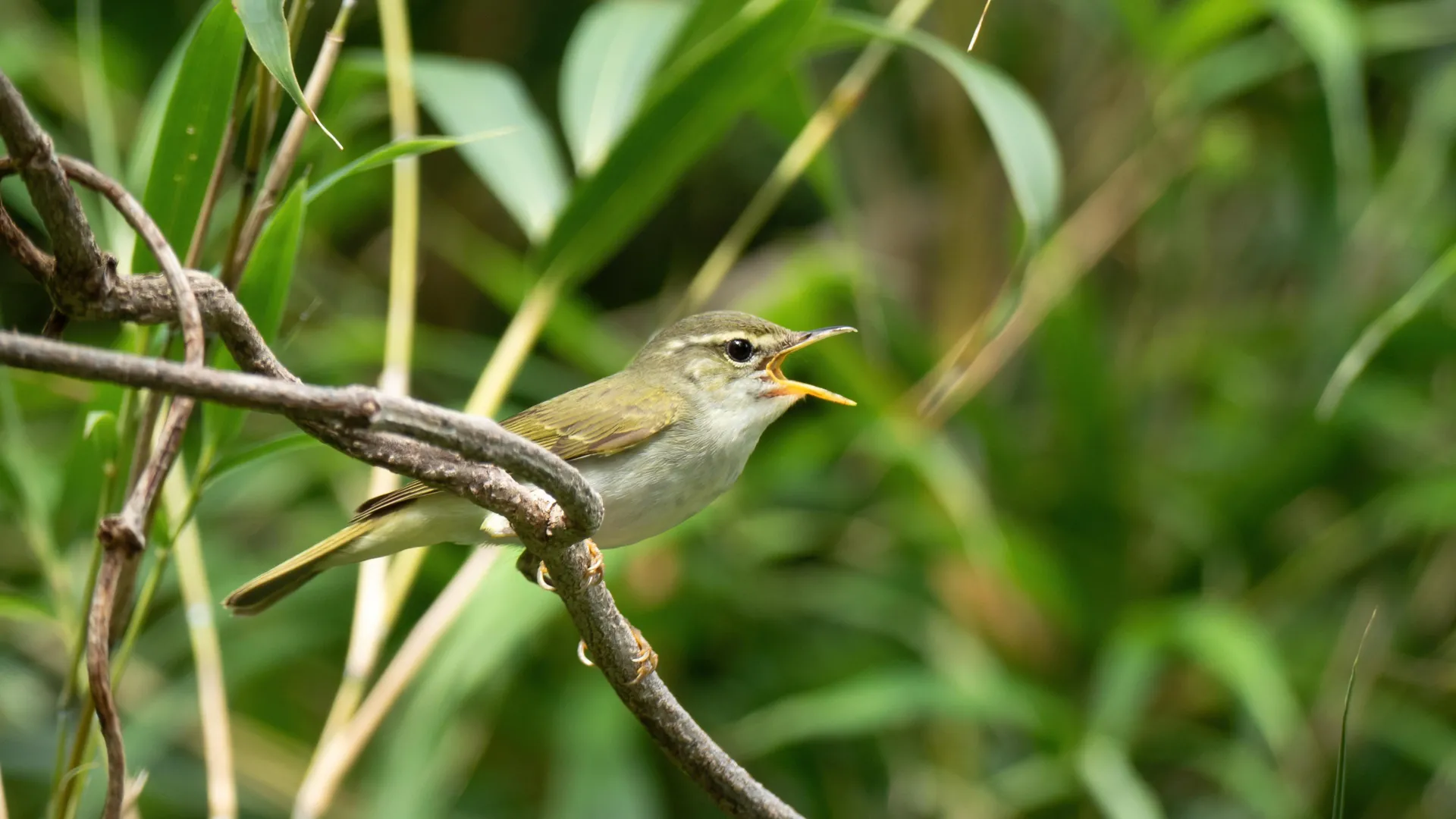
On a windswept ridge in the Tokara Islands, a tiny olive-green warbler flits through the canopy, singing a song that has echoed unanswered for millennia—unheard, until now, as belonging to a species all its own. This unassuming bird, no larger than a matchbox, has quietly defied scientific recognition for decades, not because it was hidden in remote forests, but because it looked almost identical to another species just 1,000 kilometers away. Now, thanks to DNA analysis and the subtle differences in its call, it finally has a name: Phylloscopus tokaraensis, the Tokara Leaf Warbler. The discovery, led by researchers from Uppsala University, the University of Gothenburg, and two Japanese institutions, marks Japan’s first new bird species description in over 40 years—since the Okinawa Rail was identified in 1982.
This breakthrough underscores a growing truth in conservation biology: some of Earth’s rarest species are invisible to the eye, concealed not by camouflage but by genetic subtlety. The Tokara Leaf Warbler was long mistaken for the Ijima’s Leaf Warbler (Phylloscopus ijimae), which inhabits the Izu Islands south of Tokyo. But whole-genome sequencing revealed significant divergence between the two populations, supported by distinct vocalizations that suggest reproductive isolation. "This shows how important it is to use genetic methods to reveal hidden biodiversity at a time of global biodiversity crisis," says Per Alström of Uppsala University, a leading voice in the study.
The Tokara Islands, a chain of twelve volcanic specks spanning just over 100 square kilometers, now harbor a unique avian resident found nowhere else on Earth. With such a limited range and a population exhibiting low genetic diversity, the new species faces an uncertain future. Both the Tokara and Ijima’s Leaf Warblers show signs of past population declines, though there are hopeful indications of recovery. Still, their island confinement makes them acutely vulnerable to habitat loss, invasive species, and climate change.
Conservationists are urging immediate action. While the Ijima’s Leaf Warbler is already classified as Vulnerable by the IUCN and protected in Japan as a "Natural Monument," the Tokara Leaf Warbler currently lacks formal status. Researchers recommend it receive the same Vulnerable classification, emphasizing that recognition is the first step toward protection. Ongoing monitoring will be essential to track population trends and safeguard both species.
In a world where biodiversity is vanishing faster than it can be documented, the discovery of the Tokara Leaf Warbler is a quiet triumph—one that reminds us how much remains to be found, even in well-studied corners of the planet. Sometimes, all it takes is listening a little more closely, and looking beneath the surface.