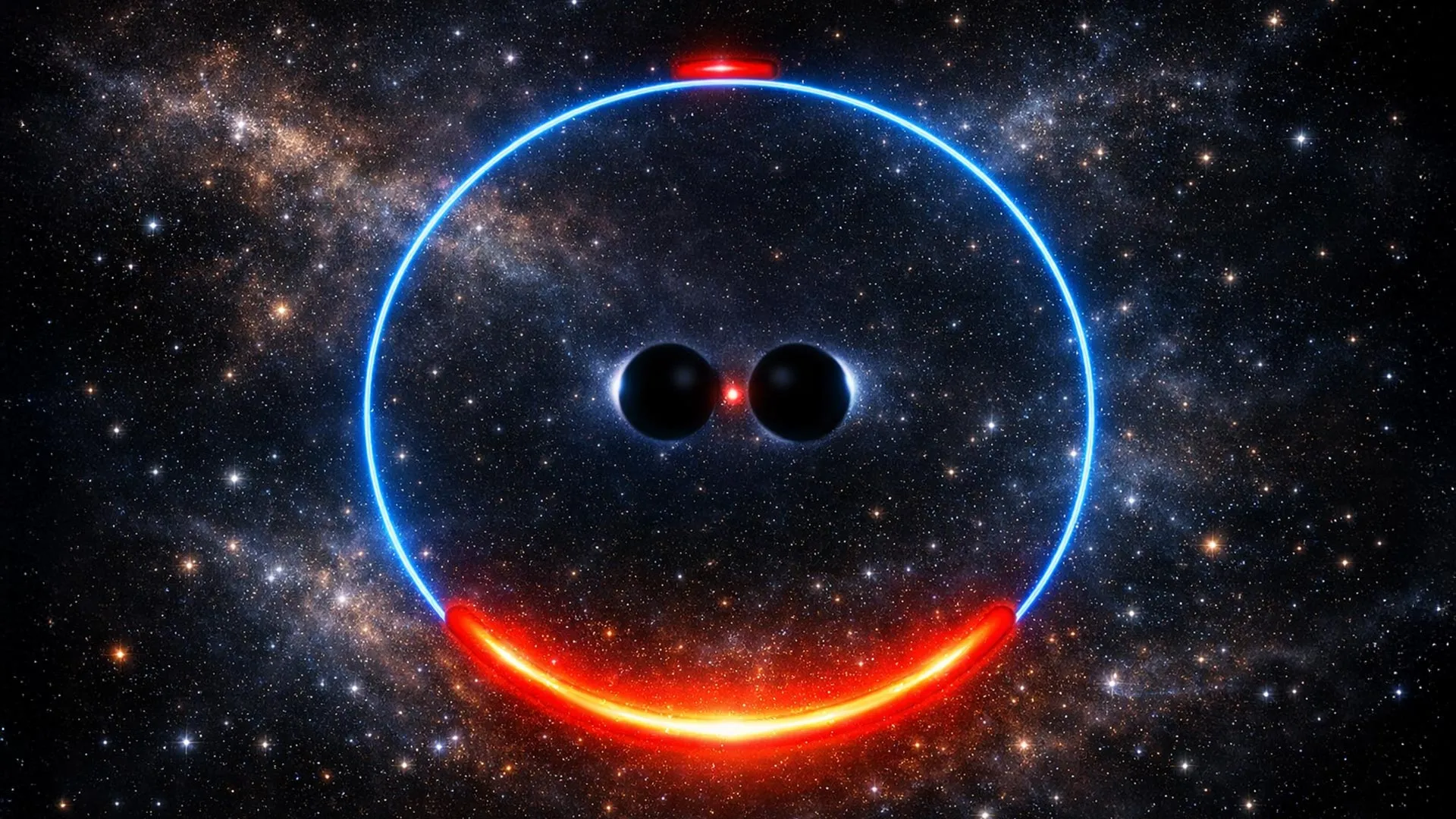
Astronomers have discovered a hidden cosmic signature that could reveal some of the universe's most elusive objects—tightly bound pairs of supermassive black holes locked in orbit around each other. Researchers from the University of Oxford and the Max Planck Institute for Gravitational Physics have outlined a strategy that could turn these invisible systems visible by watching for recurring stellar flashes created when the black holes bend and magnify starlight like a pair of cosmic lenses.
These supermassive black hole pairs form naturally when galaxies collide and merge, bringing their central black holes into gravitational orbit. Though astronomers have spotted some widely separated black hole pairs, finding those that orbit close together has remained frustratingly difficult—until now. The new research, published in Physical Review Letters, reveals that the intense gravitational fields of binary black holes create a distinctive and repeating signal that existing sky surveys could potentially detect.
Dr. Miguel Zumalacárregui from the Max Planck Institute explains the core mechanism: as the black holes orbit each other, their immense mass warps spacetime itself, bending passing light through a process called gravitational lensing. Unlike a single black hole, which can only dramatically magnify starlight during nearly perfect alignment, a binary system creates a much larger region of extreme magnification. The two black holes together form a diamond-shaped feature called a caustic curve, where background stars can be magnified far more often and far more brightly.
Graduate student Hanxi Wang, who led the study under Professor Bence Kocsis at Oxford, discovered that this caustic curve constantly shifts as the two black holes orbit each other. As it sweeps across the space behind the binary, it creates a remarkable phenomenon: when a bright star falls within that region, it produces an extraordinarily bright flash each time the caustic passes over it. The result is a series of repeating bursts of starlight—a clear signature of a hidden black hole binary playing out again and again like clockwork.
The timing and intensity of these flashes follow predictable patterns rather than appearing randomly, which makes them detectable. As the black holes gradually lose energy through gravitational wave emission and inch closer together in an inexorable spiral, they subtly alter the shape and motion of the caustic curve. Those changes leave measurable signatures in both the brightness and frequency of the flashes, creating what amounts to a cosmic fingerprint that astronomers can analyze.
By studying these patterns, researchers can extract crucial information about the hidden binary systems—the masses of the black holes and details about how they're evolving. This is particularly exciting because it means astronomers may not have to wait for future space-based gravitational wave observatories to detect these systems. New observatories like the Vera C. Rubin Observatory and the Nancy Grace Roman Space Telescope, coming online in the coming years, could identify these repeating lensing events much sooner, potentially years before gravitational wave detectors can confirm them directly.
The discovery opens the door to what scientists call "multi-messenger" studies of black holes—using light, gravitational waves, and other signals together to test gravity itself and unlock the mysteries of how these cosmic giants shape galaxies over billions of years.